Design an end-to-end CI/CD pipeline for client updates
"There are two last miles here and only one of them is mine. I control when a server changes, so that half is a rollout problem I can solve with canaries and health gates. I do not control when a client changes, so several client versions are always live at once and I can never un-ship one. That single fact drives everything: the server deploys first and stays backward compatible, the patch is downloaded days before it is activated, and the only instant lever I have over code already on a player's machine is a server-side flag."
Understanding the problem
5 minFunctional Requirements
- A merged commit should reach production servers automatically, through gates, without someone shepherding it.
- A client patch should reach players as a staged rollout, downloaded in the background and resumable.
- A bad release should be stoppable and its damage neutralisable fast, for both the server and the client.
- Clients that have not updated yet should keep working while a rollout is in flight.
Below the line (out of scope):
- The engine and asset build system itself. I care that it produces a deterministic artifact, not how it compiles shaders.
- Cheat detection, telemetry schemas, and the localisation pipeline. They ride the same rails and would each eat the hour.
- Developer environment tooling and local iteration. Real, and a different design.
- Store review stays IN scope as a constraint, not as a workflow. It takes hours to days and it is the reason risky behaviour ships as configuration rather than as a binary. Cutting it entirely would remove the most interesting force on the design.
Non-Functional Requirements
- Do the client bandwidth number first, because it turns a safety idea into a hard requirement.
- 50M daily players times an 80 MB patch is 4 PB of egress for one release.
- Delivered in a single hour that is 1.1 TB a second, which is not a capacity anyone can buy on demand.
- Spread over 48 hours it is 23 GB a second, which is an ordinary CDN commitment.
- So staged delivery is a bandwidth requirement before it is a safety mechanism, and that is the sentence that makes the rollout design inevitable rather than optional.
- It also costs real money, and the counterfactual is the number that lands: at roughly two cents a gigabyte, 4 PB of deltas is about 80,000 dollars, while shipping the full 4 GB build to the same 50M players would be 200 PB and about 4 million. That gap is why delta patching is a budget line and not an optimisation. Across all 200M installs rather than the daily actives, scale both by four.
- Then the version skew number, which is the other half.
- Players update when they feel like it, so at any moment three or more client versions are live, for weeks.
- Support N-2 for at least 30 days. That is a real tax: every protocol change is carried three times over.
- Pipeline speed: PR feedback under 10 minutes, merge to canary under an hour. 500 engineers and 2,000 commits a day means a slow pipeline is not an inconvenience, it is a queue that never drains.
- Client patch experience: background, resumable, and never blocking launch unless the protocol genuinely broke. A forced full-stop update is the worst thing you can do to a player who has 20 minutes to play.
- A rollout must be haltable globally within about 60 seconds, and a bad code path switchable off without any download at all.
- Server deploys must not drop live sessions. A match is stateful and pinned to one version, so drain time is bounded by match length rather than by process shutdown.
- Every artifact is immutable and content-addressed. What was tested must be bit-identical to what ships, which makes promotion a pointer move rather than a rebuild.
Entities + API
5 minDefining the Core Entities
- Artifact is one built output addressed by the hash of its contents: a server image, a client executable, a pack file. Immutable by construction, because the name IS the content.
- Release bundles the artifacts that belong together: a server image, a client bundle, and the manifest that describes it. One version number spans all three, which is what makes "are these compatible" answerable.
- Manifest is the most important entity and the one people forget.
- It is the answer to "what should THIS install be running", given platform, channel, cohort and current version.
- It lists content-addressed chunks, so the client downloads only what it does not already have.
- Flipping the manifest is the release. Everything before that is just moving bytes around, which is exactly why download and activation can be separated.
- Channel is the audience track: internal dogfood, alpha, beta, live. It is the cheapest safety mechanism available and it is the stage BEFORE the 1 percent cohort, so a release has usually been played by employees for a week before a stranger sees it.
- Cohort is a stable bucket of installs within a channel, derived by hashing the install id. Stable matters: a player must not oscillate between versions on every launch.
- Rollout is the state machine over cohorts: 1 percent, 10, 50, 100, with a bake time and a health gate between each step, and a halt that stops it dead.
- FeatureFlag is evaluated server-side per install and is the only lever that changes behaviour with no download at all. It is the client's rollback, and calling it that early sets up the whole dive.
- Deployment is the server-side sibling of Rollout: waves across the fleet, with drain state per instance.
API or System Interface
GET    /v1/manifest?platform=&channel=&installId=&have=   // -> { version, chunks[], activateAt }
GET    /v1/flags?installId=&version=                     // -> { flagName: value }  // every session

POST   /v1/releases                     // { artifacts[] } -> promotes, never rebuilds
POST   /v1/rollouts                     // { releaseId, plan: [1,10,50,100] }
POST   /v1/rollouts/{id}/advance        // gated on bake time + health
POST   /v1/rollouts/{id}/halt           // global, under 60 s, no approval needed
POST   /v1/flags/{name}                 // { value, cohort } -> the instant lever

POST   /v1/deployments                  // server fleet: canary, then waves
GET    /v1/deployments/{id}/health      // crash-free sessions, error rate, p99
- The manifest call carries what the client already
haves, so the service answers with a delta rather than a full list. This is what turns a 4 GB install into an 80 MB download. activateAtis the separation of download from activation in one field. The client fetches now and switches later, which is the entire answer to the bandwidth problem.- But a timestamp alone is a bug, and this is the case the halt has to survive. A client holding a cached manifest with a future
activateAtwill activate on its own clock even if the release was halted an hour ago, and a client with a wrong clock activates early. - So activation is confirmed, not scheduled: the client re-reads the manifest at flip time and the SERVER refuses the new protocol before T-0. The timestamp is a hint for when to check, never the authority. Edge cache TTL on the manifest is then the real bound on "haltable in 60 seconds", so it is set in seconds, not minutes.
- Flags are fetched every session, not cached for a day. A kill switch that takes a day to propagate is not a kill switch.
- Per-session is still not "seconds" and the page should not pretend it is. A player already in a 40-minute match keeps the bad path for up to 40 minutes. So flag revocations are pushed down the live game socket, and anything genuinely dangerous is gated server-side per action rather than trusted to a client-cached value. Seconds for new sessions, session-length for in-flight ones, unless you push.
- Halt needs no approval and advance does. Stopping is always safe, so put no friction on it; proceeding is the risky direction, so gate that one.
- Creating a Release takes artifact ids, never a source ref. The API makes rebuilding impossible rather than merely discouraged, which is how the build-once rule survives contact with a deadline.
- Cohort comes from hashing the install id, not from a server-side assignment table. 200M rows of assignment is a database nobody needs, and a hash is stable across launches and updates.
- Not across reinstalls: a reinstall usually mints a new install id, which is the point of one, so a player can land in a different cohort. Acceptable, and worth saying rather than claiming otherwise.
- Keep a small override table anyway, for QA, dogfood, support escalations and allowlists. Pure hashing gives you no way to force one install into a cohort, and you will need that on day one.
High-level design
10 min, end to end, no dives yet1) Commit to artifact: build once, then only promote
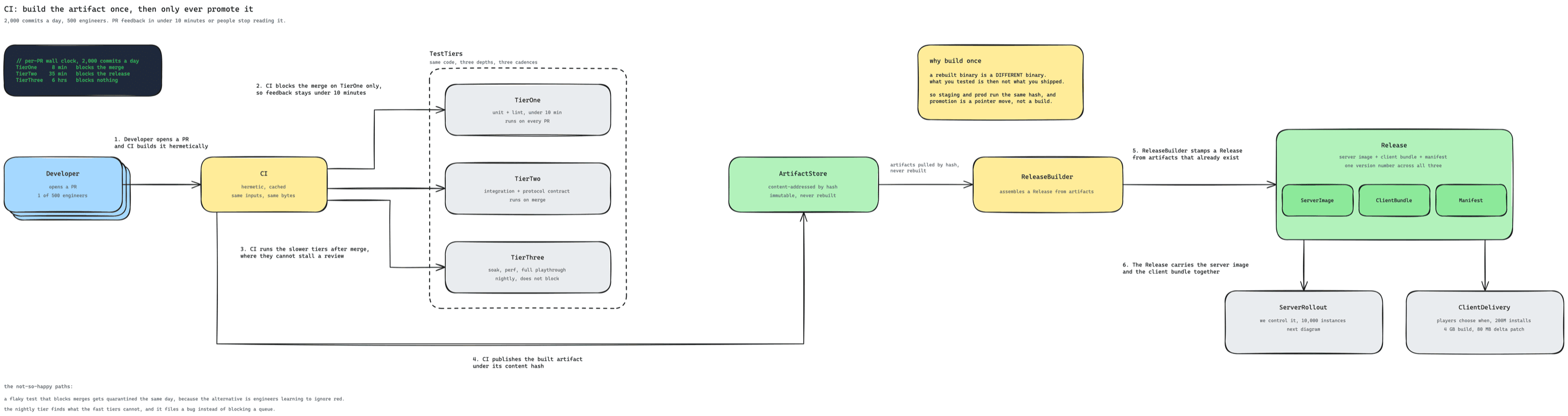
- Test tiers exist to protect the 10-minute number, not to be thorough for its own sake.
- Tier one, unit and lint, under 10 minutes, blocks the merge. It is the only thing that blocks a human.
- Tier two, integration and protocol contract tests, runs after merge where it cannot stall a review.
- Tier three, soak and performance and a full playthrough, runs nightly and files bugs rather than blocking a queue.
- With 2,000 commits a day, a 40-minute blocking suite means the merge queue never drains, so this is arithmetic rather than preference.
- Build once and promote the same bytes, and make it structurally impossible to do otherwise.
- A rebuilt binary is a different binary, so what you tested is not what you shipped.
- Artifacts are content-addressed, so staging and production provably run the same hash.
- Promotion is a pointer move, which also makes it instant and reversible on the server side.
- The release bundles the server image and the client bundle together under one version, which is what makes the compatibility question answerable later instead of guessed at.
- Flaky tests get quarantined the same day. The alternative is engineers learning that red does not mean broken, and once that is learned the gate is worth nothing.
2) The server last mile: waves, gates, and draining a stateful fleet
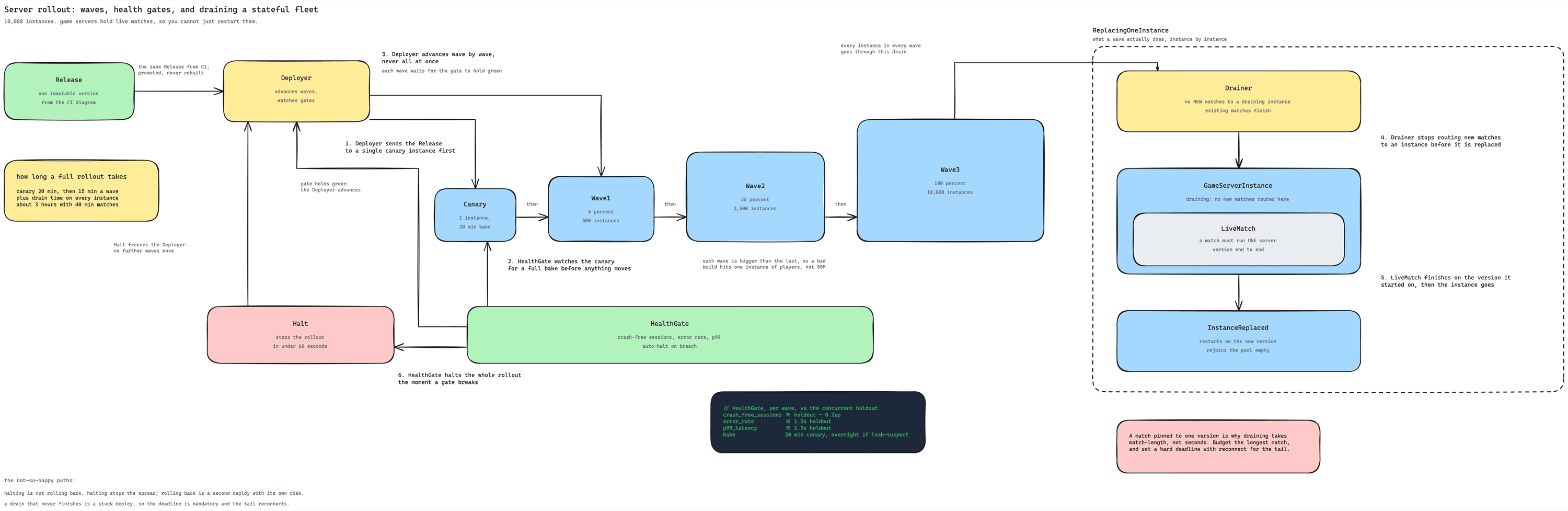
- Canary first, one instance, with a real bake time. A canary you advance past in 30 seconds has told you nothing except that the process starts.
- Then waves: 5 percent, 25 percent, 100 percent of 10,000 instances, with a health gate between each. The gate watches crash-free sessions, error rate and p99, and halts automatically rather than paging someone to notice.
- Draining is the part that is specific to this problem and the part worth spending time on.
- A game server holds live matches, so you cannot restart it and you cannot move the match.
- Draining means: stop routing NEW matches here, let existing ones finish, then replace the instance.
- A match must run one server version end to end, so drain time is bounded by the longest match, not by process shutdown. That is minutes, and it has to be budgeted.
- The tail needs a hard deadline with reconnect, or one very long match blocks the deploy forever.
- Halting is not rolling back, and the distinction matters under pressure. Halting stops the spread and is always safe. Rolling back is a second deploy with its own risk, its own drain, and its own chance of being wrong.
3) The client last mile: download now, activate later
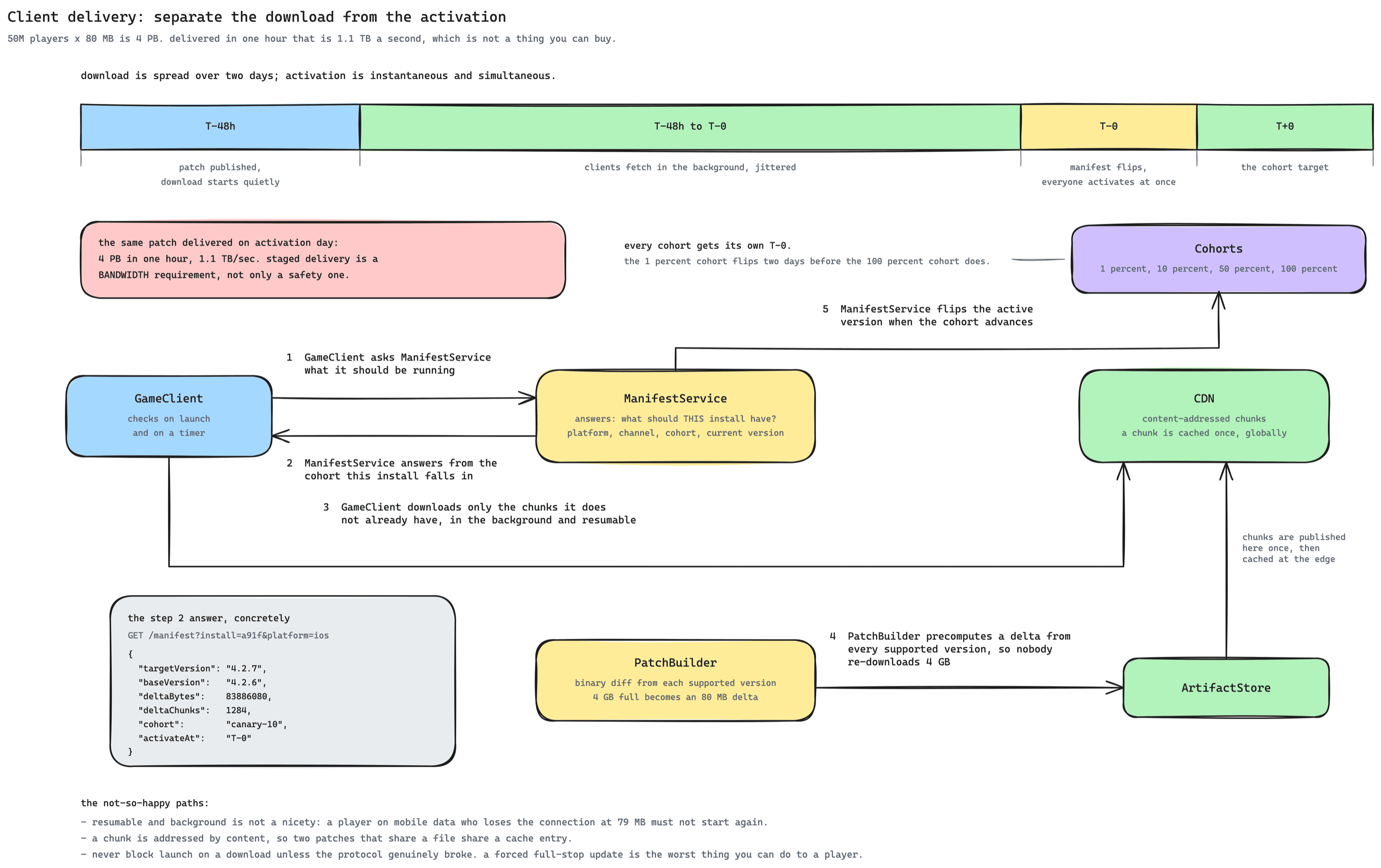
- The central trick, and the thing I would say first: separate delivery from activation.
- Publish the patch 48 hours early and let clients fetch it quietly in the background, jittered.
- Flip the manifest at the release moment, and every client that already has the bytes activates instantly.
- 4 PB spread over two days is 23 GB a second and buyable. The same 4 PB in the activation hour is 1.1 TB a second and impossible.
- Delta patching against every supported version. A 4 GB client that changed a little is an 80 MB download, and the patch builder precomputes a diff from each version still in the field rather than making the client reconstruct one.
- Content-addressed chunks mean a file shared between two releases is downloaded once, ever, and the CDN caches it globally by content rather than per release.
- Background and resumable is not a nicety. A player on mobile data who drops at 79 of 80 MB must not start again, and the download must never hold the game hostage while they are trying to play.
- Never block launch on a download unless the protocol genuinely broke, and be able to state exactly when that is true, because "we forced an update" is a retention event. The one honest case is a client older than N-2, which the server no longer speaks.
- The client-side details that decide whether players actually like this:
- Wi-Fi only by default with an explicit opt-in for cellular, because a silent 80 MB on a metered plan is a complaint.
- A storage-full path that fails gracefully and says so. Holding two versions during pre-download is exactly when disks fill, and this is the most common real update failure.
- Apply time, not just download time. On console, unpacking and installing a patch is often longer than fetching it, and it is what the player actually waits through.
- Encrypt the preload and ship the key at unlock, or dataminers read the content two days early. That is why pre-download in practice is encrypted rather than merely staged.
4) Compatibility and the levers you actually have
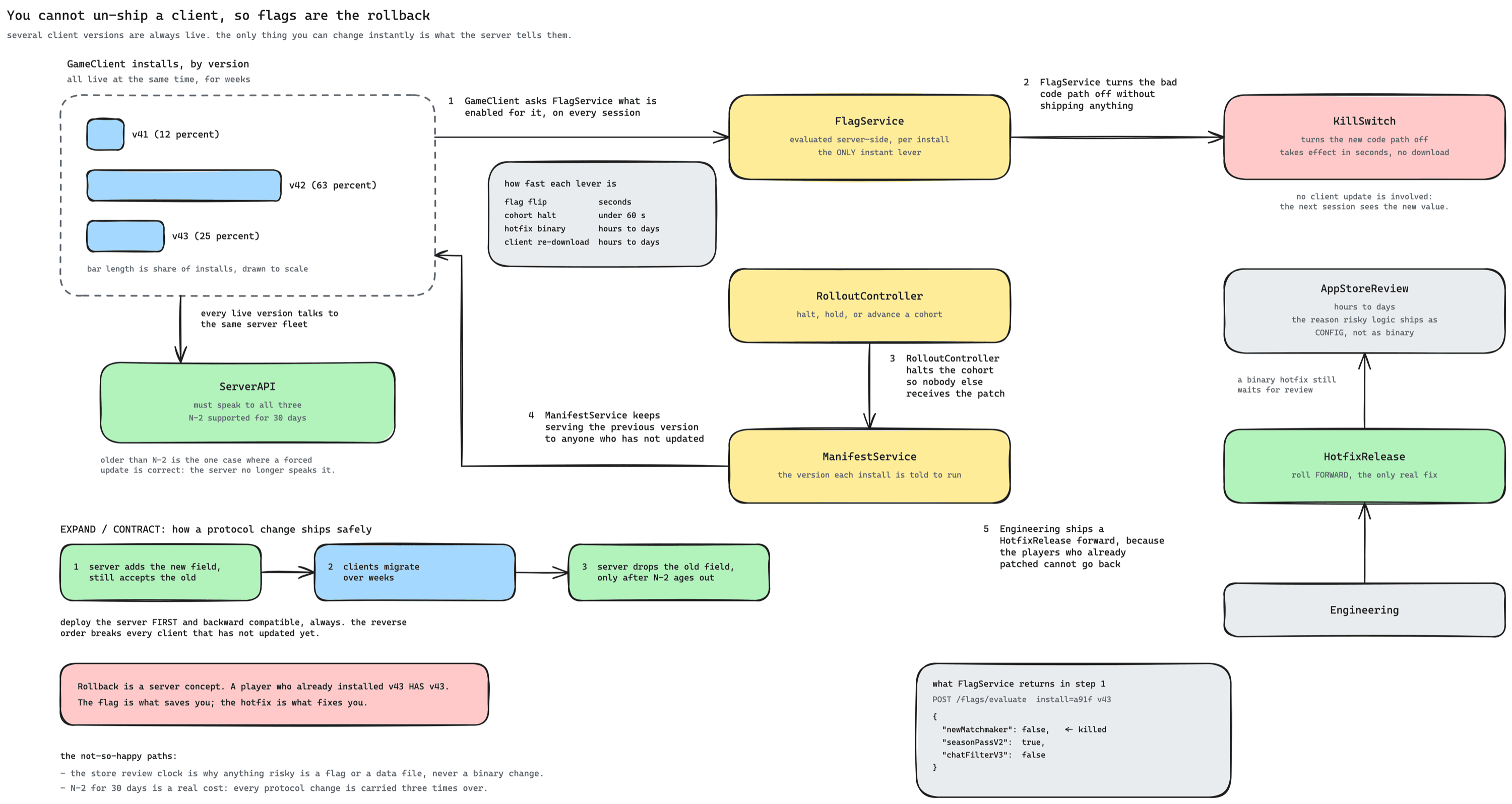
- Deploy the server first and backward compatible. Always. The reverse order breaks every client that has not updated, which is most of them on day one.
- Protocol changes follow expand then contract, over weeks:
- The server adds the new field while still accepting the old one.
- Clients migrate as they update, over the N-2 window.
- Only after the old version ages out does the server drop the old field.
- Contract tests in CI run the new server against the last N client protocol versions, so skew breakage is caught before merge and not in production.
- Skew has a user-visible cost the design has to own: the matchmaking pool splits. Three live client versions plus "a match runs one server version" means three pools, longer queues and worse matches for whoever is on the smallest version. The matchmaker is version-aware, not just the drainer, and that is the concrete price of the N-2 policy.
- Flags are the client's rollback, and this is the sentence the whole section exists for. Code already on a player's machine cannot be recalled, but the server can refuse to turn it on.
- So anything risky ships behind a flag by default, which also means the store review clock stops being on the critical path for fixing behaviour.
- Three levers, in the order you would actually reach for them: flip the flag (seconds, no download), halt the rollout (stops anyone else receiving it), ship a hotfix forward (the only real fix, and it takes as long as it takes).
Potential deep dives
~20 min, interviewer steers1) You cannot un-ship a client
- Repoint the release to the previous version, the way you would on a server.
- For the launcher and asset layer this actually works, and claiming otherwise is the trap. The manifest is the release, chunks are content-addressed, and the old chunks are still on disk from the pre-download, so repointing to v42 is a cheap revert. Steam does exactly this by repointing a branch.
- The thing that makes it a one-way door is local data, not bytes. If v43 migrated the save file or the local profile, v42 cannot read it, and a revert corrupts the player's progress rather than restoring it. That is the real reason a client revert is dangerous, and it is what an interviewer is waiting to hear.
- For a STORE binary the mechanical objection also holds: the previous version is no longer served and replacing it needs review.
- Start at 1 percent, watch, then advance. Correct and necessary, and it bounds the damage.
- But 1 percent of 50M is still 500,000 players who now have the bug and cannot be given anything else.
- Staging limits how many are hurt. It does nothing for the ones already hurt, and they are the ones filing reviews.
- Every risky change ships behind a flag, evaluated server-side per install on every session. Turning it off takes seconds and needs no download, no store, and no player action.
- That is what "rollback" means for a client, and using the word precisely is most of this dive. You are not removing the code, you are refusing to enable it.
- State the scope, because the blunt version of the claim is wrong. A manifest revert is available for the layer you deliver yourself, and it is blocked by forward-only local data migrations rather than by the download. What you genuinely cannot un-ship is a store binary. So: design migrations to be backward compatible for one version, and the manifest revert stays a real option.
- Then the three levers in order: flip the flag to stop the damage, halt the rollout so nobody else receives the patch, keep serving the previous manifest to anyone who has not updated, and ship a hotfix forward for the ones who have.
- The store review clock is why this is not optional on mobile. A binary fix is hours to days away; a flag is thirty seconds away. So the design pushes risky behaviour into data and configuration precisely so the fast lever exists.
- Both stores do give you a halt, and pretending otherwise loses credibility. Play has staged rollout with a halt, Apple has phased release with a pause. What they do NOT give you is control of download timing, so the pre-download and manifest-flip trick applies to the launcher and asset layer, not to the store binary. On mobile the store serves the bytes and pays the egress, which also means the 4 PB bill below is the self-delivered layer's.
- Say the cost honestly: flags accumulate, every one is a branch, and two flags interact in ways nobody tested. So they expire: a flag that has been at 100 percent for two releases gets deleted, and that cleanup is scheduled work rather than good intentions.
- And the thing a flag cannot save you from: a client that crashes on launch, or corrupts local data, before it ever reaches the flag service. That is what the canary cohort and a staged 1 percent are really insuring against, so both mechanisms are needed and they cover different failures.
2) Version skew, and the order of operations
- The client and server change in the same release, so deploy both at once.
- They are not simultaneous in reality. The server flips in minutes; the clients take weeks.
- For that whole window, unmigrated clients are talking to a server that no longer speaks their protocol, which is an outage for the majority of your players.
- The server handles v1 and v2, clients migrate, done. This is the right instinct and the right order.
- What it leaves out is when the old path is allowed to be deleted, so in practice it is never deleted and the server accumulates every protocol it has ever spoken.
- It also leaves skew untested: nobody runs the new server against an old client until a player does.
- Expand. The server accepts both shapes and writes both. Nothing is removed and the change is invisible to old clients.
- Migrate. Clients update over the rollout. You watch the version distribution and you know exactly what fraction is still on the old shape, because the manifest service already knows what everyone is running.
- Contract. Only when the old version drops below the support floor is the old path deleted, and deleting it is a scheduled task with a ticket, not a hope.
- Write the window down as a policy: N-2 for 30 days. Without a number, "support old clients" means forever, and the server becomes a museum.
- Test the skew in CI, which is the part almost nobody does. Contract tests run the new server against the last N client protocol versions on every merge, so a breaking change fails a build rather than a player.
- Name the tax rather than hiding it: every protocol change is written three times, and the middle state is live for a month. That is the actual price of not controlling your clients, and pretending otherwise is how skew bugs happen.
- The same recipe governs the DATABASE, and that is the half people forget.
- Expand the schema, dual-write, backfill at fleet scale, dual-read, then contract. Same shape, much slower, because the backfill is bounded by data size rather than by client adoption.
- It also breaks the promotion story above: "promotion is a pointer move, so the server side is reversible" stops being true the moment a migration has run. A schema change is the point where roll-forward becomes the only direction on the server too.
- So migrations ship separately from the code that needs them, at least one release ahead, and never in the same deploy.
3) The rollout is a bandwidth problem before it is a safety problem
- Push the notification, players update.
- 50M times 80 MB is 4 PB. Concentrated in the hour after a patch note, that is 1.1 TB a second.
- That is 8.9 Tbps. Buyable with committed capacity and notice, not on demand for one hour a fortnight and not at the marginal rate. In practice you get shaped and players see a patch that takes hours.
- The bill is about 80,000 dollars either way, so this is not a small line item to be casual about.
- Release to 1 percent, then 10, then 50, then 100, which spreads the load and limits blast radius.
- It genuinely fixes the peak, and it is the same mechanism safety wants, which is convenient.
- But it means players get the content at visibly different times, and for anything competitive or social that is a real fairness problem: a player in the 100 percent cohort is two days behind their friends.
- Publish the bytes 48 hours before the release moment and let clients fetch them in the background, jittered across the window. 23 GB a second, an ordinary commitment.
- Then flip the manifest, and choose deliberately between two flips rather than pretending you get both.
- A GLOBAL flip means everyone with the bytes activates at the same instant, which is what a content drop needs and what fixes the fairness problem cohorts create.
- A STAGED flip gives each cohort its own activation moment, which is what a risky release needs, and it costs fairness.
- So: stage the activation for anything that could break, flip globally for the content drop that has already baked behind a flag. Claiming simultaneous activation AND staged safety at once is the contradiction an interviewer will catch.
- The two mechanisms then do different jobs, and saying so is the insight: pre-download solves bandwidth, staged activation solves safety. Conflating them is what makes people think they have to choose.
- Be precise about deltas versus chunking, because they overlap more than people say.
- The chunk store is primary: "give me the chunks I do not have" IS a delta against whatever state the client is in, from any version, with no N-way matrix.
- Precomputed binary diffs are an optimisation for the common hop, not the mechanism. They are O(N) per release under N-2, so tens of objects, and the real cost is diffing CPU on a 4 GB build rather than storage.
- "Downloaded once, ever" needs content-DEFINED chunking to be true. With fixed-size chunks a one-byte insertion shifts every boundary after it and nothing dedupes, so boundaries come from a rolling hash, and pack files have to be chunk-aligned and per-chunk compressed or a small change reshuffles the whole archive.
- Content-addressed chunks mean unchanged files are never re-sent, and two releases sharing a file share a cache entry globally.
- Handle the client that did not pre-download, because a phone that was off for a week exists. It downloads on demand at activation, and that tail is small enough to absorb precisely because the bulk went early.
- Say the operational cost: you are now holding two versions on disk on the client for up to 48 hours, and disk on a console or a phone is not free. That is a real constraint worth naming.
4) Deploying a stateful fleet without dropping sessions
- Replace instances one at a time and let the load balancer sort it out.
- A stateless web request retries. A 40-minute match does not: the state is in memory on that instance and it is gone.
- Every deploy becomes a visible outage for whoever was mid-match, and with 10,000 instances that is a lot of people per release.
- Mark the instance draining, stop sending new matches, wait for the existing ones to end. This is the right mechanism.
- The gap is the tail: one very long match, or one idle lobby nobody leaves, blocks the instance forever.
- Without a deadline, a deploy can simply never finish, and the deploy that never finishes is the one that blocks the security patch behind it.
- A match runs one server version end to end. Mixing versions mid-match means two players are running different rules, which is worse than a disconnect.
- That is a default, not physics. Snapshot-and-migrate between processes exists; it is rejected on cost and on the risk of moving live state, and saying so is better than claiming it cannot be done.
- Bounded matches are the easy case. Persistent worlds and social hubs have no natural boundary, so they need scheduled shard downtime, player transfer to another shard, or a hot-reloadable script layer for anything that must change between windows.
- Past the drain deadline, say what happens to the RESULT and not just the connection: a ranked match that dies is voided and the entry refunded, because "they reconnect" is not an answer in competitive play.
- Drain time is therefore bounded by match length, and that is a number you budget for, not a surprise. If matches are 40 minutes, a full fleet rollout is measured in hours and the plan says so.
- The tail gets a hard deadline plus reconnect. Past the deadline the instance goes anyway, clients reconnect into a new match or a recovery flow, and you have chosen a small known harm over an unbounded stall.
- Capacity has to lead the drain. You need spare instances for the new version before the old ones stop accepting, or you drain straight into a shortage at peak. That is the mistake that turns a safe deploy into a queue of players who cannot get a match.
- Deploy when your players are asleep, per region, which is free if the fleet is regional and is the cheapest risk reduction available.
- Emergency path is different and should be stated separately: for a security fix you accept dropping matches, because the tradeoff has changed. Having decided that in advance is what makes it executable at 3am.
5) What stops a rollout, and how fast
- Someone keeps an eye on it and calls it if something looks wrong.
- At 1 percent of 50M, a crash affecting one player in a thousand is 500 people before anyone finishes a coffee.
- Nobody watches at 2am, and 2am in one region is prime time in another.
- Page someone when errors cross a threshold. Better, and it at least fires at 2am.
- Server error rate is the wrong signal for a client bug: a client that crashes on launch generates fewer server errors, not more, because it never connects.
- Paging a human still costs the minutes it takes them to wake up and decide, and the rollout keeps advancing while they do.
- Crash-free session rate is the primary gate, measured per version and per platform, because it is the one metric that moves for exactly the failure you are afraid of.
- Compare against the cohort still on the old version, not against an absolute number. Crash rates vary by day, region and device, so the previous version running concurrently is the only honest baseline. Staged rollout gives you that control group for free.
- Bake time per stage, sized to the signal: a crash shows in minutes, so a 20-minute canary catches those, but a leak or a progression bug takes hours and needs an overnight canary before the first real wave. Early stages bake longest, and advancing fast at 1 percent defeats the point of having a 1 percent.
- Halt automatically, resume manually. Stopping is safe and should need no human; continuing is the risky direction and should need a person who has looked.
- Give the two services on every launch and every session their own failure policy, because they are the real single points of failure. The manifest service fails OPEN to last-known-good, since failing closed stops 200M installs from launching. The flag service falls back to the last cached value with a short TTL and a safe default per flag, since a kill switch that fails open is not a kill switch. Both sit behind the edge cache, and neither is a hard dependency of starting the game.
- Watch the metrics that only exist on the client: crash-free sessions, launch success, download success and time-to-first-input. A rollout can be perfectly healthy server-side while the client is unusable, and only client telemetry sees it.
- Cover the case where telemetry itself is what broke: a sudden DROP in reported sessions is an alarm, not silence. A client that cannot start cannot tell you it cannot start, and treating zero as good is how a bad rollout goes to 100 percent.
- Be honest about the detection window. A launch crash is reported on the NEXT launch, so with any aggregation the automatic halt is minutes, not 60 seconds. The 60 seconds is how fast a halt PROPAGATES once decided, and conflating the two oversells the system.
- State the statistics rule or the gate halts on noise. Early cohorts are not a random sample, so bucket by device, OS and region, and require a minimum sample and a significance threshold before a breach counts.
Four more dives, briefly
- Signing, which is the thing a CI/CD question is really about and which this design has so far left open.
- Content addressing gives integrity only relative to a manifest you already trust. Whoever forges a manifest response owns 200M installs, which makes this the highest-value attack surface in the company.
- So manifests and artifacts are signed, the client pins a root key and verifies before applying, and the signing key lives in an HSM rather than a CI environment variable.
- Build provenance is the other half: record what source, what toolchain and what dependencies produced each hash, so a compromised dependency is traceable rather than theoretical.
- Secrets never enter an artifact. They are fetched at run time by identity, which is also what lets the same immutable image run in staging and production.
- Making the pipeline itself trustworthy, which is what makes everything else possible.
- Hermetic, cached builds so the same input gives the same bytes, which is also what makes content addressing meaningful.
- Merge queues that test the combination rather than each PR alone, because two PRs that pass separately can break together.
- Flaky tests quarantined the same day, with an owner and a deadline. A gate people have learned to ignore is worse than no gate, because it costs time and buys nothing.
- Track pipeline p50 and p95 as a product metric owned by someone. It regresses silently, one minute at a time, until nobody can ship on a Friday.
- Artifact retention is coupled to the support window, so it is not a housekeeping detail. Every chunk any N-2 client might still need has to stay alive, which means garbage collection is driven by the 30-day policy rather than by disk pressure, and deleting a chunk early is how you brick the clients that had not updated.
- Price the CI side too. 2,000 commits a day against a 4 GB build is the other budget line, and it is what makes hermetic caching a cost decision as much as a correctness one.
- Content and configuration, which is the release valve for everything the store slows down.
- Split what ships: executable code needs review; data, tuning, and content packs do not.
- So balance changes, event schedules and drop rates go out as data in minutes, while the binary keeps its slow, safe cadence.
- The catch to name: data can break a client just as thoroughly as code, so config gets the same staged rollout and the same health gates. Treating it as safe because it is "just data" is how you take down a client with a JSON file.
- Multi-platform, because the pipeline is not one pipeline.
- Console and mobile stores have review; PC and web do not. So the same release lands on different platforms at different times, and the server has to be compatible with all of them at once.
- That widens the skew window rather than changing its nature, and the N-2 policy has to be sized against the slowest platform, not the fastest.
- Certification failure is a scheduling risk with no engineering fix, so the release plan carries a buffer and the feature is behind a flag either way.
- Not a rollback. A player who installed v43 has v43 on disk, and repointing a pointer does nothing for them.
- Flip the flag first. Risky code ships behind a server-side flag, so turning the path off takes seconds and needs no download, no store and no player action.
- Halt the rollout so nobody else receives the patch, and keep serving the previous manifest to anyone who has not updated.
- Then ship a hotfix forward, because forward is the only direction that exists for the players already on it.
- On mobile the store review clock is why the flag is not optional: a binary fix is hours to days, a flag is thirty seconds.
- What a flag cannot save: a client that crashes on launch before it ever reaches the flag service. That is what the 1 percent cohort insures against, which is why you need both.
- Server first, and backward compatible. The reverse order breaks every client that has not updated, which on day one is most of them.
- Expand, migrate, contract: the server accepts both shapes, clients migrate over weeks, and only then is the old path deleted.
- The window is a written policy, N-2 for 30 days. Without a number, "support old clients" means forever and the server becomes a museum.
- Contract tests in CI run the new server against the last N client protocol versions, so skew breaks a build instead of a player.
- Name the tax: every protocol change is written three times and the middle state is live for a month. That is the price of not controlling your clients.
- 50M times 80 MB is 4 PB. In one hour that is 1.1 TB a second, which nobody sells on demand for one hour a fortnight.
- Spread over 48 hours it is 23 GB a second, an ordinary CDN commitment. So staged delivery is a bandwidth requirement before it is a safety mechanism.
- It also costs about 80,000 dollars per full rollout at two cents a gigabyte, so delta patching is a budget line, not an optimisation.
- The fix is to separate download from activation: publish 48 hours early, fetch in the background jittered, then flip the manifest so everyone activates at once.
- That also solves the fairness problem staged cohorts create, where a player is two days behind their friends.
- Content-addressed chunks mean unchanged files are never re-sent, and the client that was switched off all week downloads on demand as a small tail.
- By draining rather than restarting: stop routing new matches to the instance, let the existing ones finish, then replace it.
- A match runs one server version end to end, because mixing versions mid-match means two players are running different rules, which is worse than a disconnect.
- So drain time is bounded by the longest match, not by process shutdown. If matches are 40 minutes, a full fleet rollout is hours and the plan says so.
- The tail gets a hard deadline plus reconnect, or one idle lobby stalls the deploy forever, and that stalled deploy is blocking the next security patch.
- Capacity leads the drain: you need the new instances up before the old ones stop accepting, or you drain into a shortage at peak.
- For a security fix the tradeoff flips and you accept dropping matches. Deciding that in advance is what makes it executable at 3am.
- Crash-free session rate per version and per platform is the primary gate, because it moves for exactly the failure you fear.
- Server error rate is the wrong signal for a client bug: a client that crashes on launch produces fewer server errors, not more.
- Compare against the cohort still on the old version rather than an absolute threshold, since crash rates vary by day, region and device. Staged rollout gives you that control group for free.
- Bake time is sized to the signal: crashes show in minutes, leaks and progression bugs take hours, so early stages bake longer than late ones.
- Halt is automatic and needs no approval; resume is manual and needs a person who has looked. Stopping is always the safe direction.
- A sudden drop in reported sessions is an alarm, not silence: a client that cannot start cannot tell you it cannot start.
Final design + what is expected at each level
wrapFinal Design
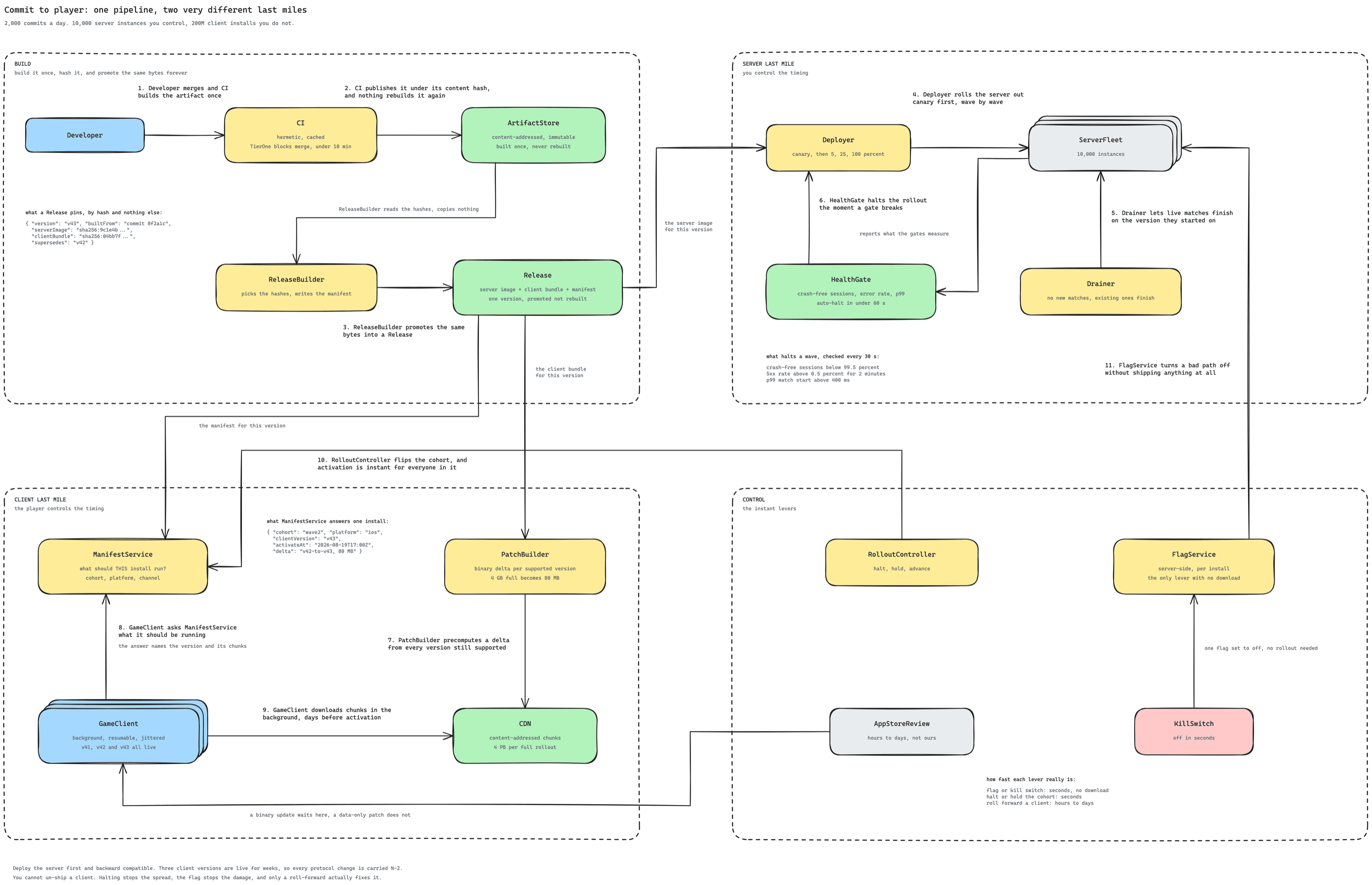
- CI builds hermetically and only tier one blocks a merge, so 2,000 commits a day still get feedback in under 10 minutes.
- Artifacts are content-addressed and immutable, a Release promotes the same bytes, and creating one takes artifact ids rather than a source ref so rebuilding is impossible rather than discouraged.
- The server rolls out canary then 5, 25 and 100 percent across 10,000 instances, with a health gate that halts automatically, and a drainer that lets live matches finish on the version they started on.
- The patch builder precomputes a delta from every supported version, and the CDN serves content-addressed chunks so an unchanged file is never sent twice.
- Clients fetch in the background 48 hours early and jittered, then the manifest flips and everyone in the cohort activates at once: 23 GB a second instead of 1.1 TB a second.
- The flag service is evaluated server-side every session and is the only lever that changes behaviour with no download at all.
- The invariant worth closing on: the server is a rollout problem and the client is a delivery problem, because I control one timeline and not the other. Server first and backward compatible, download early and activate late, and flags instead of rollback.
What is Expected at Each Level
- Mid
- Builds a working pipeline: CI, artifact storage, environments, automated deploy with a canary.
- Knows to stage a rollout and to have a rollback plan.
- Usually treats the client like a server and assumes a rollback is available.
- Usually misses that several client versions are live at once, so the compatibility question never comes up.
- Senior
- Separates the two last miles and gets the deploy order right, server first and backward compatible.
- Designs delta patching and staged cohorts, and handles draining a stateful fleet rather than restarting it.
- Uses feature flags as the client-side safety mechanism and gates rollout advancement on health.
- Sizes the test tiers against the commit rate instead of testing everything everywhere.
- Staff
- Does the 4 PB arithmetic unprompted and concludes that staging is a bandwidth requirement, not only a safety one.
- Separates download from activation, and can say why that specific move solves both the peak and the fairness problem at once.
- Says plainly that a client rollback does not exist, and reframes the levers as halt, flag and roll forward.
- Treats store review as a design force, pushing risky behaviour into config so the fast lever exists at all.
- Writes the skew window down as a policy with a number, and tests skew in CI rather than discovering it in production.
- Picks client-side health as the gate and knows that a drop in telemetry is an alarm rather than silence.
- Names what the design does not do: flags accumulate and interact, two versions sit on client disk during pre-download, and a launch-crash bug is caught by the cohort rather than by any lever.
Say the bandwidth number out loud without notes: 50M times 80 MB is 4 PB, 1.1 TB a second in one hour, 23 GB a second over two days.
Then write the three levers in the order you would reach for them: flip the flag, halt the rollout, ship forward.
Then explain expand-migrate-contract in one sentence each, and say why the server always goes first.