"The database is the schedule. The payments table, indexed by due time, is what the schedulers read; pollers claim due rows with SKIP LOCKED and leases, and the gateway idempotency key, the paymentId, collapses every retry into at most one charge."
Requirements
4 minFour questions. State your assumption for each so the interview moves even without answers.
- What is being paid: an external card/bank via a gateway, or in-game currency? Assume an external gateway (the harder case); the in-game variant swaps the gateway for the wallet service and gets simpler.
- Due-time precision: is "within a minute of due" acceptable? Assume yes; sub-second scheduling is a different problem.
- Can a payment be edited before due, or only cancelled? Assume cancel plus re-create.
- What happens on terminal failure (card declined after retries): notify and drop, or park for manual review? Assume notify + park.
100M scheduled payments/day, about 1.2K executions/sec average, with sharp due-time spikes (midnight, 1st of month) reaching 50 to 100x average. Trigger lateness p99 under 60s. All amounts in integer minor units, never floats or DECIMAL.
At most once against the gateway no matter what crashes (the money side); at least once attempted (the product side); reconciled to exactly-once effect via gateway idempotency. Full audit of every attempt. Out of scope: gateway internals, FX, subscription logic (this is the engine such logic schedules onto).
Core entities
1 min- Scheduled payment: who pays, how much, when, with a lifecycle (pending → processing → completed / failed / cancelled).
- Execution attempt: one try against the gateway, with its outcome; a payment has many, the audit trail is their history.
- Due partition: the unit of "what is due now", a time bucket the schedulers sweep.
- Gateway: the external processor, reachable only through idempotency keys.
API
3 min
// payer = authenticated actor; keys scoped (actor, key)
POST /v1/scheduled-payments
     Header: Idempotency-Key: key
     Body: { "payee": P, "amount": 2500, "dueAt": "2026-09-01T00:00:00Z" }
     → 201 { paymentId, status: PENDING }
     → 409 same key, different body
     // validated: amount > 0 and ≤ cap, dueAt in future and ≤ horizon (1y)

GET    /v1/scheduled-payments/{id}     // { status, dueAt, attempts: [...] }
GET    /v1/scheduled-payments?status=&cursor=
DELETE /v1/scheduled-payments/{id}
       → 200 CANCELLED           // won the race
       → 409 ALREADY_PROCESSING  // lost it: too late
- Cancel is a compare-and-swap (CAS, an atomic compare-then-update) on status PENDING → CANCELLED; if execution already claimed the row, cancel honestly loses with 409 rather than pretending. The race is decided by one row's state, nowhere else (dive E).
- All times accepted and stored in UTC; presentation converts.
High-level design
10 min, end to end, no dives yetclient → API → PAYMENTS TABLE (truth = schedule), partitioned by due day, keyed (actor,key) -- row 1: scheduling pollers claim due rows (SKIP LOCKED + lease + attempt) → executors → gateway (key = paymentId) -- row 2: execution reaper: expired leases → PENDING; exhausted → DLQ; CDC → Kafka → audit + notify; daily reconciliation -- row 3: the safety net
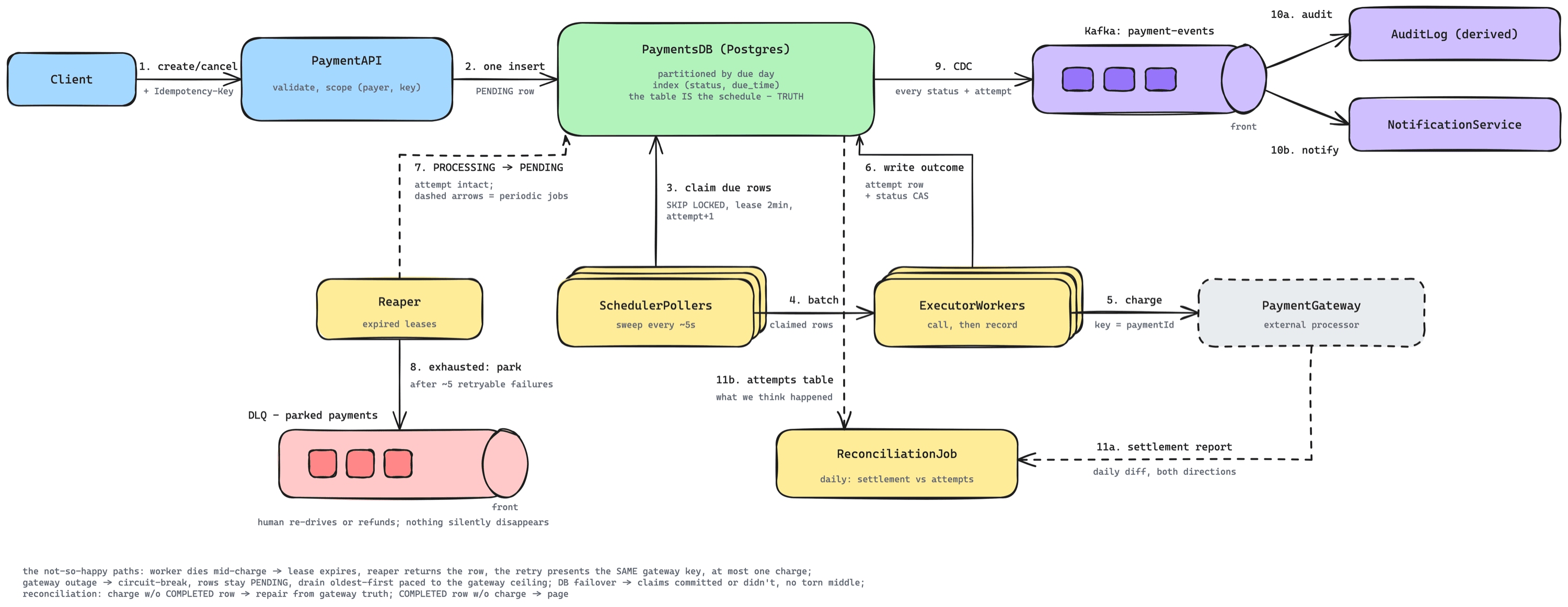
Creating a payment is one insert with a scoped idempotency key; the table, partitioned by due day and indexed by (status, due_time), is itself the schedule → dive A (why not a queue). Scheduler pollers sweep the current partition every few seconds and claim batches of due rows with SKIP LOCKED, stamping a lease and an attempt number → dive B. Executor workers call the gateway with the payment's id as the idempotency key, so any number of retries collapses into at most one charge → dive C, then record the outcome. A reaper reclaims expired leases and parks exhausted payments in a DLQ (dead letter queue, a holding pen for work that needs a human). Every status change flows via CDC to Kafka for audit and notifications, and a daily reconciliation diffs the gateway's settlement report against our attempts → dive F.
- If they just nod and wait: "the riskiest part is the claim query, shall I open it?"
- Running behind: protect dives B and C. Cut G first; A can shrink to its one-sentence argument.
Deep dives: the core four
~20 min, interviewer steers-- each poller, every ~5s, on the live partition:
UPDATE payments p SET
status = 'PROCESSING',
lease_until = now() + interval '2 min',
attempt = attempt + 1
FROM (
SELECT id FROM payments
WHERE status = 'PENDING' AND due_time <= now()
ORDER BY due_time
LIMIT 100
FOR UPDATE SKIP LOCKED
) due WHERE p.id = due.id
RETURNING p.*;
- Concurrent pollers each grab a disjoint batch of due rows without blocking each other, because rows another poller has locked are skipped, not waited on.
- N pollers scale the sweep with zero coordination service, no leader election, no distributed lock.
- A worker that dies mid-execution leaves its rows PROCESSING with an expiring lease.
- The reaper CASes expired leases back to PENDING (attempt count intact), and the next sweep retries them.
- A payment is never lost and never concurrently executed: at any instant exactly one holder has an unexpired lease, or the row is PENDING.
- Recorded on every attempt row and passed through logging, so a zombie worker whose lease expired mid-call is distinguishable in the audit trail.
- Its late outcome write CASes against the attempt it owns, failing harmlessly if the world moved on.
- Every retry of a payment, across crashes, lease expiries, and backoff, presents the same key, so the gateway collapses them into at most one charge.
- Keying by attempt would make every retry a fresh charge, which is the classic double-billing bug. Name it before they do.
- A timeout after sending means the charge may or may not have happened. Never guess.
- Keep the payment PROCESSING, and retry with the same key (safe by the above) or query the gateway's status endpoint for that key.
- Only a definitive gateway answer moves the row to COMPLETED or a retryable FAILED.
- Exponential backoff with jitter (1m, 5m, 30m, 2h, 12h), budget ~5 for retryable failures (network, 5xx, rate limit).
- Terminal failures (card declined, account closed) go straight to FAILED + notification, no retries.
- Exhausted budget parks in the DLQ for review.
- (payment_id, attempt, started_at, gateway_key, outcome, gateway_ref).
- The audit requirement is satisfied by construction, and the daily reconciliation (dive F) diffs gateway settlement against exactly this table.
payments (
  id uuid pk, payer, payee
  amount_minor bigint       -- integer cents, never DECIMAL
  due_time timestamptz, due_day partition key
  status PENDING | PROCESSING | COMPLETED | FAILED | CANCELLED
  attempt int, lease_until
  idem_actor, idem_key unique (actor, key)
) PARTITION BY due_day
  INDEX (status, due_time)      -- the sweep index
  INDEX (payer, created_at)     -- user's list view

attempts ( payment_id, attempt pk, gateway_key, outcome, gateway_ref, at )
- Pollers only touch today's partition, so the hot index covers ~100M rows, not all history; old partitions age out to cold storage after settlement.
- Humans schedule for round times, so 00:00 on the 1st can hold 100x an average second.
- Lever 1, smear: execute due payments over a window; the contract says "at due time", delivery is due + jitter within the lateness SLO, stated honestly.
- Lever 2, pace to the gateway's rate limit: the true bottleneck is the gateway's ceiling, not our sweep; the claim batches naturally form the pacing queue.
- The claim needs multi-row transactional SKIP LOCKED semantics, and the schedule benefits from one strongly consistent table with real indexes.
- At 1.2K/s average this is one primary with partitioning, no exotics.
- Cancel is
UPDATE ... SET status='CANCELLED' WHERE id=? AND status='PENDING'. - If the claim got there first, the row is PROCESSING, cancel matches zero rows and returns 409 ALREADY_PROCESSING.
- If cancel got there first, the claim's inner SELECT no longer sees the row.
- Both orders are correct because both mutations are CAS on the same status column of the same row; there is no window where both win.
- Lease expires at T, reaper flips the row to PENDING, a new claim executes with attempt N+1 and the same gateway key; the zombie finishes its stale call late.
- The gateway key collapses the charge to one regardless, and the zombie's outcome write is fenced:
UPDATE attempts SET outcome=? WHERE payment_id=? AND attempt=Ntouches only its own attempt row, never the payment's status, which only the current attempt's owner CASes.
- Not supported by design; cancel (CAS-guarded) and re-create with a new key.
- One less mutable path through the money state machine, said as a choice, not a gap.
Three more dives
rehearse after the core four- Poll the DB (chosen): indexed sweep of due rows + claim. Truth and schedule are one store; cancel is a row update; recovery is free, the row is still there.
- Delay queues: broker holds a message until the delay expires. Caps on delay horizon, cancel means tombstone-chasing a queued message, and the queue becomes a second truth store to reconcile.
- Redis ZSET: sorted set, score = due_time, pop ≤ now. Fine as an accelerator; wrong as truth (persistence and atomic-claim story weaker than the DB it would shadow).
- Timing wheel: in-memory ring of buckets. The right tool inside a process (OS timers, Kafka brokers use one); wrong across processes and restarts at day-plus horizons.
- Every alternative to polling duplicates the payments table's state into a second system, and then cancel, edit, crash recovery, and audit all become synchronization problems between the two.
- Polling a partitioned index at a few-second interval costs almost nothing at 100M rows/day and keeps one truth.
- The moment polling actually strains, the load is due-time spikes, which dive D solves in the key, not by changing the architecture.
- Nothing is lost, the schedule is rows; leases expire, the reaper returns work, attempt counts survive.
- Circuit-break, stop claiming (leave rows PENDING rather than churning attempts).
- On recovery drain the backlog oldest-first, paced to the gateway's rate limit.
- Backlog size and oldest-due age are the outage dashboards.
- The schedule is on the primary with synchronous replication; a failover pauses execution for seconds.
- Claims in flight either committed (lease holds) or did not (rows still PENDING); the state machine has no torn middle.
- Daily, diff the gateway's settlement report against the attempts table.
- Charge with no COMPLETED row → our miss, repair status from gateway truth.
- COMPLETED row with no charge → gateway's miss or our bug, page.
- This closes the loop that per-request idempotency alone cannot: it catches the failures neither side saw.
- Exhausted or ambiguous-terminal payments park with full attempt history; a human tool re-drives or refunds; nothing silently disappears, which is the audit requirement doing its job.
- Trigger lateness p99 < 60s (measured due_time → first attempt); at-most-once violation count: zero, audited by reconciliation; API availability 99.95%.
- Alerts: oldest-due PENDING age (the single best health number: if the sweep stalls, this grows), claim throughput vs due inflow, lease-expiry rate (worker health), DLQ arrival rate, gateway error and latency, reconciliation mismatches (any nonzero pages).
- Pollers and executors are stateless; roll freely, leases cover the gap.
- The table's partitions pre-create a week ahead by a boring cron that is itself monitored.
- One cron job, once a minute: SELECT due rows; execute serially. Correct at small scale, and where to start.
- It breaks on (a) execution time exceeding the interval (backlog compounds), (b) needing more than one worker (no claim semantics), (c) crash mid-batch (no leases).
- This design is that cron job grown exactly three mechanisms: SKIP LOCKED claims, leases, and gateway idempotency keys. Nothing else was added, which is the argument that the component count is earned.
- Poll interval (5s) and lease length (2m) are guesses; derive from measured execution latency distribution and the lateness SLO.
- The smear window for spikes is a product conversation: how late is "at midnight" allowed to be? The lever exists; the number needs an owner.
- Would cut first: the Kafka audit fan-out. At this scale the attempts table plus the DB's own CDC to a warehouse may serve audit and notifications without a streaming tier; keep Kafka only if notification latency or consumer count demands it.
- Recurring payments (subscriptions) are deliberately out: the clean layering is a subscription service that creates rows in this system, keeping this engine single-shot.
- Multi-region: single region of record; scheduled work tolerates a brief regional failover better than most systems since due times are minutes-grained.
The five hardest probes
show all (interview mode)Read the Step 4 walkthrough aloud once, timing yourself. If it runs past 90 seconds, cut words until it fits.