DevEx payouts: the flow, chapter by chapter
One chapter per section: the components, the flow, and the mechanism that keeps money safe at that exact point.
THE CAST
Five tables carry the whole system
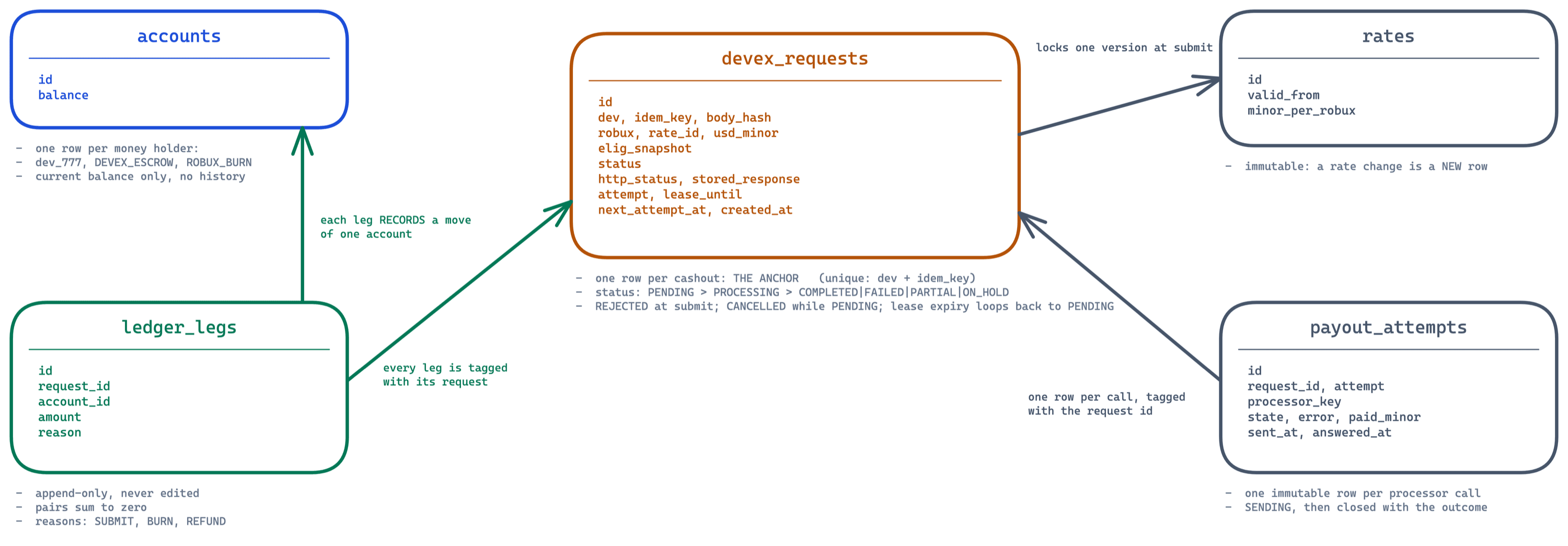
WHAT EACH ONE IS
- devex_requests — one row per cashout: the anchor. Its status column is the state machine every chapter moves.
- Two states outside the worker loop: REJECTED (born terminal at submit when the guard says no) and CANCELLED (the developer cancels while still PENDING; refunds the escrow, guarded so it cannot race a claim).
- accounts — one row per money holder (dev_777, DEVEX_ESCROW, ROBUX_BURN). Current balances only, no history.
- ledger_legs — the append-only receipts: one row per movement half, pairs sum to zero. The money truth; balances can be rebuilt from it.
- payout_attempts — one immutable row per processor call: the audit trail of trying.
- rates — immutable rate versions. A change is a NEW row, so a locked rate stays true forever.
WHO WRITES WHAT, CHAPTER BY CHAPTER
- Chapter 1 (submit): inserts the devex_requests row, moves accounts, writes two ledger_legs. Reads rates.
- Chapter 2 (claim): updates only devex_requests — status, lease, attempt counter.
- Chapter 3 (call): inserts one payout_attempts row per try. Nothing else is written.
- Chapter 4 (settle): the only writer that touches all four — status flip, balances, legs, attempt close, one transaction.
- Chapters 5-6 only read, with ONE exception: reconciliation writes the settlement a processor report proves we missed.
- Rollups, the WORM archive, and the DLQ are derived from these tables, never sources of truth.
CHAPTER 1 OF 6
The submission transaction
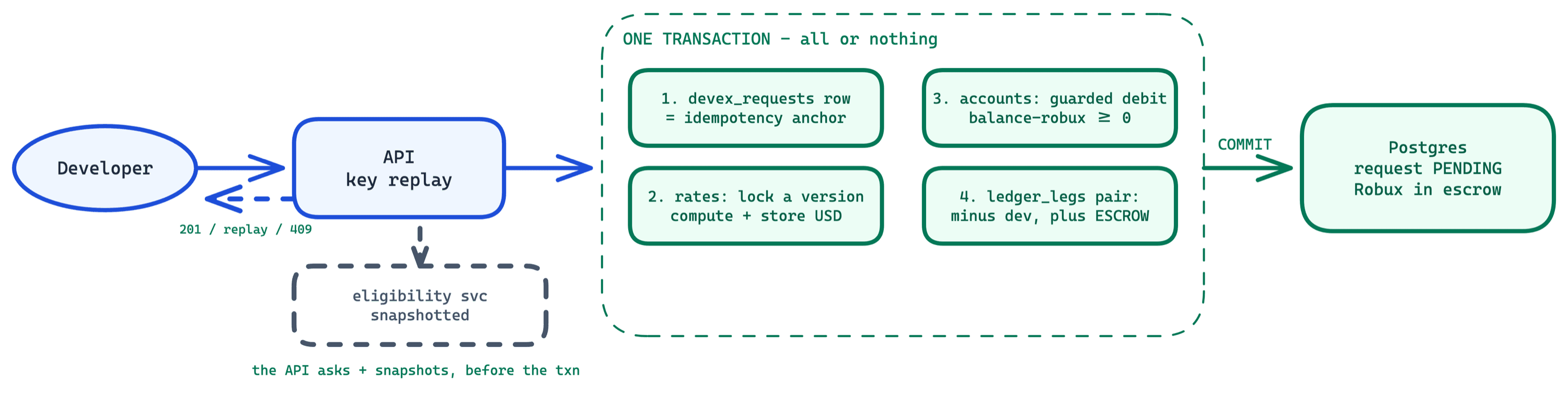
WHAT HAPPENS
- Developer POSTs with an idempotency key. Static validation runs first: malformed body or below the minimum cashout is a 422 before anything external happens.
- Then the API checks (developer, key): seen before means replay the answer stored the first time (mechanics in Appendix B).
- Same key with a DIFFERENT body is rejected (409): a key names one exact request, forever.
- An external eligibility service (KYC, tax forms, fraud state) is asked first, before the transaction below begins. Its full answer is saved (snapshotted).
- One transaction begins: insert the request row (PENDING).
- Read the newest row of the rates table. A rate change is a NEW row, never an edit, so this row can be referenced forever. Compute the USD. Store both on the request.
- Move the Robux: subtract from the developer, add to the escrow holding account. The subtracting SQL itself says "only if enough balance", so the check cannot be raced.
- Record the move as two bookkeeping rows, called ledger legs: minus on the developer (they are handing over Robux to get dollars), plus on escrow (where it waits). They sum to zero.
- COMMIT: everything above becomes real at once. The success response already shows the locked rate and the exact dollar amount in cents, and neither can ever change.
WHAT MAKES IT ROBUST
- The fused guard (our name; the standard term is a conditional UPDATE): balance check and debit are one atomic statement. Two racing submissions cannot both pass; the second re-checks the debited balance and matches zero rows.
- The anchor (our nickname for the idempotency record: the request row every retry lands on): a rejection commits it as REJECTED instead of rolling back, so a retry always finds one recorded outcome.
- Frozen inputs: rate and eligibility are stored on the request. Later rule or rate changes cannot touch this request.
- All or nothing: escrow move, ledger legs, rate, snapshot, status share one COMMIT. No partial submission can exist.
IF WE CRASH RIGHT HERE
- Before COMMIT: nothing exists anywhere. The developer retries cleanly.
- After COMMIT: the Robux sits visibly in escrow and the PENDING row survives. Chapter 2 will find it.
CHAPTER 2 OF 6
A worker claims the request
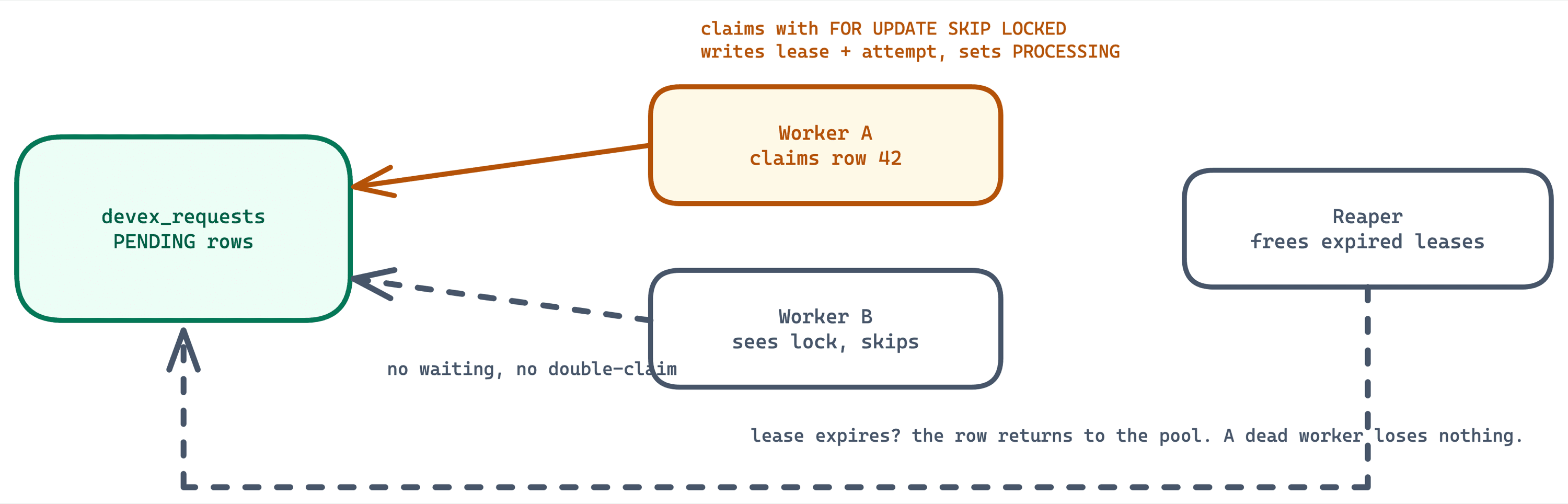
WHAT HAPPENS
- Workers sweep for PENDING rows.
- A claim locks the row (
FOR UPDATE) while other workers skip locked rows instead of waiting (SKIP LOCKED). One row, one worker, no waiting, no coordinator. - The claim also writes a lease ("mine until 12:15" - a timer that outlives a dead worker) and an attempt number (try #1, #2...), then sets PROCESSING.
- PROCESSING means "a worker owns this row". It has nothing to do with the external payment processor, which is never touched until chapter 3.
- A reaper job (a cleanup sweep) flips rows with expired leases back to PENDING.
WHAT MAKES IT ROBUST
- SKIP LOCKED: two workers can never hold the same request. Not by convention, by the database.
- The lease: a claim is a loan, not ownership. A worker that dies silently just lets its lease expire.
- Attempt numbers: every claim is numbered, so the history shows exactly who tried when.
- Right-sized: at DevEx scale (assume thousands of cashouts/day) one worker suffices. This machinery exists for crash-safety, not throughput.
IF WE CRASH RIGHT HERE
- Worker dies mid-claim: the lease expires, the reaper frees the row, the next worker starts attempt n+1.
- Nothing was sent to the payment processor (the external service that pays out real dollars; chapter 3) yet, so nothing can have been paid.
CHAPTER 3 OF 6
The processor call
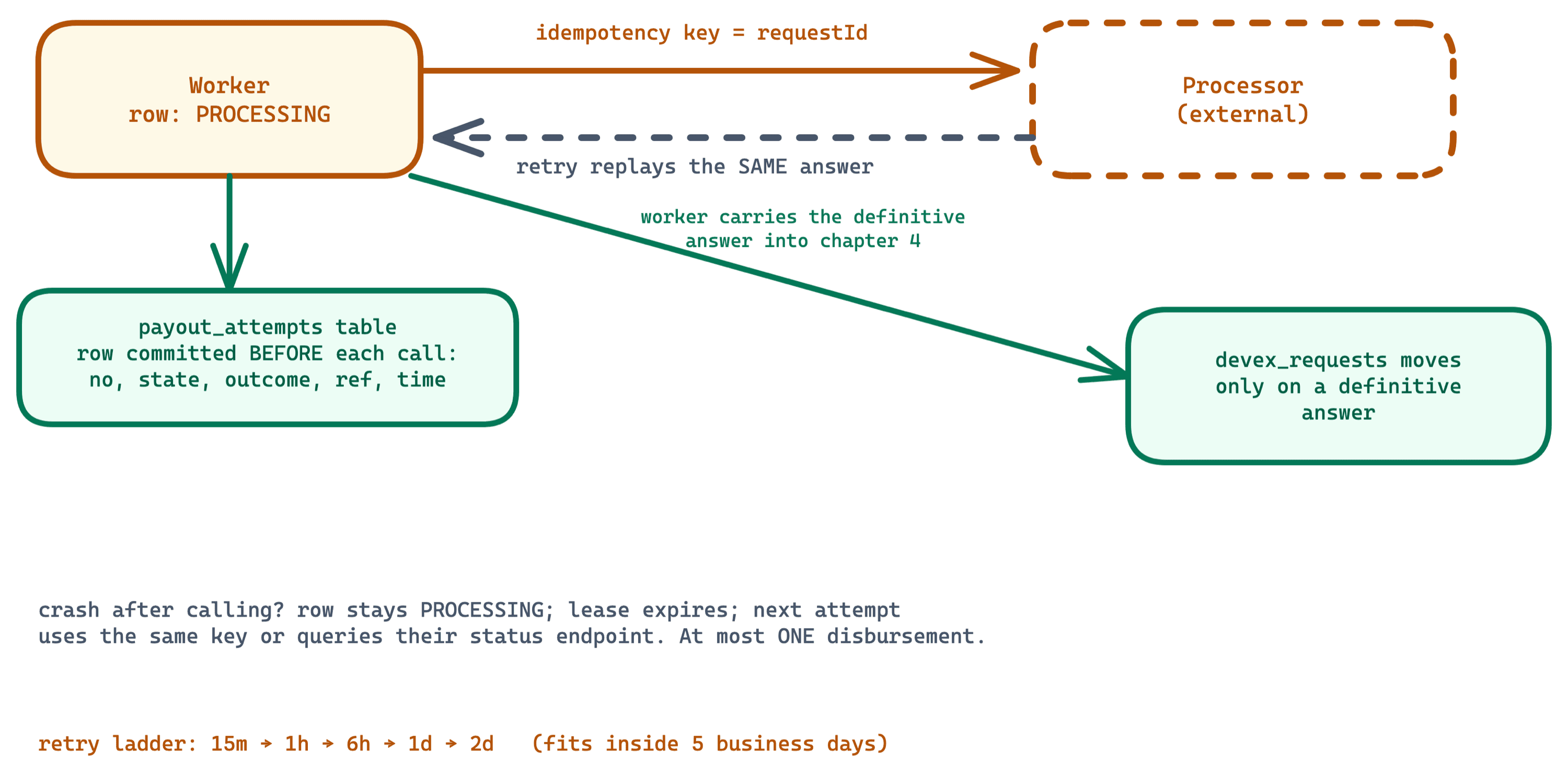
WHAT HAPPENS
ONE ATTEMPT, START TO FINISH — one worker, right now
- The worker holds the row it claimed in chapter 2: status PROCESSING, lease ticking.
- It inserts and COMMITs one payout_attempts row, state SENDING. Intent before side effect (the write-ahead idea: record first, act second): no external call without a committed record of it.
- It calls the processor. The idempotency key it sends IS the requestId — the same on every attempt, forever.
- This is a second key, one hop out: chapter 1's key deduplicates developer-to-platform; this one deduplicates platform-to-processor.
- The processor either pays once and records the answer under that key, or replays its recorded answer.
- Definitive answer (paid / failed / paid-partially): the worker carries it into chapter 4, where ONE transaction closes the attempt row (outcome, processor reference) AND settles the money.
- Timeout or garbage: not an outcome, and nothing more is written anywhere. The attempt row stays SENDING (which IS the timeout record), the request row stays PROCESSING, a later try asks again.
ZOOM OUT — the same request across retries, days apart
- One worker at a time (the lock and the lease guarantee it), several across time: each retry is claimed by whoever sweeps next.
- The request row keeps ONE counter, overwritten at each claim: attempt=3.
- The wait between tries is mechanical: freeing the row also stamps next_attempt_at = now() + ladder[attempt] (ladder below), and the claim query skips rows whose time has not come. Try #3 waits 6h.
- The payout_attempts table gets a NEW row for every try, and no row is ever overwritten. The audit trail.
- So by try #3 it holds THREE rows: attempts 1 and 2 stuck at SENDING forever (one timed out, one died before calling — the missing outcome IS the record), attempt 3 closed as FAILED.
- The log always grows, timeouts included. The status only moves on certainty.
WHAT MAKES IT ROBUST
- One key per request, not per attempt: any retry, from any worker, after any crash, collapses to at most one real disbursement. Per-attempt keys are the classic double-payout bug.
- Definitive-answer rule: a timeout is not an outcome. The row stays PROCESSING until the processor says something final.
- Attempt row first, call second: a crash between them leaves an honest SENDING row and no side effect. Nothing external happened.
- The reverse order is a bug: call first, record second means a crash can move money with no local record of the attempt. Only reconciliation would ever find it.
- The retry ladder (standard name: a backoff schedule): 15m, 1h, 6h, 1d, 2d. The product promises resolution inside 5 business days; the whole ladder plus a human-review window fits in that budget.
- Circuit breaker (stop calling a service that keeps failing): workers pause claiming, so unclaimed rows wait as PENDING.
- Rows already claimed just lease-expire back to PENDING. On recovery, workers drain the backlog oldest-first; no attempts were burned during the outage.
IF WE CRASH RIGHT HERE
- Crashed after writing SENDING, before calling: nothing external happened. Lease expires; the next attempt adds its own row and calls.
- Crashed after calling, before recording: the SENDING row makes the gap visible (a row with no outcome and an expired lease). The request row is still PROCESSING.
- Next attempt presents the same key. The processor replays its answer. We record it late. Nobody is paid twice.
- Equivalent move: ask the processor's read-only status endpoint for that requestId. Same information, no new payment risk.
CHAPTER 4 OF 6
Terminal settlement
WHAT HAPPENS
- Chapter 3 ends with a definitive outcome in the worker's hand. The same worker, still holding its lease, turns it into money movements.
- One transaction does four jobs:
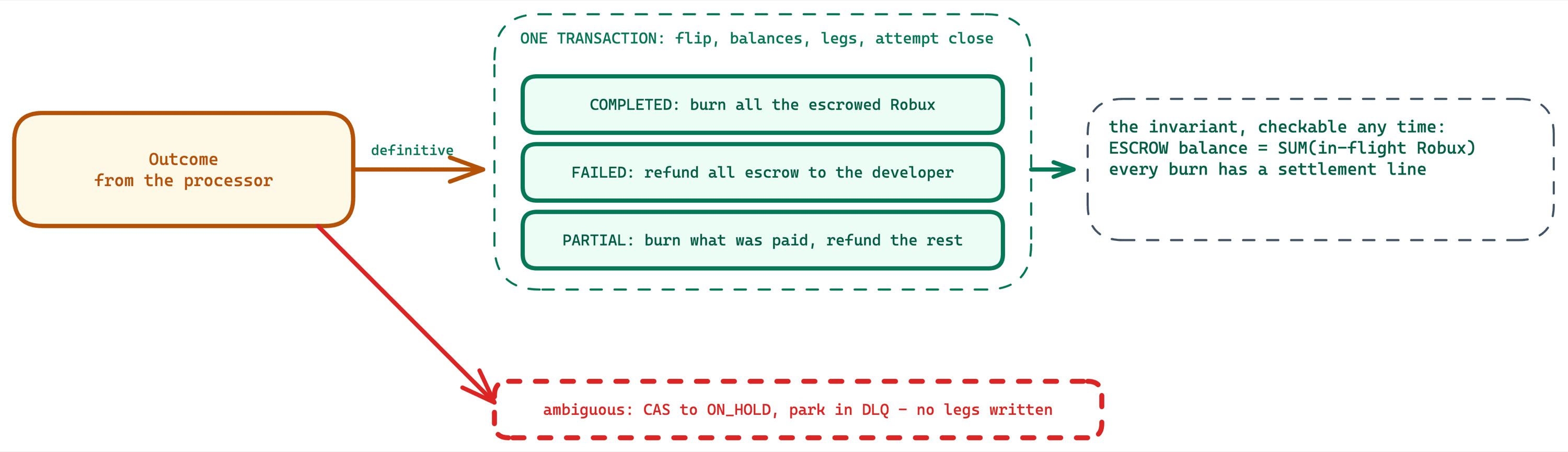
- flip the status column of the devex_requests row: PROCESSING becomes COMPLETED, FAILED, PARTIAL — or ON_HOLD, the ambiguous case below
- move the account balances: DEVEX_ESCROW down; the burn account or the developer up
- write new ledger_legs rows recording that move
- close the payout_attempts row with the outcome and the processor's reference
- The status flip is a CAS (compare-and-swap):
UPDATE devex_requests SET status='COMPLETED' WHERE id=42 AND status='PROCESSING'. - 0 rows updated means someone settled first: stop, touch no money.
- Where the Robux goes, by outcome:
- COMPLETED: burn all of it (move it to the burn account, out of the economy forever)
- FAILED: refund all of it to the developer
- PARTIAL (paid X of Y): burn robux·X/Y rounded down, refund the remainder
- An ambiguous answer (their report says PARTIAL but X is missing, negative, or bigger than Y) parks in the DLQ (dead-letter queue): a holding table for work the system refuses to guess about.
- the CAS flips the request to ON_HOLD, which takes it out of the claim-and-reaper loop
- alerts fire, escrow stays put, a human decides before any leg is written
WHAT MAKES IT ROBUST
- Status and money are one commit: no code path can mark a request finished without settling its escrow, or settle without marking.
- CAS on the status: a stale worker or a duplicate settle (the same outcome delivered twice) finds the row already flipped, updates 0 rows, does nothing.
- The escrow invariant: ESCROW balance = SUM of in-flight Robux, checkable at any moment. Every burn matches a settlement line.
- The one-liner: money left the platform if and only if Robux left the economy.
IF WE CRASH RIGHT HERE
- Crash between outcome and settlement: the transaction never committed, the row is still PROCESSING, chapter 3 repeats safely.
CHAPTER 5 OF 6
CDC: displays and the archive
WHAT HAPPENS
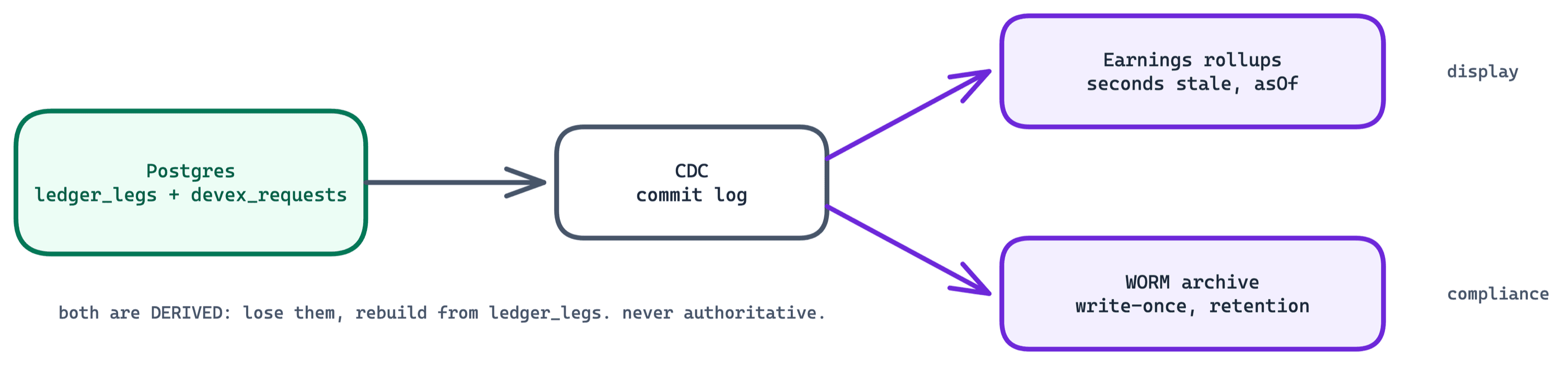
- The database publishes every committed change (CDC = change data capture, tailing the commit log).
- One consumer maintains the earnings rollups (pre-added totals per developer) that dashboards read.
- Rollups run seconds stale and carry an asOf timestamp, so stale is visible, never silent.
- Another streams every change to WORM archive storage (write once, read many): once written, the storage layer refuses edits and deletes, even from admins, until retention expires.
WHAT MAKES IT ROBUST
- Derived, never authoritative: lose the rollups or the archive copy, rebuild from the ledger.
- The money write path never waits: submissions and payouts do not touch this pipeline; it only reads commits.
- Compliance by stream: the WORM copy is the immutable record regulators ask for, without rebuilding the whole system around an event log (event sourcing).
IF WE CRASH RIGHT HERE
- The pipeline lags or dies: dashboards go stale and say so via asOf. Money paths are untouched.
CHAPTER 6 OF 6
Reconciliation
WHAT HAPPENS
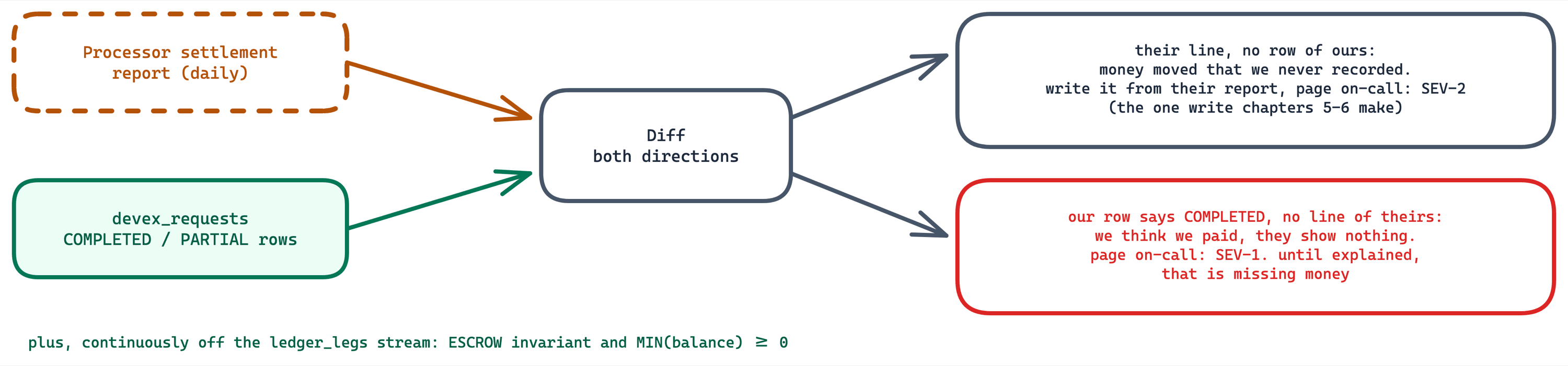
- Daily, pull the processor settlement report.
- Diff it against our COMPLETED and PARTIAL rows, in both directions.
- Their line, no row of ours (money moved that we never recorded): write the missing settlement from their report, then page the on-call at SEV-2 to find how it got lost.
- Our COMPLETED, no line of theirs (we believe we paid; their report shows nothing): page the on-call at SEV-1 (drop-everything severity). Until explained, that is missing money.
- Continuously, from the ledger stream: re-check the escrow invariant, and that every balance stays at or above zero.
WHAT MAKES IT ROBUST
- External truth check: everything upstream is our own bookkeeping; this is the one chapter that checks it against the outside world: the processor's report.
- Asymmetric severity: money we cannot account for (SEV-1) is worse than money we have not recorded yet (SEV-2). The paging level encodes that judgment.
- Backstop, not front line: chapters 1-4 prevent; this chapter detects whatever survived anyway.
IF WE CRASH RIGHT HERE
- Reconciliation itself fails: nothing corrupts. It is a reader. Rerun it; alert on it being late.
APPENDIX
Row locking, both idioms, worked
IDIOM 1 · FOR UPDATE, SORTED ORDER — a two-account transfer (teaching example, not part of the payout system)
- Setup: alice (id 1, balance 100) sends bob (id 2) 30. Bob sends alice 10. Same instant.
- Rule: every transaction locks the LOWER id first, no matter who is paying whom.
BEGIN;
SELECT status FROM accounts WHERE id = 1 FOR UPDATE;   -- min(1,2) first, always. the column picked is irrelevant: this SELECT exists only to take the row lock
SELECT status FROM accounts WHERE id = 2 FOR UPDATE;
UPDATE accounts SET balance = balance - 30 WHERE id = 1 AND balance - 30 >= 0;
-- app checks the debit touched 1 row; 0 rows means ROLLBACK and stop (or the credit below mints 30)
UPDATE accounts SET balance = balance + 30 WHERE id = 2;
COMMIT;
- 12:00:00.000 Session 1 locks row 1.
- 12:00:00.001 Session 2 also starts at row 1. Sees the lock. Waits.
- 12:00:00.002 Session 1 locks row 2, updates both, COMMITs.
- 12:00:00.005 Session 2 unblocks and runs its transfer. Nobody deadlocks; the slower one just queues.
THE SAME RACE WITHOUT SORTED ORDER
- 12:00:00.000 S1 (alice→bob) locks its sender: row 1. S2 (bob→alice) locks its sender: row 2.
- 12:00:00.001 S1 wants row 2, waits on S2. S2 wants row 1, waits on S1.
- Each holds what the other needs. Deadlock. Postgres kills one after detection: "deadlock detected".
- Same statements, same locks. The ORDER is the entire fix (standard name: lock ordering).
IDIOM 2 · FOR UPDATE SKIP LOCKED — the payout claim
- Setup: rows 41, 42, 43 are PENDING. Workers A and B run the identical claim at the same instant.
async def claim_next(pool):
    async with pool.connection() as conn:      # borrowed from a connection pool, not opened fresh
        async with conn.transaction():         # framework does BEGIN / COMMIT / ROLLBACK

            # 1. pick ONE free row and lock it: skip busy rows, never wait
            row = await conn.fetchrow(
                "SELECT id, dev, robux FROM devex_requests "
                "WHERE status = 'PENDING' AND next_attempt_at <= now() "  # the retry-ladder wait, enforced
                "ORDER BY created_at "                      # created_at: stamped by column default in chapter 1
                "LIMIT 1 FOR UPDATE SKIP LOCKED")
            if row is None:                    # every PENDING row is locked or gone
                return None                    # caller sleeps a beat, polls again

            # 2. claim the row we are holding: still locked, nobody can race us
            await conn.execute(
                "UPDATE devex_requests "
                "SET status = 'PROCESSING', "
                "    lease_until = now() + interval '15 minutes', "
                "    attempt = attempt + 1 "
                "WHERE id = $1", row.id)      # $1 = the id the SELECT above locked (say 42)

    # leaving the block ran COMMIT: lock released, claim durable
    return row                                 # caller sends row 42 to the processor
- 12:00:00.000 A reaches row 41 first, locks it. A gets 41.
- 12:00:00.000 B reaches row 41, sees the lock, does NOT wait: skips to 42, locks it. B gets 42.
- 12:00:00.002 Both COMMIT their claims. Row 43 waits for the next sweep.
- 12:07:00 Worker A crashes. Nothing happens yet.
- 12:15:00 A's lease expires. The reaper flips row 41 back to PENDING. Next claim is attempt 2.
THE SAME CLAIM WITHOUT SKIP LOCKED
- B queues behind A for row 41 — a row it can never have — instead of taking 42.
- Every worker serializes behind the first one. The pool becomes single-file.
ONE PRIMITIVE, TWO IDIOMS
- Money transfers: lock everything you touch, in one global order. Wait politely.
- Work queues: lock one free thing, skip the busy ones. Never wait.
- When is SELECT FOR UPDATE needed at all? Only when there is a gap between reading and writing that the lock must cover.
- A plain UPDATE takes the SAME row lock by itself and holds it to COMMIT. That is why the account updates in Appendices B and C need no SELECT: read, guard, and write are one statement, no gap.
- Idiom 2's gap: the worker must read WHICH row to take before it can write to it. The SELECT is the picking; FOR UPDATE makes the pick a claim.
- Lock ORDER matters either way: consecutive UPDATEs also take locks one at a time and hold them, so opposite orders can still deadlock.
- Name both idioms in an interview and row locking is covered as a topic.
APPENDIX B
Chapter 1 in the real world: what the code actually looks like
THE HANDLER, PRODUCTION SHAPE (Python-ish)
async def submit_devex(dev_id, idem_key, robux):
    # 0. replay check FIRST: a retry must get the stored answer even if
    #    eligibility has changed since the original request went through
    prior = await db.fetchrow("SELECT body_hash, http_status, stored_response "
                             "FROM devex_requests WHERE dev=$1 AND idem_key=$2", dev_id, idem_key)
    if prior:
        if prior.body_hash != hash(robux):
            return 409, {"error": "KEY_REUSED"}
        return prior.http_status, prior.stored_response

    # 1. external call OUTSIDE the transaction: own timeout, own circuit breaker
    elig = await eligibility.check(dev_id, timeout=2.0)
    if not elig.ok:
        return 422, {"error": "NOT_ELIGIBLE", "reasons": elig.reasons}

    async with pool.connection() as conn:      # borrowed from a pool, not opened fresh
        async with conn.transaction():         # framework does BEGIN / COMMIT / ROLLBACK

            # 2. the anchor, race-safe: insert-or-detect in one statement
            req = await conn.fetchrow(
                "INSERT INTO devex_requests (dev, idem_key, robux, body_hash, status) "
                "VALUES ($1,$2,$3,$4,'PENDING') "
                "ON CONFLICT (dev, idem_key) DO NOTHING RETURNING id",
                dev_id, idem_key, robux, hash(robux))
            if req is None:                    # two racing FIRSTs on one key: the loser lands here
                prior = await conn.fetchrow("SELECT * FROM devex_requests "
                                            "WHERE dev=$1 AND idem_key=$2", dev_id, idem_key)
                if prior.body_hash != hash(robux):
                    return 409, {"error": "KEY_REUSED"}
                return prior.http_status, prior.stored_response    # the replay

            # 3. rate lock + USD, still inside the same transaction
            rate = await conn.fetchrow("SELECT * FROM rates WHERE valid_from <= now() "
                                       "ORDER BY valid_from DESC LIMIT 1")
            usd_minor = floor(robux * rate.minor_per_robux)  # cents per Robux; floor: exact cents, never overpay

            # 4. the fused guard: check + debit, one statement
            n = await conn.execute(
                "UPDATE accounts SET balance = balance - $2 "
                "WHERE id = $1 AND status='ACTIVE' AND balance - $2 >= 0", dev_id, robux)
            if n == 0:
                # zero rows means frozen account OR insufficient balance: re-read the
                # account once to say WHICH, so the 422 carries the right error code
                # business rejection: RETURN, do not RAISE - raising would roll back
                # the anchor, and the anchor must survive for retries
                resp = {"error": "INSUFFICIENT_BALANCE"}
                await conn.execute("UPDATE devex_requests SET status='REJECTED', "
                                   "http_status=422, stored_response=$2 WHERE id=$1", req.id, resp)
                return 422, resp   # the retry replays exactly this, via step 0

            await conn.execute("UPDATE accounts SET balance = balance + $2 "
                               "WHERE id = 'DEVEX_ESCROW'", robux)   # the credit: no guard needed
            await conn.execute("INSERT INTO ledger_legs ... ")     # the receipts: -dev, +ESCROW
            resp_body = {"requestId": req.id, "rateId": rate.id, "usdMinor": usd_minor}
            await conn.execute("UPDATE devex_requests SET rate_id=$1, usd_minor=$2, "
                               "elig_snapshot=$3, http_status=201, stored_response=$5 "
                               "WHERE id=$4", rate.id, usd_minor, elig.json, req.id, resp_body)
            # http_status + stored_response: what a future retry replays
    # leaving the block runs COMMIT (clean exit) or ROLLBACK (exception).
    # by this line the commit has already happened.
    return 201, resp_body   # the exact object a retry will replay
THE REAL-WORLD DETAILS THE WHITEBOARD HIDES
ON CONFLICT DO NOTHING, not try/except
- A unique-violation ERROR aborts the whole Postgres transaction.
- The conflict clause detects the duplicate without erroring.
- So the replay path stays inside one clean transaction.
Return, never raise, on business rejection
- Frameworks roll back when the block exits via exception.
- The REJECTED anchor must COMMIT.
- So rejection is a normal return.
Isolation level: the default is enough
- READ COMMITTED works, because the guard lives inside the UPDATE.
- No SERIALIZABLE needed. Saying why is the senior point.
The pool
- The transaction holds a connection for single-digit milliseconds.
- 10-20 pooled connections carry the whole payout write path.
Timeouts as backstops
- statement_timeout and idle_in_transaction_session_timeout.
- A hung client can never sit on the row locks.
Deadlock or serialization error
- Retry the whole handler.
- Safe: the handler is idempotent by construction.
Client disconnects after COMMIT, before reading the 201
- Their retry hits the step-0 replay check and gets the stored response.
- This exact case is why the anchor stores the response, not just the status.
The stored response
- Status code + body, persisted on the request row.
- A replay must be byte-identical, even after a server restart.
Three rejections, three record policies
- INSUFFICIENT_BALANCE → recorded here. The verdict depended on the balance at that instant; only a committed row preserves it.
- NOT_ELIGIBLE → recorded elsewhere. The eligibility service made the call and keeps the audit; this system records money decisions, anchor onward.
- KEY_REUSED → already recorded. The original anchor row is the truth; the 409 is re-derived from it, deterministically, on every ask.
- All three still emit logs and metrics; observability is not the ledger.
- Abuse (1000 mismatched bodies on one key): that is authenticated traffic, so the API gateway (the front door every request passes through) logs every attempt. Rate limit at ~20 attempts/minute per key, alert on the burst, freeze the account. Never give an attacker a path that writes ledger rows at their chosen rate.
Eligibility failure leaves no row here, on purpose
- The check runs before BEGIN: no anchor exists, nothing in this system was touched.
- Ownership: the eligibility service made that decision and keeps its own audit. This system records money decisions, from the anchor onward.
- Also protects the write path: bots hammering an ineligible account never reach a single INSERT.
- Trade-off to say out loud: failed attempts do not appear in the developer's request history. If the product wants them visible, insert a rate-limited REJECTED_NOT_ELIGIBLE row instead. Both are defensible; choose knowingly.
WHAT BREAKS IN REAL DEPLOYMENTS, AND WHERE THIS DESIGN CATCHES IT
- Deploy rolls mid-request: transaction never committed, nothing exists, client retries cleanly.
- Eligibility service is slow: only the pre-transaction call waits; no database locks are held during it.
- Two app servers race the same key: ON CONFLICT makes one the writer; the other reads and replays.
- Clock skew between servers: irrelevant here - rate selection uses the database's now(), one clock.
APPENDIX C
Chapter 4 in the real world: the exact rows a refund writes
ONE EXAMPLE, CARRIED THROUGH EVERY CASE
- Request 42: developer dev_777 cashed out 1000 Robux at the locked rate, worth 350 usdMinor ($3.50).
- Chapter 1 already moved the Robux into escrow. Chapter 4 decides where it goes from there.
THE POSITION SETTLEMENT INHERITS (after chapters 1-3)
devex_requests
  id=42  dev=dev_777  robux=1000  usd_minor=350  status='PROCESSING'

accounts
  dev_777        4000    # had 5000; chapter 1 debited 1000
  DEVEX_ESCROW   1000    # the in-flight 1000 waits here
  ROBUX_BURN        0    # the exit door of the economy

ledger_legs (request 42 so far — chapter 1 wrote this pair)
  leg=901  account=dev_777       amount=-1000  reason='SUBMIT'
  leg=902  account=DEVEX_ESCROW  amount=+1000  reason='SUBMIT'

payout_attempts
  id=7  request=42  attempt=1  processor_key='42'  state='SENDING'
  # the key IS the requestId (chapter 3's rule). still SENDING: the definitive answer
  # is in the worker's hand; chapter 4's transaction writes it while settling
CASE: PROCESSOR SAYS FAILED — full refund
- Meaning: no dollars left the platform, so all 1000 Robux must go back.
- One transaction, four jobs (six statements):
async def settle_failed():                      # same frame as Appendix B: the with block IS the transaction
    async with pool.connection() as conn:
        async with conn.transaction():         # framework does BEGIN / COMMIT / ROLLBACK

            # 1. the CAS: claim the right to settle, or learn someone already did
            n = await conn.execute(
                "UPDATE devex_requests SET status='FAILED' "
                "WHERE id=42 AND status='PROCESSING'")
            if n == 0:                        # someone settled first
                return                        # stop, touch no money

            # 2. move the Robux back (no overdraft guard needed: escrow always covers, by invariant).
            #    developer row first, then escrow: the SAME lock order as chapter 1's submit,
            #    per idiom 1 — opposite orders between submit and refund could deadlock
            await conn.execute("UPDATE accounts SET balance = balance + 1000 WHERE id='dev_777'")
            await conn.execute("UPDATE accounts SET balance = balance - 1000 WHERE id='DEVEX_ESCROW'")

            # 3. the receipts: two NEW legs. chapter 1's legs are never edited or deleted.
            await conn.execute("INSERT INTO ledger_legs VALUES (903, 'DEVEX_ESCROW', -1000, 'REFUND', 42)")
            await conn.execute("INSERT INTO ledger_legs VALUES (904, 'dev_777',      +1000, 'REFUND', 42)")

            # 4. close the attempt with the processor's reason
            await conn.execute("UPDATE payout_attempts SET state='FAILED', error='account_closed' WHERE id=7")

    # leaving the block ran COMMIT: all six statements land, or none do
after COMMIT:
  dev_777        5000    # whole again, as if the request never happened
  DEVEX_ESCROW      0    # this request's slice is exactly zero
  legs for request 42: -1000 +1000 -1000 +1000  # sum = 0, story preserved
CASE: PROCESSOR SAYS PARTIAL — paid 210 of 350 usdMinor
- Meaning: 60% of the dollars went out, so 60% of the Robux must leave the economy.
- Burned share: floor(1000 · 210/350) = 600. Refund the remaining 400.
- Floor rounding sends the fractional Robux back to the developer, never into the burn.
- Same shape: CAS to 'PARTIAL', then TWO pairs of legs instead of one:
# alternative outcome for the SAME request 42 (instead of the FAILED case, not after it),
# so leg numbering starts at 903 again
async def settle_partial():                     # paid 210 of 350: burn 600, refund 400
    async with pool.connection() as conn:
        async with conn.transaction():

            # 1. the CAS: claim the right to settle, or learn someone already did
            n = await conn.execute(
                "UPDATE devex_requests SET status='PARTIAL' "
                "WHERE id=42 AND status='PROCESSING'")
            if n == 0:
                return                        # someone settled first: stop, touch no money

            # 2. balances — developer, then escrow, then burn. "global" = EVERY transaction in the
            #    codebase uses this same sequence (skipping rows is fine, reordering is not),
            #    so no cycle of waiters can ever form — idiom 1's rule, with names
            await conn.execute("UPDATE accounts SET balance = balance + 400  WHERE id='dev_777'")
            await conn.execute("UPDATE accounts SET balance = balance - 1000 WHERE id='DEVEX_ESCROW'")
            await conn.execute("UPDATE accounts SET balance = balance + 600  WHERE id='ROBUX_BURN'")

            # 3. the receipts: TWO pairs this time, each summing to zero
            await conn.execute("INSERT INTO ledger_legs VALUES (903, 'DEVEX_ESCROW', -600, 'BURN',   42)")
            await conn.execute("INSERT INTO ledger_legs VALUES (904, 'ROBUX_BURN',   +600, 'BURN',   42)")
            await conn.execute("INSERT INTO ledger_legs VALUES (905, 'DEVEX_ESCROW', -400, 'REFUND', 42)")
            await conn.execute("INSERT INTO ledger_legs VALUES (906, 'dev_777',      +400, 'REFUND', 42)")

            # 4. close the attempt with what was actually paid
            await conn.execute("UPDATE payout_attempts SET state='PARTIAL', paid_minor=210 WHERE id=7")

    # leaving the block ran COMMIT: all nine statements land, or none do

after COMMIT:
  dev_777        4400    # got 400 back
  DEVEX_ESCROW      0    # emptied for this request, again
  ROBUX_BURN      600    # 600 Robux left the economy, matching the $2.10 that left the platform
CASE: PROCESSOR SAYS COMPLETED — for symmetry
- CAS to 'COMPLETED', one pair of legs: DEVEX_ESCROW -1000, ROBUX_BURN +1000.
- The one-liner: dollars left the platform, so exactly that many Robux left the economy.
RULES THAT HOLD IN EVERY CASE
- Append-only ledger: a refund is two new rows, never an edit of chapter 1's rows. The history stays readable.
- Escrow drains to exactly zero for the request, whichever case fires. That is the per-request escrow invariant.
- Legs come in pairs summing to zero, and the request's whole set sums to zero: nothing minted, nothing lost.
- Lose the CAS, write nothing: status flip, account updates, legs, and the attempt close share one transaction.
- Ambiguous writes NO legs: the CAS parks the request as ON_HOLD and the 1000 sits in escrow until a human picks one of the three cases above.
NEXT ACTION, 3 MINUTES
Walk chapters 1-6 aloud, one sentence each, using only the section titles. That sentence chain IS the interview walkthrough.