SQL locking cheat sheet
Start here: most of the time you need none of this
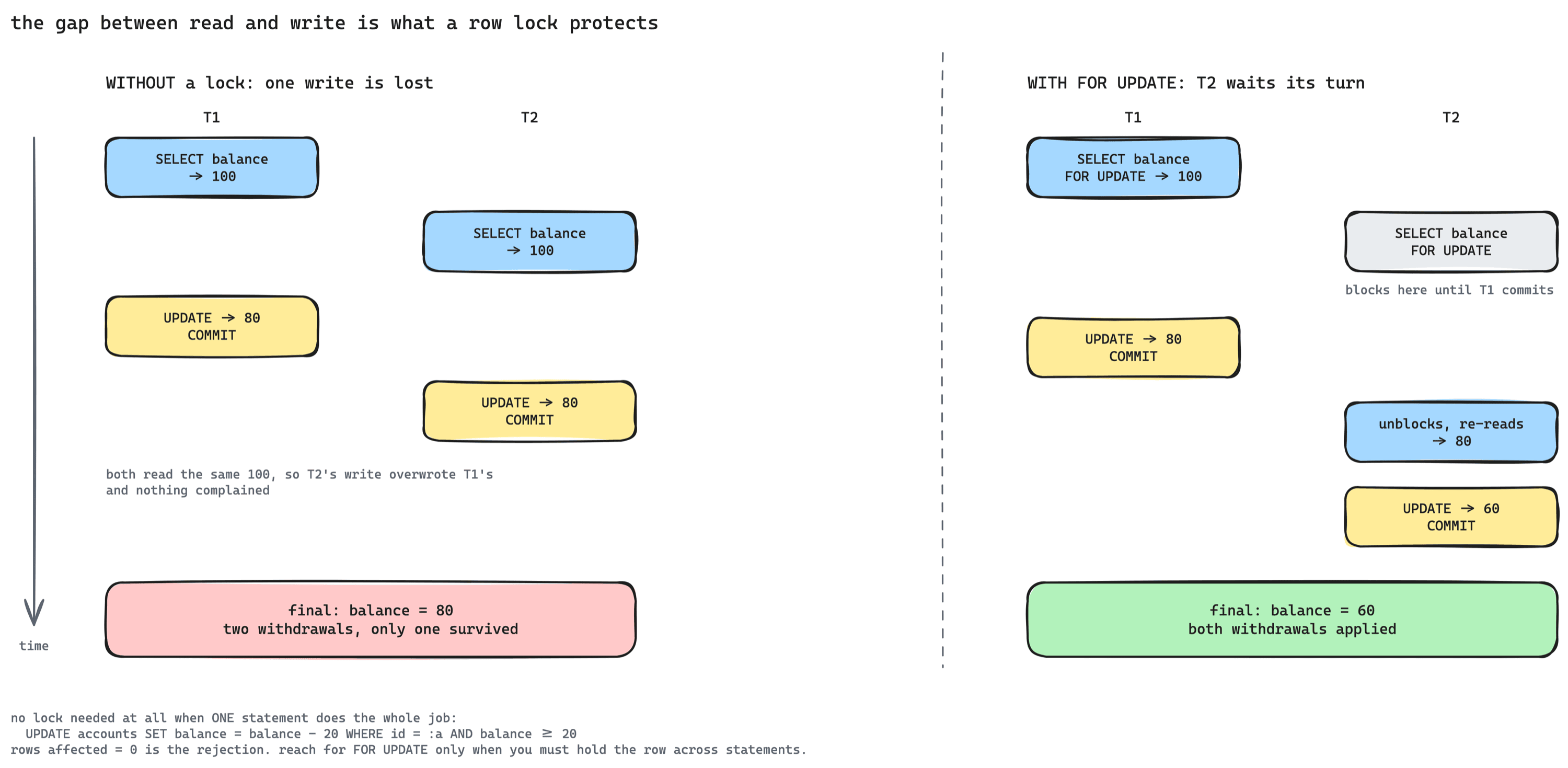
A single SQL statement is already atomic. This needs no lock clause from you, because Postgres takes a row lock internally for the duration of the statement and the guard either matches or it does not:
UPDATE accounts SET balance = balance - 20
 WHERE id = :a AND balance >= 20
Rows affected = 0 is the rejection. That is the whole mechanism behind the fused
guard in devex-payouts and the window fence in like-counter, neither of which writes
FOR UPDATE anywhere.
You reach for explicit row locking when you must hold a row across more than one statement in a transaction: read it, decide something, then write based on what you read. That read-to-write gap is the thing the lock protects, and it is the only reason these clauses exist.
The four row lock strengths
All four are written SELECT ... FROM t WHERE ... FOR <mode> and all four
last until the transaction ends. Weakest to strongest:
| clause | what it stops | where you meet it |
|---|---|---|
| FOR KEY SHARE | only key changes and deletes of that row | what a foreign-key check takes on the parent row |
| FOR SHARE | anyone trying to update or delete the row; other readers are fine | "this row must still say what it says when I commit" |
| FOR NO KEY UPDATE | updaters and FOR SHARE, but not FK checks |
what a plain UPDATE takes when it touches no key column |
| FOR UPDATE | everything above | "I am about to modify this row, hands off until I commit" |
The two you will actually type are FOR SHARE and FOR UPDATE. The
other two mostly explain why an UPDATE sometimes blocks on a foreign key you
had forgotten about.
The conflict matrix
Read it as: someone already holds the row lock in the left column, you now ask for the one across the top.
| held \ requested | KEY SHARE | SHARE | NO KEY UPDATE | UPDATE |
|---|---|---|---|---|
| FOR KEY SHARE | ok | ok | ok | BLOCKS |
| FOR SHARE | ok | ok | BLOCKS | BLOCKS |
| FOR NO KEY UPDATE | ok | BLOCKS | BLOCKS | BLOCKS |
| FOR UPDATE | BLOCKS | BLOCKS | BLOCKS | BLOCKS |
- Someone holding
FOR SHAREdoes block yourFOR UPDATE, and blocks a plainUPDATEorDELETEtoo, because those take an update-strength lock internally. You wait until they commit or roll back. That is exactly the point ofFOR SHARE: it is a veto on modification, not a hint. - Many readers can hold
FOR SHAREon the same row at once, so a queue of share-lockers can starve a writer that is waiting behind them.
SELECT takes none of these locks and is never blocked by any of them.
Readers and writers do not block each other under MVCC. "Locked" never means "unreadable",
it only means "the next writer waits".FOR SHARE as a fence
The interesting use of FOR SHARE is not reading, it is asserting that
something stays true. In the game-matching claim transaction:
BEGIN;
SELECT 1 FROM leases WHERE partition = :p AND epoch = :my_epoch FOR SHARE;
-- zero rows means we are a zombie: ROLLBACK
...the claim writes...
COMMIT;
A takeover bumps that epoch with an UPDATE, which conflicts with this
FOR SHARE, so the stale owner and the new owner cannot both commit. A plain
SELECT there would read a snapshot and prove nothing.
The two modifiers
These attach to FOR UPDATE or FOR SHARE and change what happens
when the row you want is already locked. The default is to wait indefinitely.
| modifier | on a locked row | use it for |
|---|---|---|
| (none) | waits, forever if need be | the correct default when you genuinely need that row |
| NOWAIT | raises error 55P03 immediately | interactive paths where failing beats hanging |
| SKIP LOCKED | silently skips it and moves on | worker queues |
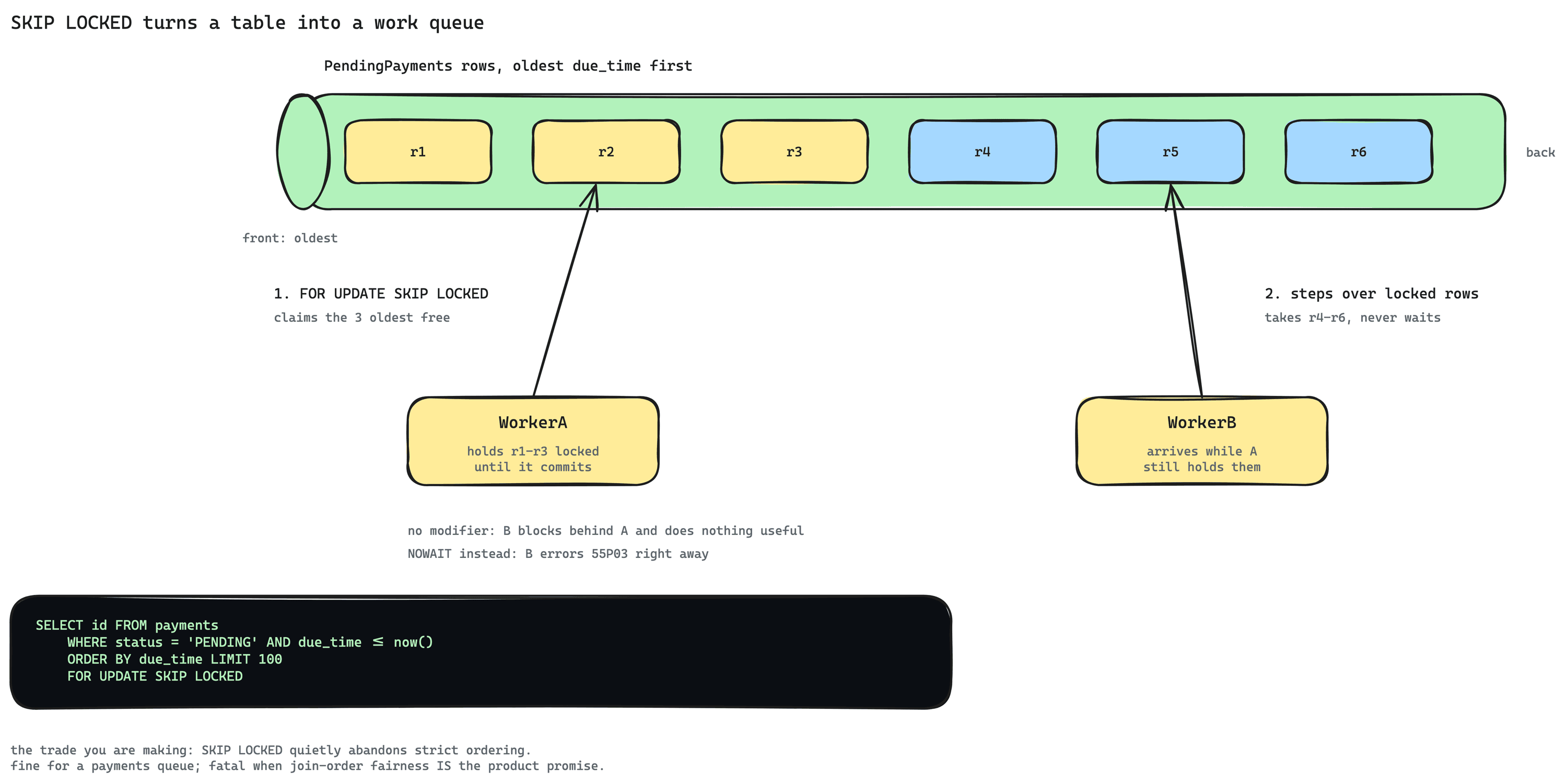
SKIP LOCKED is what turns a table into a work queue, which is the
delayed-payments poller exactly. The cost is the part to say out loud before an interviewer
says it: skipping locked rows quietly abandons strict ordering. Nobody cares in a payments
queue. It is fatal in a matchmaking queue whose product promise is join order, which
is why game-matching names it and declines it.
Deadlocks, and the one rule that prevents them
Two transactions each holding a row the other wants deadlock, and Postgres kills one with
error 40P01. Prevention is boring and absolute: acquire locks in a consistent global
order everywhere in the codebase. Wallet does this by locking min(A,B) then
max(A,B) so a transfer in either direction takes the same path.
ORDER BY combined with FOR UPDATE does not guarantee the
order in which locks are acquired. That is planner behaviour, not a contract. If order
matters, issue separate single-row statements in the sequence you want. This is also why
the fix for a hot-account batch is to lock every touched row in one global sorted sequence
before applying anything, rather than locking the hot row first and the receivers as they
come.Advisory locks
Locks on a number you invent, attached to no row. Useful when the thing to serialise is not a row: "only one instance of this job at a time", or "serialise everything touching user 12345" without holding real rows.
| function | scope | notes |
|---|---|---|
| pg_advisory_xact_lock(k) | transaction | released automatically at commit or rollback. Default to this one. |
| pg_advisory_lock(k) | session | must be unlocked explicitly or the connection closed. In a pooler this leaks a lock that outlives the request. |
| pg_try_advisory_lock(k) | session | returns true or false instead of waiting: "if someone else is doing this, skip it". |
Distributed locks, and why a CAS usually beats one
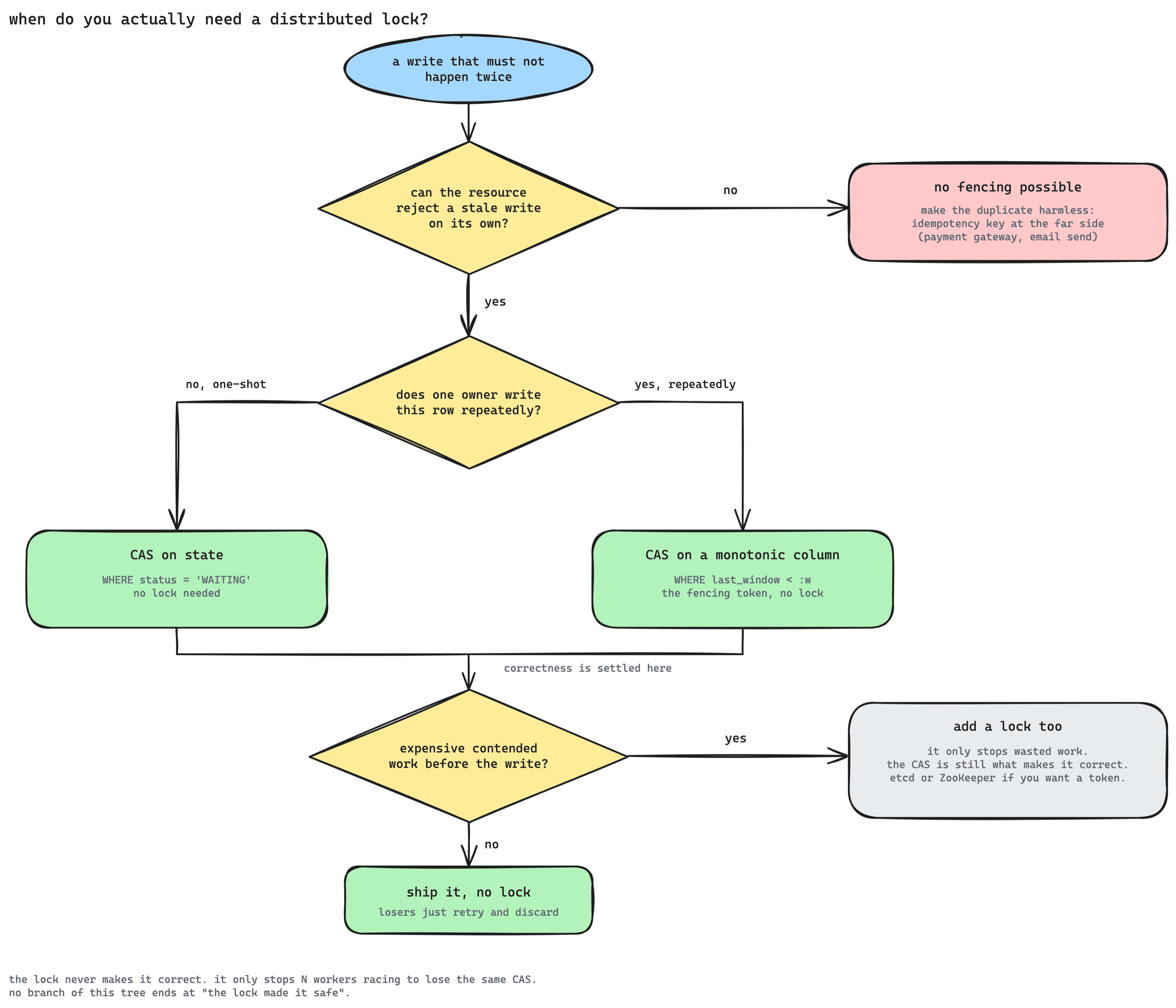
For a single row in a single database you do not need a distributed lock. The CAS is strictly better, and reaching for Redis there is cargo cult. Four situations are where a lock genuinely earns its place.
1. The resource cannot compare anything
A CAS needs a WHERE clause to live in. An S3 object, a filesystem, a printer,
a third-party payment gateway: there is no state to hang a condition on. That is the case
fencing tokens were invented for, and they only work if the resource compares the token,
which is resource-side participation all over again. If it genuinely cannot compare anything,
no lock saves you and the honest move is idempotency at the far side. That is exactly why
delayed-payments keys the gateway call by paymentId instead of trying to fence
it.
2. The critical section spans more than one row
A CAS guards one row. If the unit of work is "read 10,000 rows, compute a plan, write to three tables and publish to Kafka", per-row CAS gives you no mutual exclusion over the job. Every individual write can pass its own guard while two workers still duplicate the entire computation and interleave their outputs. A lock is a claim about the whole critical section, which no single-row guard can make.
3. Efficiency, which is a different goal from correctness
This is the distinction most people skip. Locks get used for two unrelated reasons:
| purpose | a duplicate causes | what you actually need |
|---|---|---|
| efficiency | wasted work, a bigger bill | a sloppy lock is fine; correctness never depended on it |
| correctness | corrupted data | fencing or CAS at the resource; the lock alone is not enough |
With 50 workers and an expensive job, a lock stops 49 of them burning CPU on work that would lose the CAS anyway. That is a throughput argument, not a safety one. CAS is optimistic (everyone works, losers retry and discard) and a lock is pessimistic (one works). When the work before the write is expensive and contention is high, optimism gets expensive.
4. There is no distinguishable "before" value to CAS on
CAS-on-state works when a write is a one-shot transition out of a known state:
WHERE status = 'WAITING' works precisely because WAITING happens once and is
consumed. When the same owner legitimately writes the same row over and over, there is no
stale prior value left to test against, and a zombie's write looks structurally identical to
a legitimate one. That is when you add a monotonic column and compare against it instead of
against the data.
| mechanism | rejects based on | reads as | example |
|---|---|---|---|
| CAS on state | what changed | "the world must still look like this" | status = 'WAITING' |
| fencing token | who is newer | "no later owner has spoken yet" | last_window < :w |
They are the same machinery pointed at different columns. The like-counter fence is exactly this: you cannot CAS on the count, because the count is supposed to keep changing, so it fences on a monotonic window id instead.
And the punchline for these designs: if you already have the database, you do not need Redis at all. A lease row with an epoch column gives you mutual exclusion, a monotonic token, and, uniquely, validation in the same transaction as the write. That is what game-matching does, and it is strictly stronger than an external lock plus fencing, because with an external lock the check and the write can never be atomic.
Table-level locks, and why your migration caused an outage
You rarely write LOCK TABLE yourself. These matter because DDL takes them.
| mode | taken by | blocks |
|---|---|---|
| ACCESS EXCLUSIVE | DROP, TRUNCATE,
VACUUM FULL, REINDEX, most ALTER TABLE |
everything, including plain reads |
| SHARE | CREATE INDEX (non-concurrent) |
writes; reads are fine |
| SHARE UPDATE EXCLUSIVE | VACUUM, ANALYZE,
CREATE INDEX CONCURRENTLY | neither reads nor writes |
The failure mode to be able to describe: an ACCESS EXCLUSIVE request queues
behind whatever long transaction is already running, and every new query then queues behind
it. That is how a migration that "takes 2ms" produces a five minute outage. Defences:
CREATE INDEX CONCURRENTLY, and set a short lock_timeout before DDL
so the migration fails fast instead of forming a queue.
The other axis: isolation levels
Locking is one way to prevent anomalies. Isolation level is the other, and they trade off against each other.
| level | what you get | what you owe |
|---|---|---|
| READ COMMITTED | a fresh snapshot per statement (Postgres default) | explicit locks or WHERE guards wherever correctness needs them |
| REPEATABLE READ | one snapshot for the whole transaction | handle serialization failures (40001) with a retry |
| SERIALIZABLE | true serializability via predicate locking | retry on 40001, and accept the abort rate under contention |
SERIALIZABLE can replace most explicit locking, but it does not delete the
work, it moves it into a retry loop you have to actually write. Worth naming as the
alternative you considered and declined.
If the interview is MySQL
FOR UPDATEandFOR SHAREboth exist; older MySQL spelled the latterLOCK IN SHARE MODE.SKIP LOCKEDandNOWAITarrived in 8.0.- InnoDB defaults to
REPEATABLE READ, notREAD COMMITTED. - InnoDB takes gap locks and next-key locks that lock the ranges between index entries, not only the rows you matched. A query that locks "no rows" can still block an insert into that range, so deadlock patterns appear that Postgres would never produce.
Where each of these already lives in your own designs
| mechanism | design | doing what |
|---|---|---|
| FOR SHARE | game-matching | fencing the lease epoch inside the claim transaction |
| FOR UPDATE SKIP LOCKED | delayed-payments | the poller claiming a batch of due rows |
| FOR UPDATE, sorted | wallet | two single-row locks in min/max order to prevent deadlock |
| no explicit lock | devex-payouts, like-counter | a single guarded statement: fused balance guard, window fence |
Ninety second recall
- One statement with a
WHEREguard needs no lock. Rows affected = 0 is the rejection. - Row locks exist for the read-to-write gap inside one transaction, and last until commit.
FOR SHARE= nobody may change this.FOR UPDATE= nobody may touch this. Share blocks update; update blocks everything.- Plain
SELECTis never blocked by any of them. SKIP LOCKEDfor queues, and say the ordering cost out loud.NOWAITwhen hanging is worse than failing.- Deadlock prevention is one consistent global lock order, and
ORDER BYdoes not give you one. - Advisory locks when the thing to serialise is not a row; prefer the
_xact_variant. ACCESS EXCLUSIVEfrom DDL blocks reads too, which is the migration outage.SERIALIZABLEreplaces locking with a retry loop you must write.- A distributed lock never makes a write correct, it only stops workers racing to lose the same CAS. Ask "can the resource reject a stale write itself?" first.
- CAS on state for one-shot transitions, a monotonic column for rows written repeatedly, idempotency when the resource cannot compare at all.