Design a user tracking event system with a top-K API
getTopK(start, end, k) · Hello Interview flow, board rules, one idea per line"This looks like a heavy-hitters problem and it is not one. There are only a thousand event types, so an entire minute of the firehose is a thousand counters, about eight kilobytes, which means I can keep the counts exact and answer top-k with a partial sort instead of a sketch. The genuinely hard parts are somewhere else: the ten billion raw events I still have to store and erase on request, and the one event type that is forty percent of the traffic."
Understanding the problem
5 minFunctional Requirements
- Clients should be able to emit tracking events, at high volume, without the system losing them.
- A caller should be able to ask for the top
kevent types by count within[start, end). - New event types should be able to appear, and old ones retire, without a deploy.
- A user should be able to have their tracking data erased and exported.
Below the line (out of scope):
- Arbitrary group-bys and filters on event properties. That is a full OLAP warehouse and it is a different system with a different storage engine. Say the cut out loud, because "top k by type" is a single fixed query shape and that is the only reason any of this is cheap.
- Sessionization, funnels, and per-user journeys. They need the raw events joined and ordered per user, which the counting path deliberately never does.
- Real-time alerting on thresholds, bot and fraud filtering, and billing-grade accuracy. Ad billing would change the durability bar from "do not lose events" to "prove you did not lose events".
Non-Functional Requirements
- Do the cardinality number first, because it decides everything below it.
- 1,000 event types is the entire key space, and it is fixed by the product, not by the traffic.
- One minute of the whole firehose collapses to 1,000 counts. At 8 bytes a count that is 8 KB a minute and 11.5 MB a day, so a year would be about 4 GB at minute grain if you kept one, and retention means you never do.
- So the counts are EXACT. Count-Min Sketch, Space-Saving, and lossy counting are answers to a problem I do not have here. Say this deliberately, because the interviewer is expecting you to reach for a sketch and the point is that you knew not to.
- Name the condition that would flip it, because that is what shows you understand why: if the "type" became a URL, a productId, or a userId, cardinality goes to 10^8 and the exact-counts plan dies. Then you sketch, or you keep exact counts for a tracked head and approximate the tail.
- Then the volume number, which sizes a completely different system.
- 10B events a day is about 115K events/sec average, and call it 350K/sec at peak with a 3x diurnal factor.
- At roughly 500 bytes an event that is 5 TB a day of raw data, so 450 TB at 90 days retention, before replication.
- The two numbers point at two different systems. The raw bytes are the expensive one to store, replicate, and erase. The counting is almost free. Most candidates spend the whole hour on the cheap half.
- Reads are rare, writes are constant, which is the inverse of a feed. Dashboards and scheduled reports, order of tens to hundreds of requests a second against 17.5K write requests a second, which is 350K events a second. Nothing here should be designed as if reads were the load.
- Query latency p99 under about 100 ms, and the cost must not grow with the traffic.
- Ten billion events a day and a hundred billion a day should cost the same to answer, because the answer is 1,000 numbers either way. That is the property the rollup tiers buy, and it is the one worth promising.
- Be precise rather than sweeping: cost does still grow with the calendar, just very slowly. A day-aligned 30-day range is 112 bucket reads and a ragged one of similar length is about 193; a year is 447 aligned and about 528 ragged. Claiming a flat ceiling is the kind of thing an interviewer checks with a pencil.
- Freshness: a minute's counts are readable about three minutes after that minute began, and the API says so.
- Where the three minutes go: one minute for the window itself, plus a two-minute watermark to let ordinary stragglers in.
- Readable is not the same as final, and conflating them is the mistake. A bucket stays restatable for the 15-minute lateness window and can be rewritten again by the nightly backfill, so "final" is really the next day.
- The tradeoff is explicit: exact once a window has settled, versus instant and approximate. Pick exact and settled, and make the incompleteness visible rather than silent.
- Durability: no event is silently dropped. At-least-once transport plus idempotent aggregation is what gets exactly-once counts, and those are two separate mechanisms rather than one guarantee.
- Correctness under replay: reprocessing a window must produce the same number it produced the first time. This is a design constraint on the sink, not a property you get for free from the framework.
- GDPR: erasure honoured inside the statutory month, which the design runs as a 30 day internal SLA, export on request, and personal data confined to a small, named set of stores rather than sprinkled across every derived table.
Entities + API
5 minDefining the Core Entities
- Event is one tracked action:
eventId,eventType,userId,eventTime,receivedAt, and a properties blob.eventIdis a UUID the client generates before its first attempt, and it is the idempotency key. Nothing else can make a retry safe.- There are two timestamps and choosing between them is a design decision, not a detail.
eventTimeis the client's clock: it is what the user actually did and when, and it is wrong, skewed, and user-settable.receivedAtis the server's clock: it is trustworthy and it is not what anybody is asking about.- Count by
eventTime, because a dashboard asking "what happened between 9 and 10" means the user's 9 to 10. That choice is what creates the late-event problem in deep dive 4, and taking it knowingly is the point.
- EventType is a registry row:
typeId(a small int, under 1,000 today and hard-capped at 4,000),name, schema version, owner,piiFlag, and status (active or deprecated).- The registry is small enough to sit in memory in every process, refreshed on a timer.
- The small integer is load-bearing: it is the slot index into the count vector, so a type is one array position rather than a string key. A retired type keeps its slot forever, because renumbering would silently rewrite history.
- CountBucket is the aggregate: key
(granularity, bucketStart), value a slot vector of counts plus a monotonicrevision.- One row per bucket, not a thousand rows per bucket. This is the single most important storage decision on the page and it falls straight out of the cardinality number.
- Name the store, because the claim depends on it. Anything with a single-key atomic put of an opaque value works: DynamoDB, Cassandra, or plain Postgres. A conditional put on
revisionis the one primitive that is actually required, and all three have it. - The vector is sized to the registry high-water mark, not to 1,000. Today that is 1,000 slots and about 8 KB; at the 4,000-slot cap from dive 5 it is 32 KB and every read figure on this page scales with it. Buckets written at different times can therefore have different widths, so the reader treats a short vector as zero-padded rather than assuming a fixed length.
- Granularity is one of minute, hour, day. Same shape at every tier, so the query code is written once.
- UserKey is the key store:
keyId = HMAC(secret, userId)to a wrapped per-user data key. Keying it by the HMAC rather than the rawuserIdmeans the table itself holds no plaintext identifier. It exists so erasure can be a key delete instead of a rewrite of a petabyte-scale lake. - DeletionRequest records
userId,requestedAt,completedAt. It is the audit trail a regulator asks for, and it is also what makes a restored backup re-converge.
API or System Interface
POST   /v1/events                              // { events: [ { eventId, eventType, userId, eventTime, properties } ] }
                                               // → 202 { accepted, warned: [ { eventId, reason } ],
                                               //              rejected: [ { eventId, reason } ] }

GET    /v1/stats/top?start=&end=&k=            // → 200 { window, complete, results: [ { eventType, count } ] }
GET    /v1/stats/series?type=&start=&end=&granularity=  // one type over time, same buckets, no new storage

GET    /v1/event-types                         // the registry, cacheable
POST   /v1/event-types                         // { name, schema, piiFlag } → 201, no deploy needed

POST   /v1/privacy/erasure                     // { userId } → 202 { requestId, dueBy }
GET    /v1/privacy/export?userId=              // → 202, delivered out of band
- The write path is a batch endpoint, and that is a capacity decision rather than a convenience.
- 350K events/sec as individual calls is 350K RPS of TLS handshakes, headers, and auth checks, where the overhead dwarfs the 500-byte payload.
- At 20 events a batch it is 17.5K RPS, which is an ordinary fleet.
- The cost is latency at the edge: the SDK holds events for a few seconds, so a user who closes the tab loses that buffer. Accept it and say so, because tracking is not transactional.
- 202, not 200. The server has durably accepted the batch and taken responsibility for it. It has not counted it yet, and pretending otherwise would be a lie the freshness section then has to walk back.
- Partial rejection is in the response shape, and
rejectedmeans malformed, not unfamiliar.- One bad event in a batch of twenty must not fail the other nineteen, and the client needs to know which one and why.
- A schema violation or a nonsense timestamp is rejected. An unknown
eventTypeis not: it is counted into a reserved overflow slot and returned inwarnedrather thanrejected, for the reasons in deep dive 5.
completeandasOfare first-class fields on the read, not footnotes.completeis false while the range touches anything younger than the backfill horizon, so a caller knows the number is still moving.- Pin the horizon to a number or the flag is useless. Set it at 24 hours: the nightly backfill closes yesterday and nothing older is restated on the normal path. Leaving it implicitly equal to the 90-day clock clamp from dive 4 would mean
complete: trueonly for ranges entirely older than 90 days, which is no dashboard anyone runs. - An event older than the horizon still gets counted, but through an explicit restatement that bumps the revision, so callers see it via
asOfrather than silently. complete: trueis not a promise the number is frozen for ever, and the response has to admit that, because an event arriving after the horizon still triggers an explicit out-of-band restatement of a bucket that already read complete. Ordinary lateness and the nightly backfill cannot, since both run inside the horizon.- So the response also carries
asOf, which is the MAXIMUM revision across every bucket the answer read, not the revision of the newest bucket. - That distinction is the whole point of the field. A late event restates an OLD bucket, which leaves the newest bucket's revision untouched, so a newest-bucket
asOfwould stay identical while the number changed. Taking the max, or a digest over the revision vector, is what actually detects it.
- No
userIdappears anywhere in the query path. That is deliberate: it is what keeps the aggregate store outside the scope of an erasure request, and it is worth saying out loud when you get to GDPR. - The two halves have different threat models on purpose. The write endpoint is public and takes data from untrusted clients, so it needs per-key quotas and validation. The read endpoint is internal and authenticated. Same system, and treating them the same is how a cardinality attack gets in.
High-level design
10 min, end to end, no dives yet1) Clients should be able to emit events without the system losing them
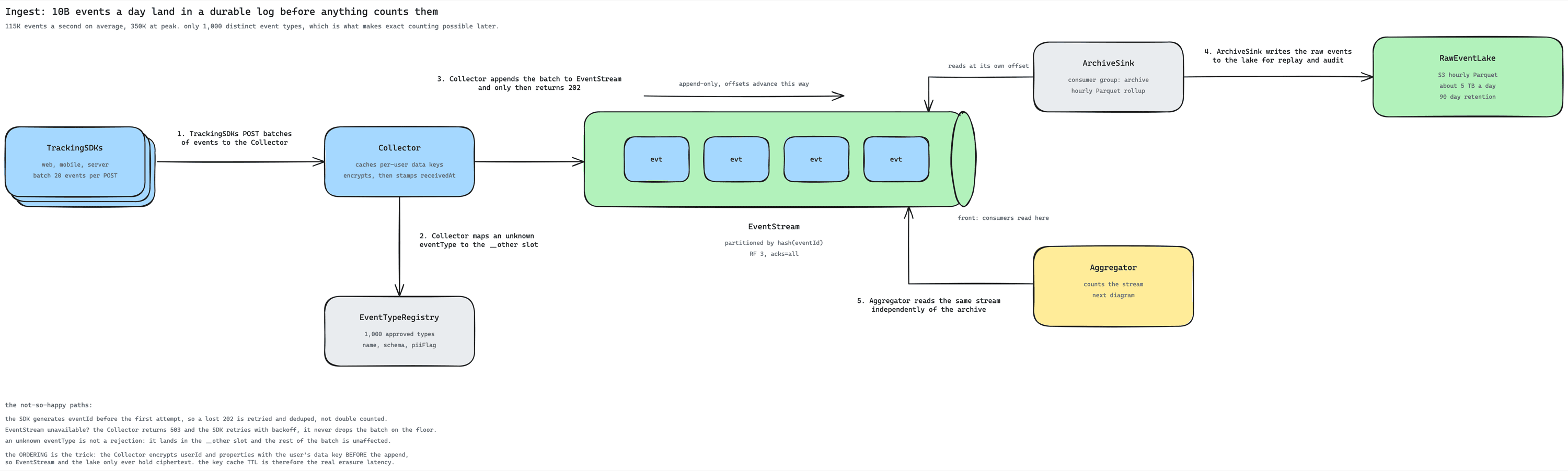
- The Collector does four things and nothing that can be deferred: authenticate the writing key (and enforce its new-type quota), validate each event against the registry and clamp its clock, encrypt
userIdand the properties blob with the user's data key, and stampreceivedAtbefore appending the batch to the log.- It stamps
receivedAtand it does not enrich, join, or count. Everything it might do instead is something that can fail, and this is the one component that must not. - The encrypt step is the one that spoils the clean story, so own it rather than hiding it. It means the Collector is not truly stateless: it holds a TTL-bounded cache of per-user data keys, because a KMS call per event at 350K/sec is not a thing.
- That cache is a dependency inside the component that must not fail, so it fails open in the only safe direction: a key that cannot be fetched means the batch is 503'd and retried, never written in the clear.
- The cache TTL is also the real erasure latency, which is why it is short and measured. It is the number to quote when someone asks how fast erasure takes effect.
- It stamps
- The durable log is the contract between ingest and everything downstream.
- The Collector returns 202 only after the append is acknowledged with
acks=all, so an ack means the data survives a broker loss. - Partition by
hash(eventId), not byeventType. This is the trap: keying the log by event type would send 40 percent of all traffic to a single partition, which is the hot-key problem created on purpose at the one place it is hardest to fix. Hashing the event id spreads perfectly by construction. - Two independent consumers read the same stream at their own offsets: the archive and the aggregator. Neither can block the other, and adding a third later costs nothing.
- The Collector returns 202 only after the append is acknowledged with
- The raw lake is the system of record for its 90-day retention, and it is what the counts are rebuilt from.
- Hourly Parquet in object storage, partitioned by date and hour, about 5 TB a day, 90 days hot.
- It exists for three reasons that are worth naming separately: replay after an aggregation bug, backfill of late data, and the legal obligations in requirement 4.
- Loss and duplication are handled by two different mechanisms. The log plus
acks=allis what stops loss. The client-generatedeventIdis what stops a retry becoming a second event. Conflating them is the most common mistake here.
2) Counting the stream exactly
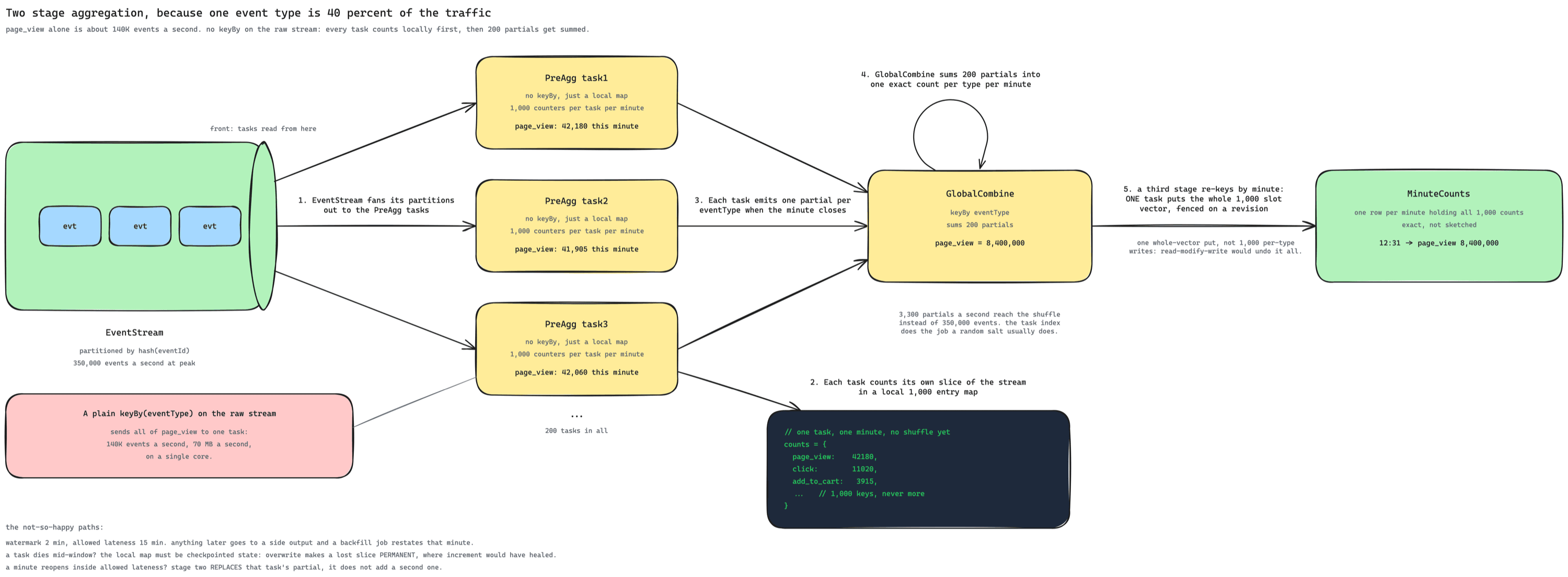
- Aggregation is two stages, and the reason is the skew.
- Event traffic is Zipf-shaped in every real product:
page_viewalone is around 40 percent of everything. - A plain
keyBy(eventType)on the raw stream routes all of it to one task: 140K events/sec, roughly 70 MB/sec, on a single core. The job does not fall over gracefully, it just develops permanent lag on the one key everybody looks at.
- Event traffic is Zipf-shaped in every real product:
- Stage one is a local pre-aggregate with no keyBy at all.
- Each task keeps a plain map of at most 1,000 counters for the current minute, over whatever slice of partitions it happens to own.
- 1,000 counters is nothing. This is only possible because of the cardinality number from step 1, which is why that number came first.
- That map must be checkpointed operator state, and the reason is the sink. If a task dies mid-window with an uncheckpointed local map, its slice is lost, and because the sink overwrites rather than increments, the too-low number becomes permanent. Increment would have healed itself on replay; overwrite does not. Idempotence on the write side moves the durability burden onto the aggregation state.
- Stage two is where the keyBy finally happens, and by then the volume is gone.
- At the close of each minute every task emits one partial per event type it saw.
- 200 tasks times 1,000 types over 60 seconds is about 3,300 partials/sec crossing the shuffle, instead of 350,000 raw events/sec.
- The hottest key in the second stage receives 200 partials a minute, which is not a hotspot in any sense.
- This is local-global aggregation, and the task index is doing the job people usually do with a random salt, without the salt's downside of having to choose a fan-out factor in advance.
- The sink overwrites, it does not increment, and this is the exactly-once story.
- There is a third stage, and leaving it out is the mistake that makes "overwrite" a slogan instead of a mechanism.
- GlobalCombine is keyed by
eventType, so it produces 1,000 independent results for one minute, spread over many tasks. - If each of those wrote itself into the shared bucket row, that is 1,000 concurrent read-modify-writes on one row, which is exactly the non-idempotent operation overwrite was introduced to remove.
- So after GlobalCombine, re-key by WINDOW. One task assembles the whole 1,000-slot vector for that minute and does a single atomic put of the entire row.
- The write is then "the vector for
minute Mis V", one writer, one key, one put. That is what makes replay a no-op.
- GlobalCombine is keyed by
- Fence the put with a monotonic revision, because there is more than one writer over the life of a bucket.
- The streaming restatement and the nightly backfill both write the same bucket. Pure last-writer-wins is ordered by arrival, not by correctness, so a straggling streaming write landing after the backfill makes the worse number permanent.
- Every put carries a revision and is conditional: reject if the incoming revision is not greater than the stored one. Backfill revisions are drawn above streaming ones, so the batch recomputation always wins.
- Note the asymmetry that makes this necessary: with increment a lost update is one wrong number, recoverable. With overwrite a wrong write is permanent by construction. That is the price of idempotence and it has to be paid with a fence.
- So replaying the same window after a checkpoint restore produces the same row rather than double counting it, and no distributed transaction is required to get there.
- Deep dive 3 is where you defend the boundary of that claim, because a replayed window is only deterministic if the same events land in it.
- There is a third stage, and leaving it out is the mistake that makes "overwrite" a slogan instead of a mechanism.
3) Answering topK(start, end, k)
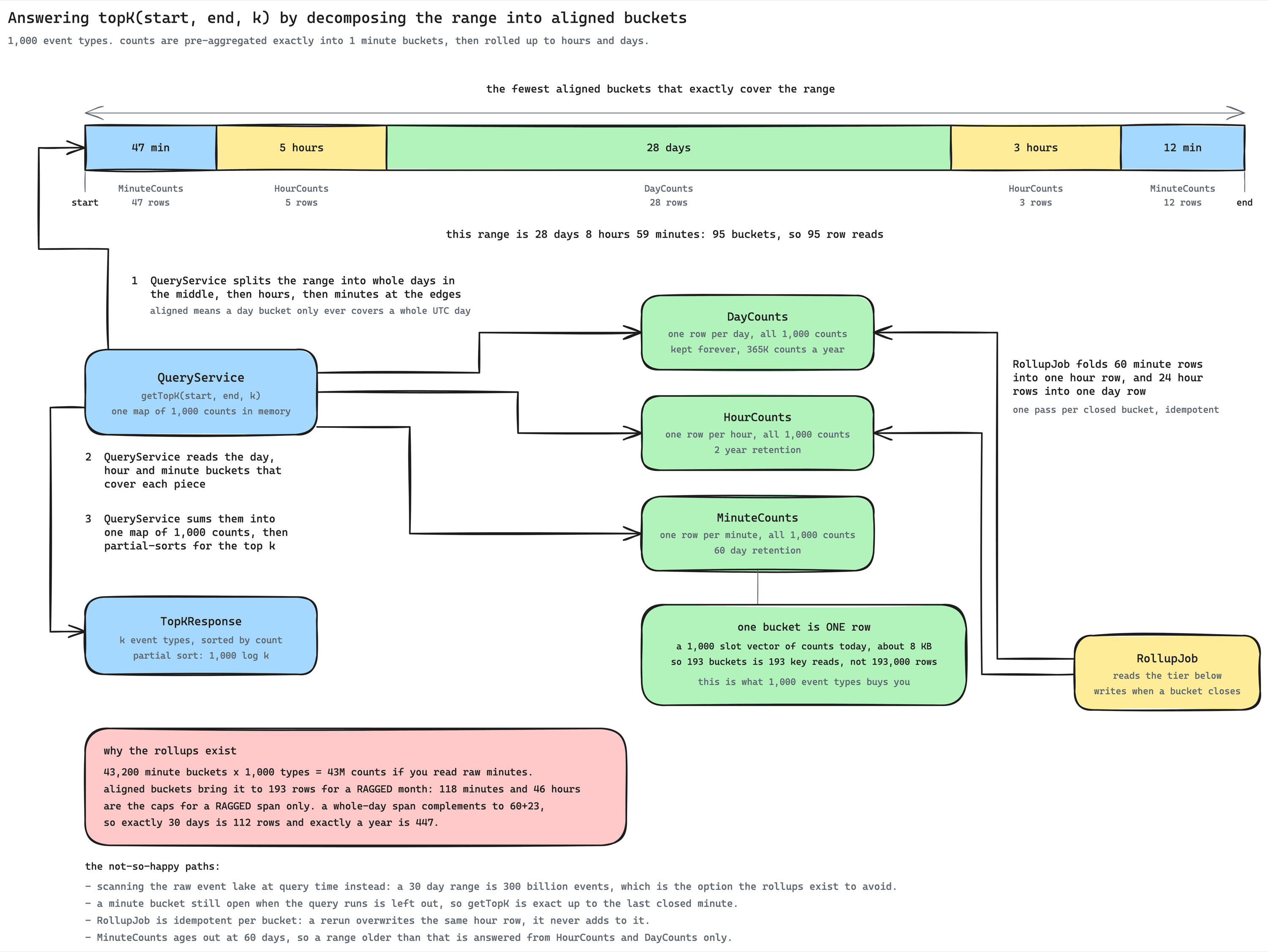
- Three tiers of the same shape: minute, hour, day.
- A rollup job folds 60 settled minutes into an hour and 24 settled hours into a day. It reads only buckets past the 15-minute lateness window, and reruns for any bucket a later restatement dirties.
- Retention differs per tier because size differs wildly: minutes for 60 days, hours for 2 years, days forever at 365,000 counts a year.
- Say what retention does to the query, because it is not free: a range older than 60 days has no minute rows for its ragged edges, so it degrades to whole hours, and past 2 years to whole days. That is a fine answer, but it has to be said rather than discovered.
- The query decomposes the range into the fewest aligned buckets that exactly cover it.
- Whole days in the middle, hours at the shoulders, minutes at the two ragged edges.
- Say whose day, because "aligned" is meaningless without it and nobody asks until it is wrong. Buckets are UTC-aligned, which is what makes "24 hours folds into a day" true all year.
- Align to a local calendar instead and the rollup breaks twice a year: a US Eastern local day is 23 hours in March and 25 in November, so a 24-hour fold undercounts one and double-counts the other, permanently, because the sink overwrites.
- The cost of UTC is paid at the product edge: a caller wanting local "yesterday" gets 24 hour buckets instead of 1 day bucket, and a half-hour zone such as India or Nepal can never use the day tier at all. Exact and bounded either way, so it is a product decision, not a correctness one.
- The edges are bounded by the calendar: at most 118 minute buckets and 46 hour buckets, no matter how long the range is. Those two terms never grow.
- The day term does grow, so do not oversell the bound. An arbitrary range up to a month is about 193 reads, up to a year about 528.
- Say which range you mean, because a whole-day-aligned one is much cheaper and the difference is not obvious. If the span is an exact multiple of a day, the two edges complement: the minutes sum to 60 and the hours to 23, not 118 and 46. So exactly 30 days is at most 112 reads and exactly 365 days is at most 447. The caps apply to ragged spans, not to "yesterday" or "the last 30 days".
- Retention pulls the real ceiling down further. A year-long range has no minute rows at its old edge, since minutes age out at 60 days, so that edge degrades to hours and the reachable worst case is about 469 rather than 528.
- If a year has to look like a week, add a month tier and a year tier, but do the edge arithmetic before promising a bound: the fixed overhead becomes 118 minutes + 46 hours + 60 days + 22 months = 246 buckets before a single year bucket, so a decade is about 255 and a century about 345. The ladder helps, it does not flatten.
- Each bucket is one key read, because a bucket is one row holding all 1,000 counts.
- So a ragged month-long query is about 193 reads of 8 KB, roughly 1.5 MB moved, rather than 193,000 row reads. A day-aligned 30-day query is 112 reads. A year is about 469 in practice, under 4 MB either way.
- Compare the naive version honestly: a 30-day range read as raw minutes is 43,200 buckets holding 43 million counts to add up, and 43 million row reads as well if each type is stored as its own row. Scanning the raw lake instead is 300 billion events.
- Constrain the input, because the decomposition silently rounds. The finest bucket is a minute, so a 30-second range would be answered with a whole minute and the caller would never know. Snap
startandendto minute boundaries and say so in the response, or reject anything finer with a 400. Do not let the API accept a precision it cannot honour. - Then it is arithmetic, not a database problem. Sum the vectors elementwise into one 1,000-entry array, and take the top k with a partial selection. At 1,000 entries a full sort is also fine, and saying "I would just sort a thousand numbers" is a better answer than reciting a heap.
- Cache aggressively, but define "closed" as past the 24-hour backfill horizon, not merely past the window.
- A bucket can still be rewritten by allowed lateness for 15 minutes, and again by the nightly backfill. "Immutable once the window shuts" is the trap.
- So the cache key is
(granularity, bucketStart, revision), and a restatement bumps the revision, which evicts by construction rather than by invalidation message. - That key is circular unless you add one thing, and the omission is easy to miss: you cannot build it without knowing the current revision, and reading the bucket to learn the revision is the read you were trying to avoid. So keep a separate revision manifest, one small row per day holding the revisions of the buckets under it. Without it the revision in the key is decorative and you are really just running a TTL. Count its cost honestly: it is one extra round trip before the batch, and one manifest row per day of range, so 30 for a month and 365 for a year on top of the bucket reads.
- Anything younger than the backfill horizon gets a short TTL. Anything older is cached indefinitely.
4) Erasing a user's data on request
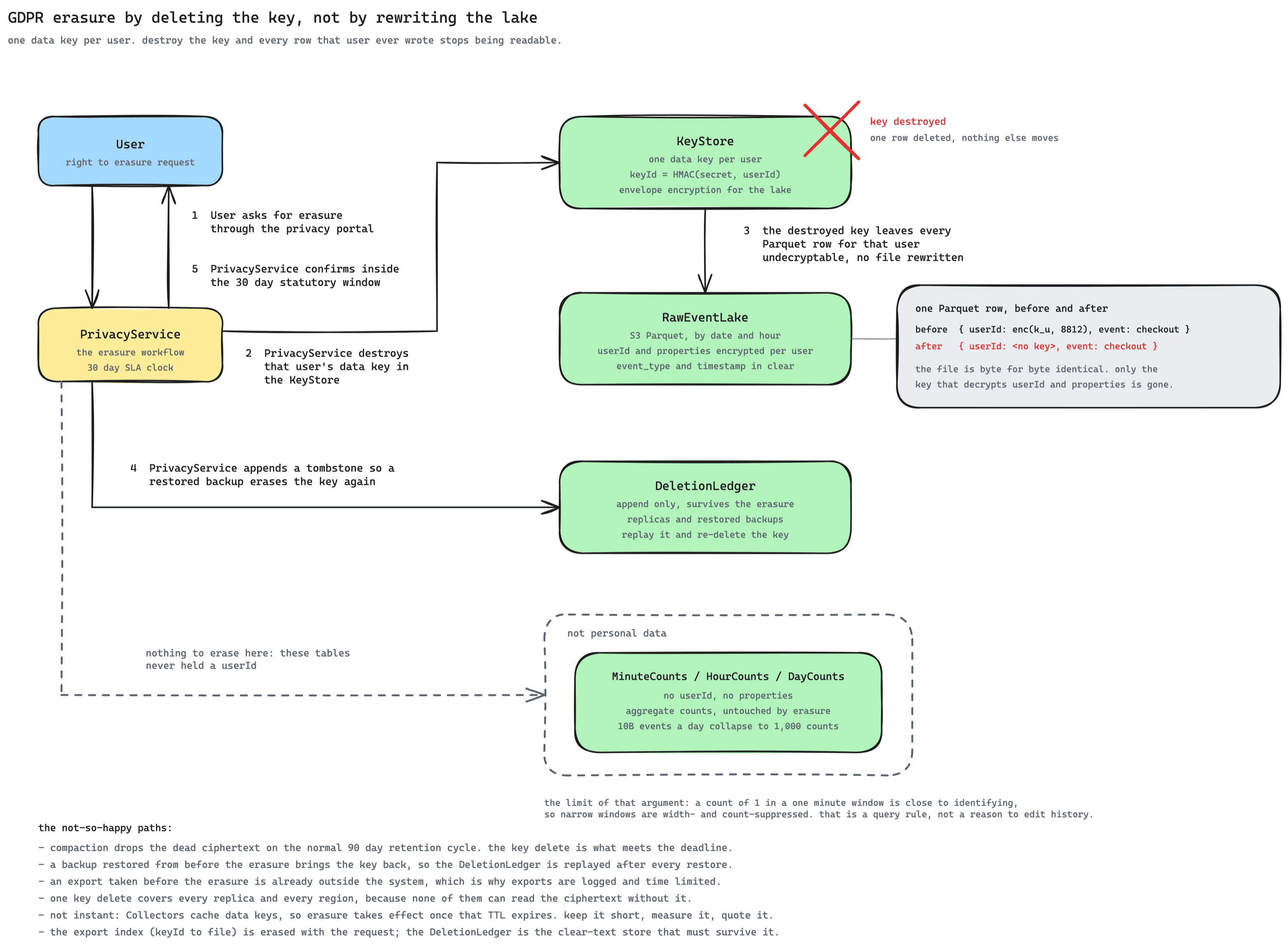
- Start by saying where personal data actually lives, and be exact, because "one place" is a claim people overreach on.
- The Collector encrypts
userIdand properties before the append, so the log and the lake both hold ciphertext and neither is readable without the key. That ordering is the whole trick and it is easy to get backwards. - The count vectors hold neither field, in any form.
- What is not ciphertext, and must be named: the deletion ledger, the export index, and the sampled unknown-type-name table, which is exactly where an identifier-shaped type name would land. The key store is keyed by an HMAC, so it holds no plaintext identifier.
- Two of those three are deletable by ordinary means; the ledger is not, and the distinction matters. The export index and the type-name sample go with the erasure request. The deletion ledger has to survive it: it is replayed after every restore and it is the audit trail a regulator asks for, so it stores the keyId and the timestamps, never the raw identifier or any event data.
- Inventory the whole field list, not just
userId, because a tracking event is full of personal data people forget: IP address, device id, session id and user agent are all personal data under GDPR. They go inside the encrypted blob with everything else, and saying the list out loud is what convinces a DPO you have actually looked. - Confining it deliberately is the design. A system that sprinkles
userIdinto six derived tables has six erasure problems.
- The Collector encrypts
- Deleting rows out of the lake is the obvious plan and it is not viable at this size.
- The lake is immutable Parquet, so "delete one user" means finding and rewriting every file that touched them, across 450 TB and 90 days.
- One active user's events can be spread over thousands of files, and you would repeat that work for every request.
- So encrypt per user at ingest and erase by destroying the key.
- Each user has a data key, wrapped by a KMS master key, standard envelope encryption. The Collector encrypts
userIdand properties with it before the row is ever written. - Two details decide whether this is real erasure or theatre, and they are the ones people skip.
- Use a random IV per row. Deterministic ciphertext would leave an identical token on every one of that user's rows, so after the key is destroyed you could still single out one person's entire behavioural trace, which is precisely what erasure is supposed to prevent.
- Derive the key id as an HMAC under a secret, not a bare
hash(userId). User ids are enumerable, so an unsalted hash is a rainbow table away from plaintext and is a reversible pseudonym rather than anonymisation.
eventTypeandeventTimestay in the clear, which is what lets replay, backfill and audit keep working after a mass erasure. It also means an erased user's events keep contributing to the counts, which is consistent with the aggregates argument below.- Erasure destroys that one key, which is a single small write. Every row for that user, in every file, in every replica and every region, becomes undecryptable, because none of them can read ciphertext without it.
- Not literally at the same instant, and the gap is worth owning: Collectors cache data keys, because a KMS call per event at 350K/sec is not a thing. Erasure is effective once the caches expire, so keep that TTL short, measure it, and quote it as the real number.
- The dead ciphertext is removed later by ordinary compaction on the 90-day retention cycle. The key delete is what meets the deadline, not the cleanup.
- The cost, which the 5 TB a day figure hides: per-user ciphertext is unique, so the widest column stops dictionary-compressing. That number is wire size, and this design gives up most of the compression a plain Parquet lake would get.
- Each user has a data key, wrapped by a KMS master key, standard envelope encryption. The Collector encrypts
- Write a tombstone to a deletion ledger, because backups come back.
- Restoring a snapshot from before the request would otherwise resurrect a live key, so the ledger is replayed after every restore.
- The backup that matters is the KEY STORE's, not the lake's. Restoring lake files changes nothing, since they are unreadable. Restoring the key store is the only event that can undo an erasure, which is the part usually missed.
- Export needs an index, and admitting that is better than pretending erasure and export are the same shape.
- Erasure is one key delete. Export has to FIND the rows, and encrypted
userIdis not searchable, so without help it is a 450 TB scan. - So the archive sink maintains a small index from the
keyIdto the files and row groups that user appears in. Export reads the index, decrypts, and assembles. - It has to be the keyId and not a fresh hash of the userId, for two reasons. The sink sits downstream of the log, where the identifier is already ciphertext, so a plaintext hash is not available to it. And a bare hash of an enumerable id is the reversible pseudonym ruled out above. So the
keyId, which is already an HMAC under a secret, travels in the clear on the row and is the join key. - It is a second store keyed by a pseudonymous id, so it is in scope too and the same request deletes its entries. Say it out loud, because "personal data lives in exactly one store" is the tidy claim candidates leave standing here, and the export index is what makes it false.
- Erasure is one key delete. Export has to FIND the rows, and encrypted
- The aggregates are untouched, and you should defend that rather than apologise for it. A count with no identifier is not personal data, cannot be re-identified at any useful aggregation width, and removing one user's contribution to "page_view: 8,400,000" is neither required nor meaningful. The second of the three short dives covers where that argument runs out.
Potential deep dives
~20 min, interviewer steers1) How is topK fast for any range, from a minute to a year?
- Group by
eventTypeover the range and sort.- A 30-day range is 300 billion rows. Even at a fantasy 10 GB/sec of scan this is hours, and it burns the entire cluster for one dashboard load.
- It also scales with traffic rather than with the question, which is backwards: the answer is 1,000 numbers regardless of whether ten billion or ten trillion events went into it.
- This is the right instinct and it fixes the common case. A one-hour query is 60 buckets and it is instant.
- But cost is now linear in the range: 43,200 buckets for 30 days, 525,600 for a year.
- If each bucket is also stored as 1,000 separate rows, that is 43 million rows read for a month, and the p99 requirement is gone.
- The failure is quiet, which is worse: the demo is fast and the quarterly report times out.
- Roll up minute into hour into day, with each tier written only from settled data below it.
- Decompose the range into the fewest aligned buckets that cover it exactly.
- Ragged minutes at the two edges, whole hours next, whole days in the middle. It is the same idea as a segment tree, but the tree is the calendar so there is nothing to build.
- The edge terms are bounded and tight: at most 59 + 59 minutes and at most 23 + 23 hours, both achievable at once with a range like 00:01 to 23:59 of a later day.
- The day term is linear, so state the real numbers, and state which range they describe. A ragged span up to a month is about 193 reads and up to a year about 528. Every one is a point read on a key you computed without touching the database, so after the manifest lookup they issue as one parallel batch, not 500 serial round trips.
- A whole-day-aligned span is much cheaper, because the edges complement: minutes sum to 60 and hours to 23 rather than hitting 118 and 46 independently. Exactly 30 days is at most 112 reads, exactly 365 days at most 447. "The last 30 days" is the aligned case, so quoting 193 for it overstates by 70 percent.
- If a flatter bound is required, extend the ladder, but do not overclaim what it buys. Adding month and year tiers raises the fixed edge overhead to 118 minutes + 46 hours + 60 days + 22 months = 246 buckets before any year bucket at all, so a decade is about 255 and a century about 345. It flattens the slope; it does not remove it.
- The reason the ladder still helps is the same reason the first three tiers did: a month rung is 12 rows a year and a year rung is 1, and each turns a linear term into a constant one.
- Store a bucket as one row: a slot vector indexed by
typeId, 1,000 slots wide today.- About 193 key reads of 8 KB for a ragged month, roughly 1.5 MB, comfortably inside 100 ms when issued in parallel. 112 reads if the range is day-aligned. A year is about 469 once retention is accounted for, under 4 MB.
- Fixed slots mean a new type appends a slot and a retired type keeps its own forever. Never renumber, or every historical vector silently means something different.
- Sum elementwise into 1,000 counters, then partial-sort for k. With 1,000 entries the selection algorithm genuinely does not matter, and claiming a heap is essential here would be theatre.
- Cache by
(granularity, bucketStart, revision), with the revisions themselves read from a small per-day manifest so the key is not circular. Past the backfill horizon a bucket changes only through an explicit restatement, which bumps the revision and so evicts itself from this key; anything younger gets a short TTL, because dive 4 can still rewrite it.
2) One event type is 40 percent of the traffic. Where does that melt?
- It looks natural, because the counting is per type, so the data "should" be grouped that way.
- One partition then takes 140K events/sec, about 70 MB/sec, and more to the point exactly one consumer task has to deserialize and count all of it.
- One consumer task owns it, and no amount of scaling out helps: adding tasks cannot split a single key.
- It also caps parallelism at 1,000 forever, and the useful parallelism is far lower because the distribution is Zipf.
- Key by
(eventType, random 0..15), then sum the 16 partials in a second stage. This does work, and it is the standard answer.- The salt factor is a magic number chosen ahead of time: 16 is far too much for a rare type and not enough if one type reaches 80 percent.
- Every raw event still crosses the shuffle. You have fixed the hotspot and paid full network cost for it, roughly 175 MB/sec.
- Be fair about the comparison, because a good interviewer will be: a real salted pipeline usually pre-aggregates too, and then it is close to the Great answer. The thing that matters is the local pre-aggregate, not salt versus task index. What the task index adds is that there is no fan-out constant to pick.
- Stage one does not key at all. Each task counts its own slice into a local map of at most 1,000 counters for the current minute.
- Skew is irrelevant, because tasks are fed by
hash(eventId), which is uniform by construction. Every task sees roughly the same volume no matter how lopsided the types are.
- Skew is irrelevant, because tasks are fed by
- Stage two keys by
eventType, but only partials cross the shuffle.- Stage two REPLACES per task, it does not blindly add. When allowed lateness reopens a minute, stage one re-emits a partial for a window it already reported, and a stage that simply summed arrivals would add the restated partial on top of the original. So its state is keyed by
(eventType, minute, taskIndex)holding the latest partial per task, and the emitted count is the sum over tasks of those latest values. - At most 3,300 partials/sec instead of 350,000 events/sec, and fewer in practice because Zipf means most tasks do not see all 1,000 types in a given minute.
- That is roughly 100x fewer messages, and far more in bytes: a partial is a typeId and a count, order of 16 bytes, against a 500-byte event.
- The hottest second-stage key gets 200 messages a minute.
- No fan-out constant to tune: parallelism is the fan-out, so it adapts when the job is resized.
- Stage two REPLACES per task, it does not blindly add. When allowed lateness reopens a minute, stage one re-emits a partial for a window it already reported, and a stage that simply summed arrivals would add the restated partial on top of the original. So its state is keyed by
- Say what it costs, because everything does: counts only materialise at window close, so the pipeline is minute-granular by construction. If someone wanted per-second freshness, shorten the window and pay in partial volume. That is the actual dial.
- Guard the input side too: the log is partitioned by
hash(eventId), so no producer-side key can create a hot partition even if a single tenant sends everything.
3) At-least-once delivery, exactly-once counts
- Every retried batch, every consumer rebalance, every checkpoint restore adds the same events again.
- The error is silent, permanent, and always in the same direction: counts only ever drift upward.
- There is no way to detect it after the fact, because the correct number was never written down anywhere.
- Check every
eventIdagainst a set before counting it. Correct in principle.- The set is unbounded: 10 billion ids a day, 900 billion at 90 days.
- It puts a remote lookup in front of every one of 350K events/sec, which is now the slowest thing in the pipeline and a new hard dependency.
- A Bloom filter shrinks it but false positives silently drop real events, which trades an overcount for an undercount.
- The sink writes a value, not a delta, and it writes the WHOLE bucket.
- After GlobalCombine there is a third stage that re-keys by window, so one task assembles the full 1,000-slot vector for a minute and does one atomic put: "the vector for
minute Mis V". - Per-type writes would defeat the whole idea. 1,000 keyed results writing into one shared row is 1,000 read-modify-writes, and read-modify-write is precisely the non-idempotent operation this design exists to avoid.
- Replaying a window then rewrites the same row with the same vector. Applying it twice is a no-op, and no distributed transaction is required.
- Fence it with a monotonic revision, conditional on the stored one, because the streaming restatement and the nightly backfill both write this bucket and arrival order is not correctness order. Backfill revisions sort above streaming ones so the recomputation wins.
- This is also why stage two aggregates a window and emits once, rather than streaming increments out as it goes.
- After GlobalCombine there is a third stage that re-keys by window, so one task assembles the full 1,000-slot vector for a minute and does one atomic put: "the vector for
- Bound the dedupe to the window, because that is where almost every duplicate is.
- An SDK retry lands within seconds, so the duplicate is inside the same minute as the original in essentially every case.
- Each task keeps the
eventIds it has seen for the window, in local memory, with no remote call. - The reason a LOCAL set is sufficient is
hash(eventId)partitioning, and this is the second job that choice is doing. A retry carries the sameeventId, so it lands in the same partition and therefore the same task as the original. Partition any other way and a local set catches nothing. - Size it, since everything else on this page is sized: 350K/sec over 200 tasks is about 105K ids per task per minute, order of 5 MB of task state, and roughly 75 MB if you hold it across the full lateness window.
- Two preconditions that are easy to state and easy to forget.
- Colocation only holds while the partition count is fixed, because it is
hash(eventId) mod partitions. Adding partitions remaps nearly every key, so do it during a quiet window and accept that in-flight retries can double count across the change. - The set has to be checkpointed operator state, not a bare local map, or a rescale mid-window drops it and the duplicates it was holding back get through.
- Colocation only holds while the partition count is fixed, because it is
- Then name the leaks, all of them, because "exactly once" is a claim that invites exactly this question.
- A retry straddling a window boundary is counted once in each minute. Acceptable at analytics precision.
- A duplicate arriving during the 15-minute lateness window is counted into the restated total if the dedupe set was dropped at window close. Holding the set for the lateness period is the fix, and it costs the 75 MB above.
- The backfill path has no dedupe at all, and it is the dangerous one: the lake is written by an at-least-once consumer, so it contains duplicates, and because the sink overwrites, a wrong backfill number becomes the permanent value. The backfill must dedupe by
eventIdover the hour it is rebuilding, which is affordable precisely because it is batch.
- Checkpoint the source offsets with the window state, so a restart resumes from a consistent point instead of an arbitrary one. The framework provides this; the overwrite sink is what makes it sufficient.
- Determinism is the real precondition, and it is weaker than it first looks.
- Bucket ASSIGNMENT is deterministic:
eventTimetravels in the event, so a replayed event always lands in the window it landed in before. - Which events are ADMITTED is not deterministic. Watermark advance and lateness expiry depend on arrival order and wall clock, so a replay can admit an event the first run sent to the side output, or drop one it previously counted.
- So the honest claim is: identical given the same admitted set, and the lake plus the backfill is what makes the number eventually right regardless. That is the real correctness backstop, not the checkpoint.
- Bucket ASSIGNMENT is deterministic:
4) Late and out-of-order events
- Every problem in this dive disappears, and the product breaks instead.
- A mobile client that was offline for an hour dumps its buffer into the current minute, so a spike appears where nothing happened.
- "What happened between 9 and 10" is answered with events from 8, which is the wrong answer delivered confidently.
- Hold each minute open for a couple of minutes to let stragglers in, then close and write.
- Correct for the ordinary case, and it is what the watermark is.
- But anything later than the delay is now dropped, silently. Mobile buffering makes hour-late events routine, so this is not a rare tail.
- Trusting client clocks also lets a device with a wrong date write into a window from last year.
- Watermark of about two minutes closes the normal case, so a minute becomes readable about three minutes after it began: one minute of window plus the two-minute watermark.
- Allowed lateness of about 15 minutes restates a window in place when a straggler arrives. The overwrite sink is what makes restating safe: the window is recomputed and rewritten, not adjusted.
- Anything later goes to a side output, never to the floor.
- A batch backfill job re-reads the affected hours from the raw lake and rewrites those buckets, typically nightly.
- The lake is what makes this possible, which is the second time it has paid for itself.
- Rollups downstream of a restated minute must be recomputed too, so the rollup job is driven by a dirty-bucket marker rather than by a clock.
- Clamp client clocks at the Collector. Reject or pin
eventTimemore than a day in the future or more than 90 days old, which is the lake retention and therefore the oldest bucket a backfill could ever restate. Count the rejects as their own metric. Otherwise one broken device rewrites arbitrary history. - Expose it rather than hiding it, and define the flag against the backfill horizon rather than the window.
complete: falsewhenever the range touches anything younger than that horizon, which is the honest boundary because everything younger really can still move.- Pair it with
asOf, the max revision over every bucket read, so a caller can tell a restatement from a disagreement. A newest-bucket-onlyasOfwould miss exactly the case this dive is about. - The alternative is a dashboard that quietly contradicts itself between two refreshes, which destroys trust far more effectively than an honest flag ever does.
5) Event type handling and the cardinality attack
- The 1,000-type assumption is now an assumption about client behaviour, and every guarantee on this page rests on it.
- One release ships
"checkout_" + orderIdas a type name and cardinality goes to millions overnight. - The local pre-aggregate map is no longer 1,000 entries, so the tasks OOM. The bucket vector is no longer 8 KB. The query no longer sums 1,000 numbers.
- Say the shape of this out loud: it is not a slow degradation, it is the collapse of the one assumption the design is built on.
- One release ships
- Types must be registered before use, and the Collector rejects the rest. This does protect the invariant.
- But rejection loses data that was genuinely emitted, and the client learns about it from a log nobody reads.
- Registration becomes a ticket to another team, so people work around it by overloading an existing type, and now the data is wrong in a way that is much harder to see.
- Registration is an API call, not a deploy and not a ticket.
POST /v1/event-typesreturns the nexttypeId. The registry is small and cached in every process with a short refresh. typeIdis assigned once and never reused.- Deprecating a type marks it inactive and keeps its slot. Reusing slot 42 would make every historical vector silently mean something else, and nothing would ever surface the error.
- The vector is sized to the registry high-water mark, not to the count of currently active types.
- Unknown types go to a reserved overflow slot rather than to the floor. It sits alongside the 1,000 registered types rather than taking one of their slots, so the vector is really 1,001 wide and still about 8 KB.
- The invariant holds because
__otheris one slot no matter how many distinct unknown names arrive. - The traffic is still visible, so a team that shipped before registering sees their volume rather than silence.
- Sample the distinct unknown names into a side table, capped, so the on-call can see what is arriving without storing millions of strings.
- Alert on the overflow slot: a jump there is the early warning for both a bad release and an attack.
- The invariant holds because
- Quota per writing key on distinct new types per hour, so a single compromised or buggy client cannot exhaust the registry. This is the actual defence against a deliberate cardinality attack, and it belongs at the public write endpoint where the untrusted input arrives.
- Cap the registry outright as well, because a rate limit only slows growth. The 8 KB row is today's figure and it scales linearly with the high-water mark, so put a hard ceiling on it (say 4,000 slots), alert well before it, and make crossing it a deliberate decision rather than a slow surprise.
Three more dives, briefly
- Replication and partitioning, per store, because the answer is different for each.
- Log: RF 3,
acks=all,min.insync.replicas=2, spread across availability zones. It tolerates one broker loss with no acknowledged write lost, and rejects writes rather than accepting unreplicated ones when two are down. - Counts store: partition by
bucketStartso it is time-ordered and retention is a partition drop rather than a mass delete. The whole thing is small, so replicate it fully to every region and serve reads locally.- Full replication is only affordable because of the cardinality number. Worth saying, since it is the third distinct thing that number bought.
- Raw lake: partitioned by date and hour, which is what makes a backfill read one hour instead of the whole lake. Cross-region replication for durability, and the object store handles the redundancy inside a region.
- Multi-region ingest: write to the local region and replicate asynchronously, because a tracking event must never wait on a cross-ocean round trip. Aggregate per region, then sum the regional vectors: they are 8 KB each, so the global rollup is trivial.
- Do the merge once, in a job, not per query. Summing regional vectors at read time multiplies every query's read count by the number of regions. A merge job writes a global bucket whose revision advances only when every region has reported, so the query path stays single-tier.
- That gives the honest cost: a global number lags the slowest region, and a region that is down leaves the global bucket incomplete rather than silently short.
complete: falseis doing the work here too.
- Log: RF 3,
- The privacy edge case that the "aggregates are anonymous" argument does not cover.
- A count of 1 for a rare type in a one-minute window is close to identifying a single person, especially combined with anything else the caller knows.
- Suppress or widen: refuse ranges under a minimum width, or drop entries below a minimum count, for any caller without a legitimate reason to see raw precision.
- Also enforce purpose limitation and consent at ingest: if a user has not consented to analytics, the event should not be written, which is cheaper and safer than erasing it later.
- Data residency is a partitioning question in disguise: EU events stay in EU storage, so the regional aggregation above is doing double duty.
- What changes at 100x cardinality, which is the most likely follow-up of all.
- If the key becomes a URL or a productId, 1,000 becomes 10^8 and the vector, the local map, and the full-scan sum all die together.
- Then you split: keep exact counts for a tracked head of a few thousand known-hot keys, and a Count-Min Sketch or Space-Saving summary for the tail.
- Top-k over sketches is approximate and, importantly, is not mergeable across buckets without error accumulating, so the rollup design changes too.
- The reason to have this ready is that it shows the exact-counts choice was a judgement about this problem, not the only tool you have.
How you would know it is wrong
- A design whose entire pitch is the word "exact" needs a number that goes red, and this is the thing most candidates never bring up.
- Reconcile, do not assume. A daily job recounts one hour straight from the lake and diffs it against the stored HourCounts. Any non-zero diff is a bug, not a rounding artefact, because both sides claim to be exact.
- Count at every stage boundary and require them to agree: accepted at the Collector, appended to the log, counted by the aggregator, archived to the lake. A gap between two adjacent counters localises the loss immediately.
- Alarm on watermark lag and on a stuck rollup, since a bucket that is never written looks exactly like a quiet minute.
- Alarm on the
__otherslot, which is the early warning for both a bad release and a cardinality attack. - Track the conditional-put rejection rate. It should be near zero; a spike means two writers are fighting over the same bucket.
- Because a sketch solves high cardinality, and there are only 1,000 event types.
- A full minute of the entire firehose is 1,000 counters, about 8 KB, so a whole minute of exact state is one small array.
- Exact is strictly better when it is affordable: no error bounds to explain, and the counts are mergeable across buckets without error accumulating, which is what makes the rollup tiers work at all.
- The volume, 10B a day, sizes the raw storage and the ingest pipeline. It has nothing to do with the size of the counting state, and conflating the two is the trap in the question.
- What would change my answer: if the key were a URL, a productId, or a userId. Then it is a tracked head of exact counts plus a sketch for the tail.
- It melts at any keyBy on eventType: 140K events/sec, about 70 MB/sec, onto one task, and adding tasks cannot split a single key.
- First, do not create it upstream: the log is partitioned by hash(eventId), so ingest is uniform by construction.
- Then local-global aggregation. Stage one keeps a local map of at most 1,000 counters per task with no keyBy, so skew is irrelevant.
- Stage two keys by eventType, but only per-window partials cross the shuffle: about 3,300 a second instead of 350,000 events a second.
- The task index is doing the job a random salt usually does, without having to pick a fan-out constant that is wrong for both the hottest and the rarest type.
- The cost is that counts only materialise at window close, so freshness is minute-granular by construction.
- Because the sink overwrites rather than increments, and it overwrites a WHOLE bucket: a third stage re-keys by window so one task puts the full 1,000-slot vector for that minute in one atomic write. Applying it twice is a no-op.
- Per-type writes would have broken it: 1,000 keyed results writing into one shared row is 1,000 read-modify-writes, which is the non-idempotent operation the whole design avoids.
- The put is fenced on a monotonic revision, because the streaming restatement and the nightly backfill both write this bucket and arrival order is not correctness order. Without the fence a late straggler makes the worse number permanent.
- Recomputing a window is deterministic because events are assigned by eventTime, which is carried in the event, not by arrival order.
- Source offsets are checkpointed with the window state, so the replay boundary is consistent rather than arbitrary.
- Within the window each task holds the eventIds it has seen, in local memory, which catches SDK retries. That works only because hash(eventId) partitioning puts a retry on the same task as the original.
- The honest gaps: a retry straddling a window boundary is counted in each minute, and the backfill path has to dedupe by eventId itself because the lake is written at-least-once and the sink overwrites.
- The Collector encrypts userId and properties BEFORE the append, so the stream and the lake both hold ciphertext only. The key store is keyed by an HMAC so it holds no plaintext identifier either; what is left is the deletion ledger, the export index, and the sampled unknown-type names.
- Erasure destroys that user's data key. Every row for them, in every file, replica, and backup, becomes undecryptable in one small write.
- Two details make it real erasure rather than theatre: a random IV per row, so no stable per-user token survives to single them out, and an HMAC under a secret for the key id, since a bare hash of an enumerable userId is a reversible pseudonym.
- Rewriting Parquet is not viable: 450 TB, and one active user is spread over thousands of files. Compaction drops the dead ciphertext later on the normal 90-day cycle.
- A tombstone goes in the deletion ledger, replayed on restore, so a backup from before the request cannot resurrect the key.
- The count vectors are untouched because they hold no identifier. Removing one person's contribution to "page_view: 8,400,000" is neither required nor meaningful.
- The gap to own: Collectors cache data keys, so erasure is effective once those caches expire, and it is the KEY STORE's backups, not the lake's, that can undo it.
- Export is the harder half: encrypted userId is not searchable, so the archive sink keeps a keyId-to-file index, which is itself in scope and erased by the same request. It keys on the HMAC keyId, not a fresh hash, because downstream of the log there is no plaintext userId left to hash.
- The limit of that argument: a count of 1 for a rare type in a one-minute window approaches identifying. That is handled by minimum-width and minimum-count suppression, not by editing history.
- Decompose into aligned buckets: ragged minutes at the two edges, whole hours at the shoulders, whole days in the middle.
- Careful: "the last 30 days" is a WHOLE-DAY-ALIGNED span, so the two edges complement. The minutes sum to 60 and the hours to 23, giving at most 60 + 23 + 29 = 112 reads.
- 118 and 46 are the caps for a RAGGED span of arbitrary length, which tops out near 193 for a month. Quoting 193 for an aligned 30-day query overstates it by 70 percent, and this is the pencil check an interviewer actually does.
- Each bucket is ONE row: a 1,000-slot vector indexed by typeId, about 8 KB. So 112 key reads, under a megabyte moved, not 112,000 row reads, and they issue as one parallel batch.
- Do not overclaim the bound: the minute and hour terms are capped and never grow, but the day term is linear, so a ragged year is about 528, and about 469 once you account for minute rows ageing out at 60 days. Month and year tiers flatten the slope but add 246 buckets of fixed edge overhead.
- Then sum 1,000-entry vectors elementwise and partial-sort for the top 10. At 1,000 entries a plain sort is fine.
- Past the backfill horizon a bucket only changes through an explicit restatement, which bumps the revision and evicts itself from a (granularity, bucketStart, revision) key. Anything younger gets a short TTL, because ordinary lateness can still restate it.
- For contrast: as raw minutes that is 43,200 buckets and 43M counts to sum, and off the raw lake it is 300 billion events.
Final design + what is expected at each level
wrapFinal Design
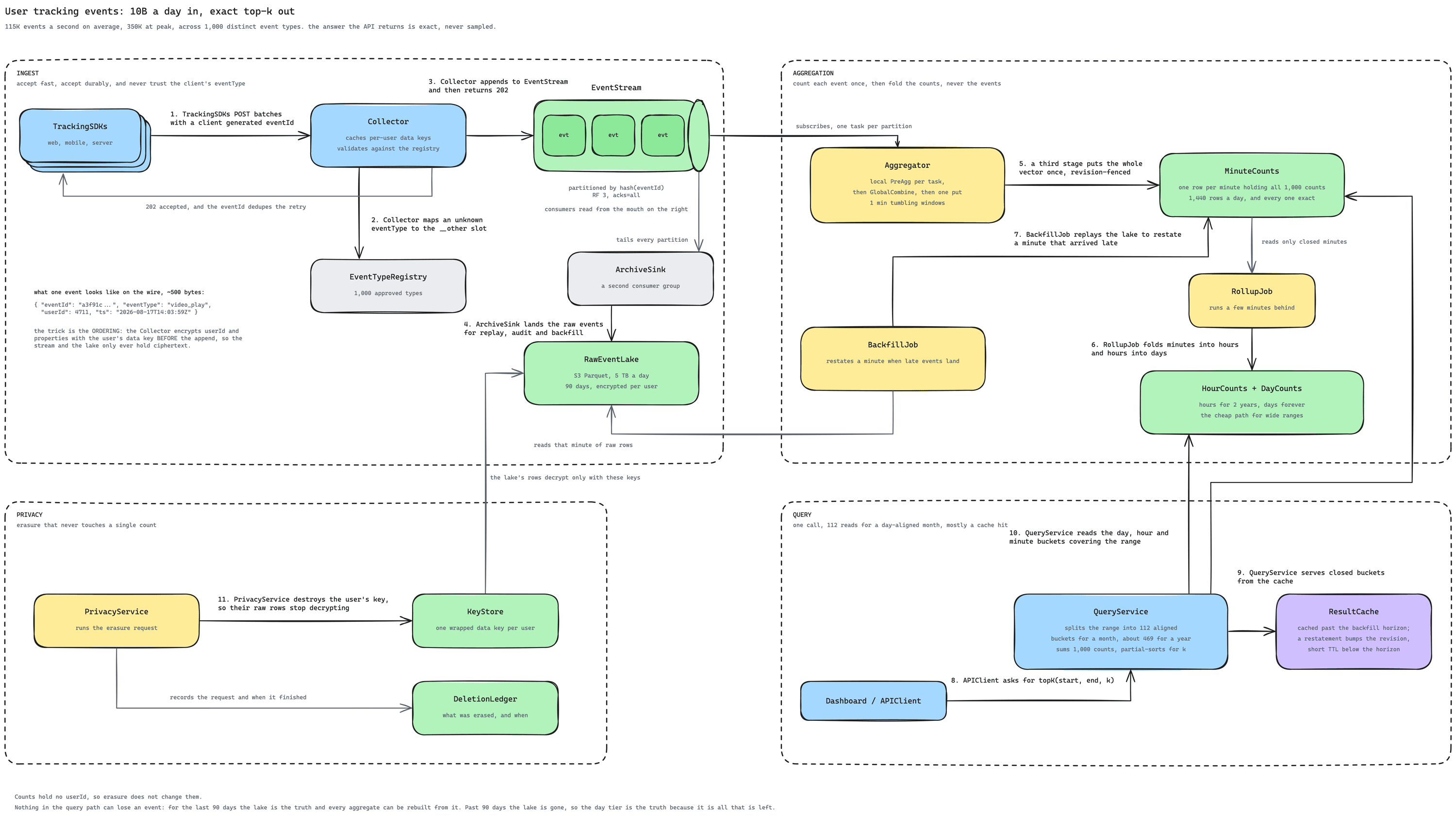
- SDKs batch events with a client-generated
eventIdand POST them to a Collector, which validates against the registry, encrypts the personal fields, and returns 202 only after a durable append. It is stateless apart from a short-TTL cache of per-user data keys. - The log is partitioned by
hash(eventId)with RF 3 andacks=all, so ingest cannot hot-spot and an ack means the event survives a broker loss. - Two independent consumers read it: an archive sink landing hourly Parquet in the raw lake, and the aggregator.
- The aggregator is local pre-aggregate then global combine over one-minute tumbling windows, and a third stage re-keys by window so one task does a single atomic put of the whole 1,000-slot vector, fenced on a monotonic revision.
- A rollup job folds settled minutes into hours and hours into days, and a backfill job restates buckets when late events land.
- The query service decomposes a range into aligned buckets, 112 for a day-aligned 30-day range and about 193 for a ragged one, reads one row per bucket in parallel, sums 1,000 counts, and partial-sorts for k, serving anything past the backfill horizon from cache.
- The privacy service holds per-user data keys and a deletion ledger, so erasure is a key destroy that never touches the aggregates.
- The invariant that makes the whole thing defensible, stated with its expiry date: for the last 90 days the lake is the truth and every aggregate is a derived view that can be rebuilt from it, so nothing in the counting or query path can permanently lose data.
- Past 90 days that invariant is gone, and it is worth saying before the interviewer says it. The lake ages out at 90 days while DayCounts is kept forever, so the old day tier is unrebuildable and unauditable: it is the truth because it is all that is left. If that is unacceptable, the fix is to keep a compacted per-day archive alongside it, which is small, rather than to keep 5 TB a day forever.
What is Expected at Each Level
- Mid
- Gets to a working pipeline: collector, queue, stream aggregation into per-minute counts, a query that sums buckets.
- Names a top-k selection and can implement it.
- Usually reaches for a sketch without first checking whether the cardinality needs one.
- Usually stores a row per type per bucket, and does not notice the read amplification that creates.
- Senior
- Does the cardinality arithmetic unprompted and concludes that exact counts are affordable.
- Identifies the hot event type and fixes it with two-stage aggregation.
- Builds the rollup tiers so a long range does not read every minute.
- Handles late events with a watermark rather than ignoring them.
- Separates at-least-once transport from idempotent counting, and says why they are two mechanisms.
- Staff
- Leads with the cardinality number and uses it as the reason for at least three separate decisions: exact counts, one row per bucket, and full replication of the counts store.
- Separates the two systems in the problem out loud, the cheap counting one and the expensive raw-storage one, and spends time proportional to that rather than to which one the question emphasised.
- Makes query cost independent of traffic, and is precise that it still grows slowly with the calendar rather than claiming a flat ceiling, including that a day-aligned range is much cheaper than a ragged one.
- Notices that "overwrite, do not increment" is only a mechanism once there is a single writer per bucket and a revision fence, and that the design has two writers.
- Brings up reconciliation unprompted, because a system that claims exactness owes you the number that would go red.
- Treats GDPR as an architecture constraint solved at ingest with crypto-shredding, not as a delete job bolted on afterwards, and can defend leaving the aggregates alone as well as name where that defence stops.
- Identifies the cardinality attack on the event-type registry as the thing that invalidates the whole design, and defends it with a stable typeId, an overflow slot, and a per-key quota.
- Names what the design does not do: no arbitrary group-bys, three-minute freshness with restatement after that, a straddling retry counted twice, and export needing an index that erasure does not.
Say the opening number out loud without notes: 1,000 types, 8 KB a minute, so the counts are exact and no sketch is needed.
Then draw the query decomposition from memory: minutes at the edges, hours at the shoulders, days in the middle, one row read per bucket. Caps: 118 minutes and 46 hours for a ragged span, but only 60 and 23 when the span is whole days, so "the last 30 days" is 112 reads and not 193.
Then write the six words that carry the deep dives: hash(eventId), local-global, whole-vector-put, revision-fence, watermark, crypto-shred.