Build a content delivery system for avatars and skins
"The question offers me a trade-off, faster delivery against cache invalidation complexity, and I want to refuse it, because that trade only exists if I choose mutable URLs. If an asset is named by the hash of its own bytes then a new version is a new URL, every edge can cache for a year, and there is nothing to invalidate. I still take that trade exactly once, on the small pointer that says which version is current, because it is the only object cheap enough to afford it. What that buys me is the freedom to spend the whole hour on the two problems it does not solve: user generated content has a fifty-million-item cold tail rather than a hot working set, and moderation still needs one asset gone from two hundred edges in sixty seconds."
Understanding the problem
5 minFunctional Requirements
- A client should fetch every asset it needs to draw an avatar, quickly, anywhere in the world.
- A creator should be able to publish a new version of an item, and players should get it.
- A moderator should be able to take an asset down, and it should stop being served everywhere within about a minute.
- It should work for the millions of items almost nobody requests, not only the popular ones.
Below the line (out of scope):
- The authoring and upload pipeline, and the format conversion behind it. I care that ingest produces immutable named blobs; how a mesh gets optimised is a different hour.
- The marketplace, pricing and the economy. Entitlement shows up once, in the API section, because it changes where authorisation lives, and then it goes away.
- Rendering, and the moderation DECISION itself. Classifying an asset as banned is a machine-learning problem; propagating that ban is a delivery problem, and only the second one is mine.
Non-Functional Requirements
- Do the shape of the catalogue first, because it is the opposite of what a CDN expects.
- 50M creator-made assets, averaging about 300 KB, is roughly 15 TB at origin. That is small. Storage is not the problem here.
- 20M daily users fetching about 200 DISTINCT assets a session is 4 billion requests a day: about 46,000 a second, call it 139,000 at peak with a 3x diurnal factor that is conservative for a globally spread player base.
- Say distinct, and say why, because the raw number is much larger. A single crowded scene naively wants 1,500 fetches (100 avatars times 15 assets). Almost all of that collapses: players share default bodies and popular items, and the client already holds most of it from earlier in the session. The 200 figure is the deduplicated working set, and the 1,500 is what you would fetch if you did none of the work in dive 5.
- At 300 KB that is 1.2 PB a day leaving the edge. So the catalogue is tiny and the traffic is enormous, which tells you immediately that this is a caching problem and not a storage problem.
- Then the distribution, which is what makes UGC different from a normal CDN workload.
- About ten thousand popular items are most of the traffic and will sit hot in every PoP.
- The other tens of millions are requested rarely, unpredictably, and from anywhere. A normal CDN assumes a hot working set; user generated content does not have one.
- That tail is a minority of requests and nearly all of the origin load, which is the number the design has to attack.
- Latency: p99 under about 100 ms, and notice immediately that this constrains the hit rate rather than being independent of it.
- At a 98 percent hit rate the 98th percentile fetch IS a miss, so p99 is an origin round trip and the target is unreachable. Holding p99 at the edge needs better than 99 percent, realistically 99.5 and up once shield misses are counted.
- The number that matters to a player is worse than the per-asset one, because an avatar is 15 assets: at 98 percent per asset, 26 percent of avatars contain at least one miss. At 99.5 percent it is 7 percent, at 99.9 percent it is 1.5.
- So hit rate is a latency argument before it is a cost argument, and that is the strongest case for the shield in the whole design.
- Cache hit rate: target 99.5 percent or better, and be precise about what it moves. The 1.2 PB a day going to clients is fixed by the product; hit rate does not change CLIENT egress. What it changes is origin fill and fleet size (24 TB a day at 98 percent, 6 TB at 99.5, 1.2 TB at 99.9), and the avatar-level miss rate above.
- Takedown propagation under about 60 seconds, globally. This directly contradicts caching for a year, and that contradiction is the most interesting thing on the page rather than an oversight.
- Publish visibility of seconds to a minute is fine. Creators tolerate a short delay; players never notice one.
- Graceful degradation: a failed asset fetch should render a placeholder, not block the scene. Availability here is about never blocking a frame, not about never missing bytes.
Entities + API
5 minDefining the Core Entities
- Asset is a blob of bytes named by their own hash:
contentHash, bytes, mime type. It is immutable by construction, because changing the bytes changes the name.- The server computes that hash, never the client, and this is a security property rather than a detail. If an uploader can declare the digest, they can store bytes under someone else's hash and poison a year-TTL entry in 200 PoPs, in a system whose whole design has no purge path. Ingest rehashes what it received and rejects a mismatch.
- This is the decision the whole design rests on, so say it in the entity list rather than saving it for a dive.
- Item is what a creator and a player think of as "a hat":
itemId, plus a pointer to the currentcontentHashand the history of previous ones. The item is mutable; the asset never is. - Variant is one rendition of an item for one target: a level of detail, a texture format, a platform. Each variant is its own asset with its own hash, because they are genuinely different bytes.
- Composite is a baked low-detail avatar, keyed by a hash of its INPUTS (the sorted component hashes plus LOD and format) because the output hash is unknown until after baking. That input-to-output mapping is the design's second mutable pointer, and it is listed here rather than discovered in a dive.
- Manifest is the mutable pointer: avatar id to a list of slot and content hash. In a session the client is PUSHED this by the session server; the HTTP object below is the cold-entry and out-of-session path.
- Size it rather than calling it small. Fifteen slots with full URLs and sha256 hashes is about 2 KB. Truncating the hash to 128 bits, still far beyond collision risk here, gets it to roughly 1.5 KB. Bare hashes with no URLs would reach about 600 bytes, but that hands URL construction back to the client, which the API section deliberately refuses. Either way it is cheap in bytes; none of them is 400.
- It changes whenever the player changes clothes, which is rare per player and constant in aggregate.
- DenyList is the set of banned content hashes. It is small and it is checked on every single request, which makes it a data-structure decision rather than a table. It is a SET rather than an append-only log, because bans get reversed on appeal and un-banning has to be as cheap as banning.
API or System Interface
WS   roster.push                     // session server -> client, the common path
                                     // { avatarId: [ { slot, url } ], ... } for the whole instance

GET  /v1/avatars/{userId}/manifest   // -> { slots: [ { slot, url } ] }, the fallback
                                     // Cache-Control: max-age=30

GET  /assets/{contentHash}.{ext}     // -> the bytes
                                     // Cache-Control: public, max-age=31536000, immutable

POST /v1/items/{itemId}/versions     // creator publishes -> { contentHash }
POST /v1/moderation/deny             // { contentHash } -> propagates to every PoP
- Two objects with deliberately opposite cache policies, and that contrast IS the architecture. One is about 2 KB and changes when a player changes clothes. The other is 300 KB, can never change, and is cached for a year. Giving both the same policy is the mistake the question is hinting at. The small one mostly does not travel over HTTP at all, which is the next step of the same argument.
- No ETag on the asset, because the URL is the version. Conditional requests exist to ask "has this changed", and the answer here is structurally always no.
- The manifest returns URLs, not ids. The client should never construct a URL, so the server can move assets, change variant selection or point at a different CDN without shipping a client.
- Publishing returns a hash, not a success flag. The creator's new version exists the moment the bytes are stored; making it visible is a separate, tiny write to the item pointer.
- Entitlement is enforced at the MANIFEST, never at the CDN, and be careful with the reason, because the obvious one is wrong.
- Signed URLs do NOT cost you cacheability: CDN token auth deliberately excludes the signature from the cache key, so the object still caches once for everyone entitled.
- The real reason is that the bytes are not the secret. Ownership is. A cosmetic asset leaks from the client the first time it renders, so signing adds key management and clock skew to protect something that is not protectable.
- That would change if the asset were genuinely confidential, and saying so is what makes it a decision rather than a habit.
High-level design
10 min, end to end, no dives yet1) Two objects with opposite rules
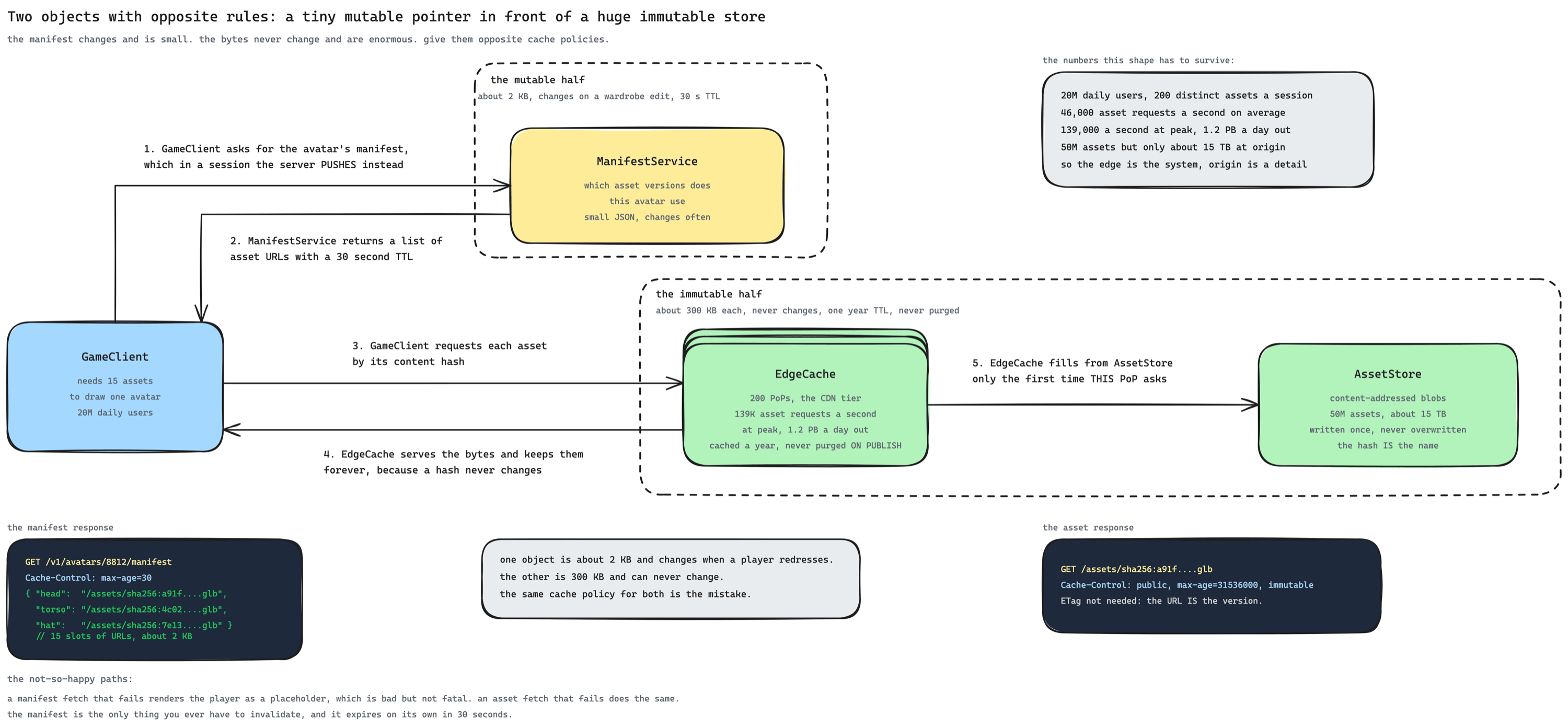
- There are exactly two kinds of object here, and separating them is most of the design: one small mutable pointer saying which versions are current, and many large immutable assets. How that pointer reaches the client is the next question, and the answer turns out not to be HTTP.
- The manifest is the only thing that ever needs to change quickly. About 2 KB with a 30 second TTL, so it expires on its own and nothing has to be purged.
- Now check that the cheap object is actually cheap, because the whole design rests on it and bytes are the wrong unit.
- Your own manifest, refreshed on a 30 second TTL across a 30 minute session, is about 14,000 requests a second at 20M daily users. Affordable, but already a third of the asset rate.
- Other players' manifests are the problem. A scene shows other avatars, and each one is a manifest. At a million concurrent players with 100 visible avatars on a 30 second TTL that is over 3 million requests a second, roughly seventy times the asset traffic the entire design is sized around.
- And it caches badly, which is the part that turns it from expensive into dangerous. A per-avatar key has about one reader, so a 30 second TTL buys almost no edge hits. Manifest misses, not asset misses, would become the dominant origin load.
- So the manifest does not travel over HTTP in the common case. The session server already knows the instance roster and already holds a socket to every client, so it pushes the hash list at spawn and pushes a delta when someone changes clothes. Avatar equipment is game state, and shipping game state over a CDN was the mistake.
- The CDN manifest object stays, for cold entry, for out-of-session views like a profile page, and as the fallback when the push path is unavailable. It is then a small fraction of that rate rather than all of it.
- The assets are cached for a year and served from the nearest PoP. A content hash can never point at different bytes, so there is no staleness to reason about at all.
- Failure is a placeholder, not an error dialogue. A missing asset renders as a default shape; the scene keeps running. That is what lets the whole path be aggressive about caching rather than defensive about correctness.
- The session server belongs in this picture, and it is the component most answers leave out. It already knows who is in the instance and already holds a socket to every client, so it is the natural transport for the roster of hashes and the natural trigger for pre-warming. Treating avatar equipment purely as a CDN object ignores the one service that already has the answer.
2) Content addressing, and refusing the trade-off
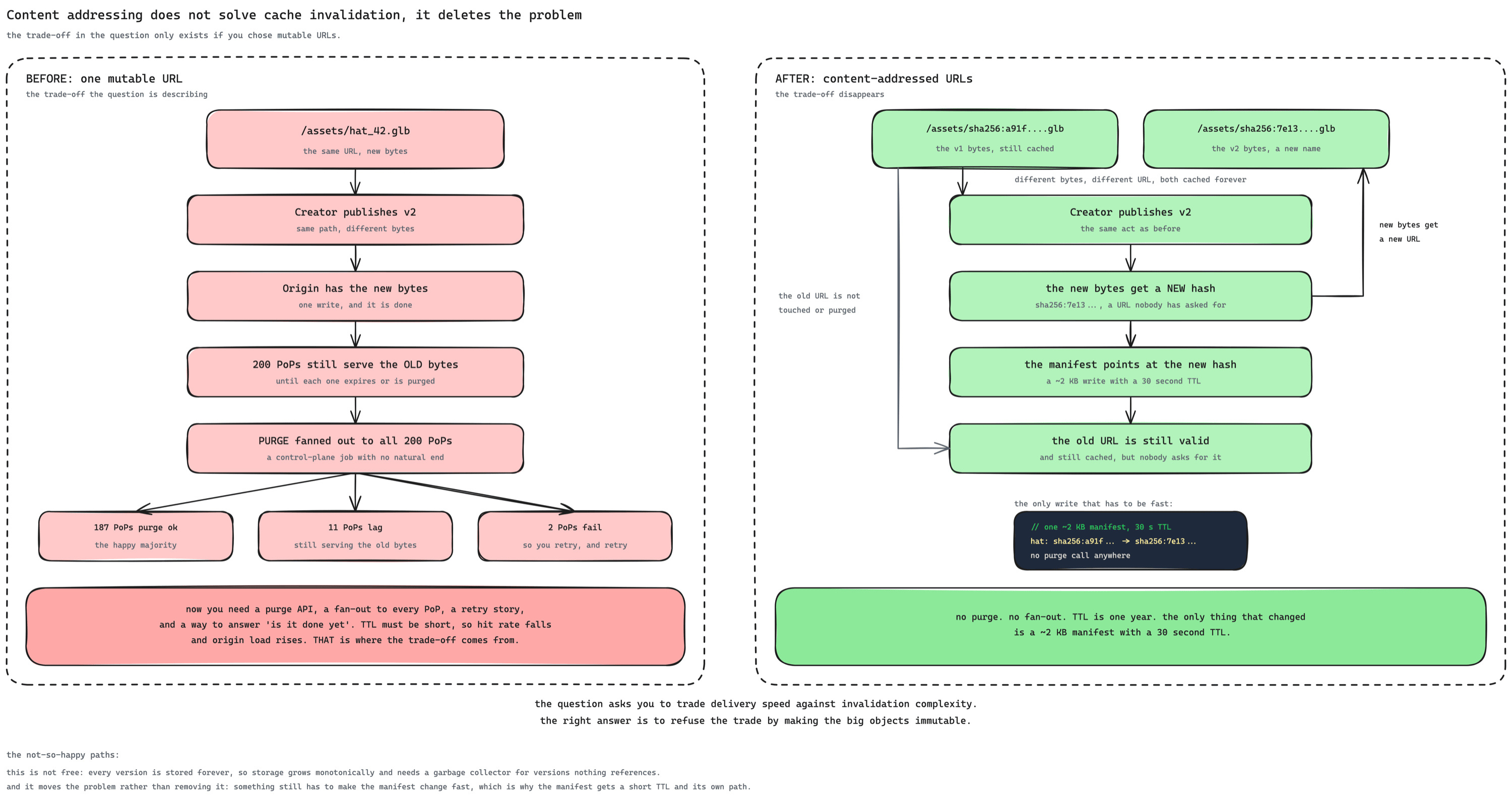
- Name the bytes by their hash and the invalidation problem stops existing. A new version is different bytes, so it is a different hash, so it is a different URL. The old URL is still valid and still cached; nobody asks for it any more.
- That is why the stated trade-off is a false one. "Faster delivery versus invalidation complexity" is the tension you get from mutable URLs, where a short TTL is the only way to bound staleness, and a short TTL is exactly what destroys hit rate.
- The mutability does not vanish, it gets confined, and "cheap" has to be earned in the right unit.
- In bytes it is obviously cheaper: about 2 KB against a 300 KB blob replicated to 200 PoPs.
- In REQUESTS it is not automatically cheaper at all, because a per-avatar object with a 30 second TTL barely caches. That is why the common-case transport is the session server rather than the CDN, and saying so is the difference between a slogan and a design.
- Say what it costs, because it is not free: every version is stored forever, so storage grows monotonically and needs a collector for versions nothing references any more.
3) The long tail, and tiered caching
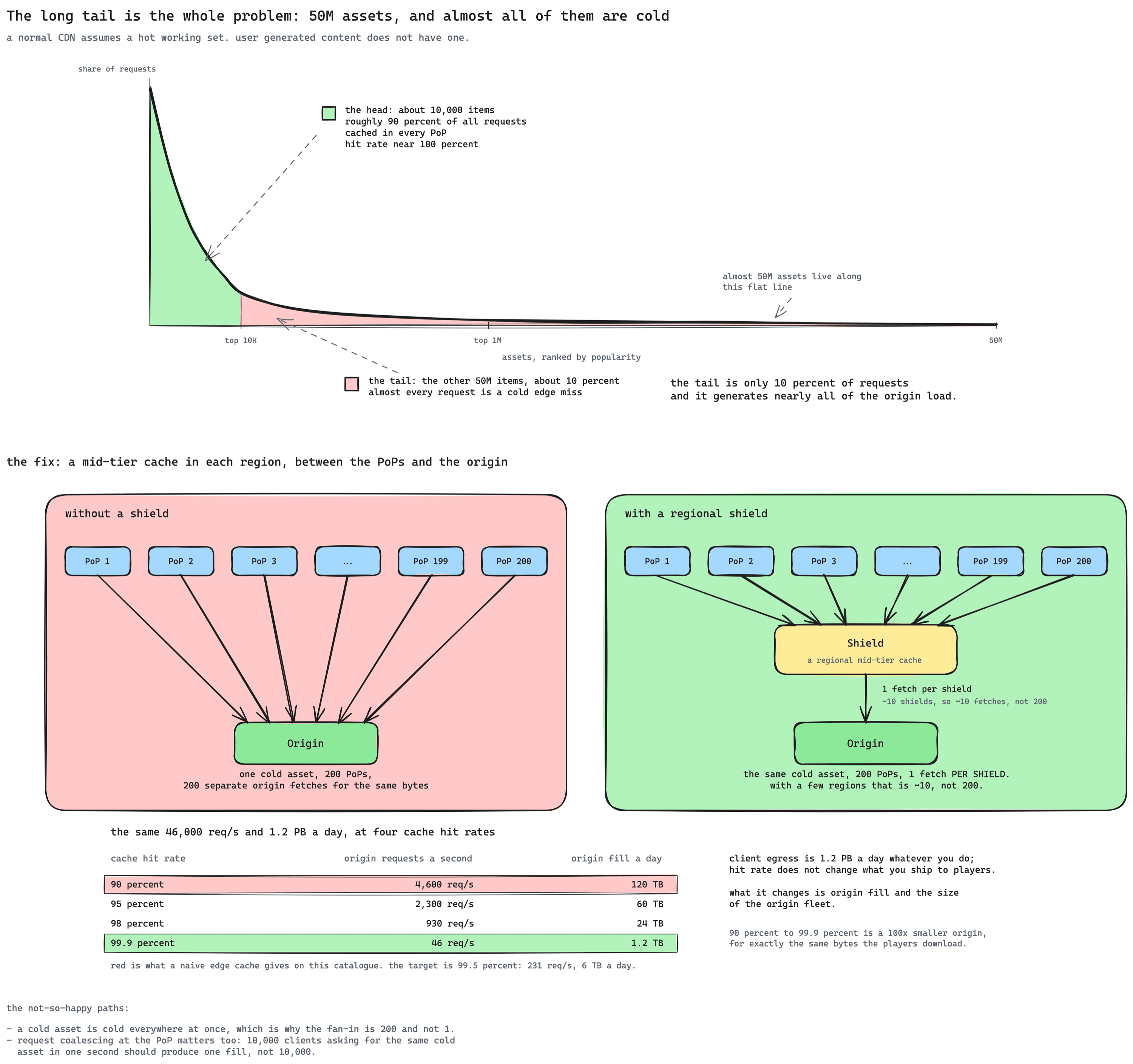
- The head takes care of itself. About ten thousand popular items sit hot in every PoP and serve at nearly 100 percent hit rate without anyone doing anything clever.
- The tail is the design problem, and its shape is specific: a cold asset is cold in all 200 PoPs at the same time, so one unlucky item can produce 200 independent origin fetches for exactly the same bytes.
- A regional shield collapses that fan-in, and say the real factor rather than the flattering one. Edges miss to a mid-tier instead of to origin, and each shield fills once for everyone behind it. With a handful of regional shields, 200 fetches becomes one per shield, so roughly 10, not 1. Still a 20x cut, and it is the honest number.
- Then claim the win the sizing actually supports: one rendition each is 15 TB and all twelve renditions are about 180 TB, so the whole catalogue fits inside every shield either way. The shield is not a hot-set cache, it is close to a full replica, and that is what makes the high hit-rate rows reachable rather than aspirational.
- A single global shield is the tempting shortcut and it is wrong twice: it is a single point of failure for all origin fill, and it puts a transcontinental hop in front of a 100 ms budget.
- The fan-in is also worse than 200, which is the detail that shows you have run one. A PoP is many cache nodes, so without consistent hashing inside the PoP you multiply by nodes per PoP. That intra-PoP layer is a real component, not a setting.
- Coalesce concurrent misses at the PoP as well. Ten thousand clients asking for the same cold asset in the same second should produce one fill, not ten thousand, and this is a per-PoP setting rather than an architecture.
- Be precise about what hit rate buys. The 1.2 PB a day going to players is fixed by the product. Hit rate moves origin fill and origin fleet size: 24 TB a day at 98 percent, 6 TB at the 99.5 target, 1.2 TB at 99.9.
4) Takedown, the one true invalidation
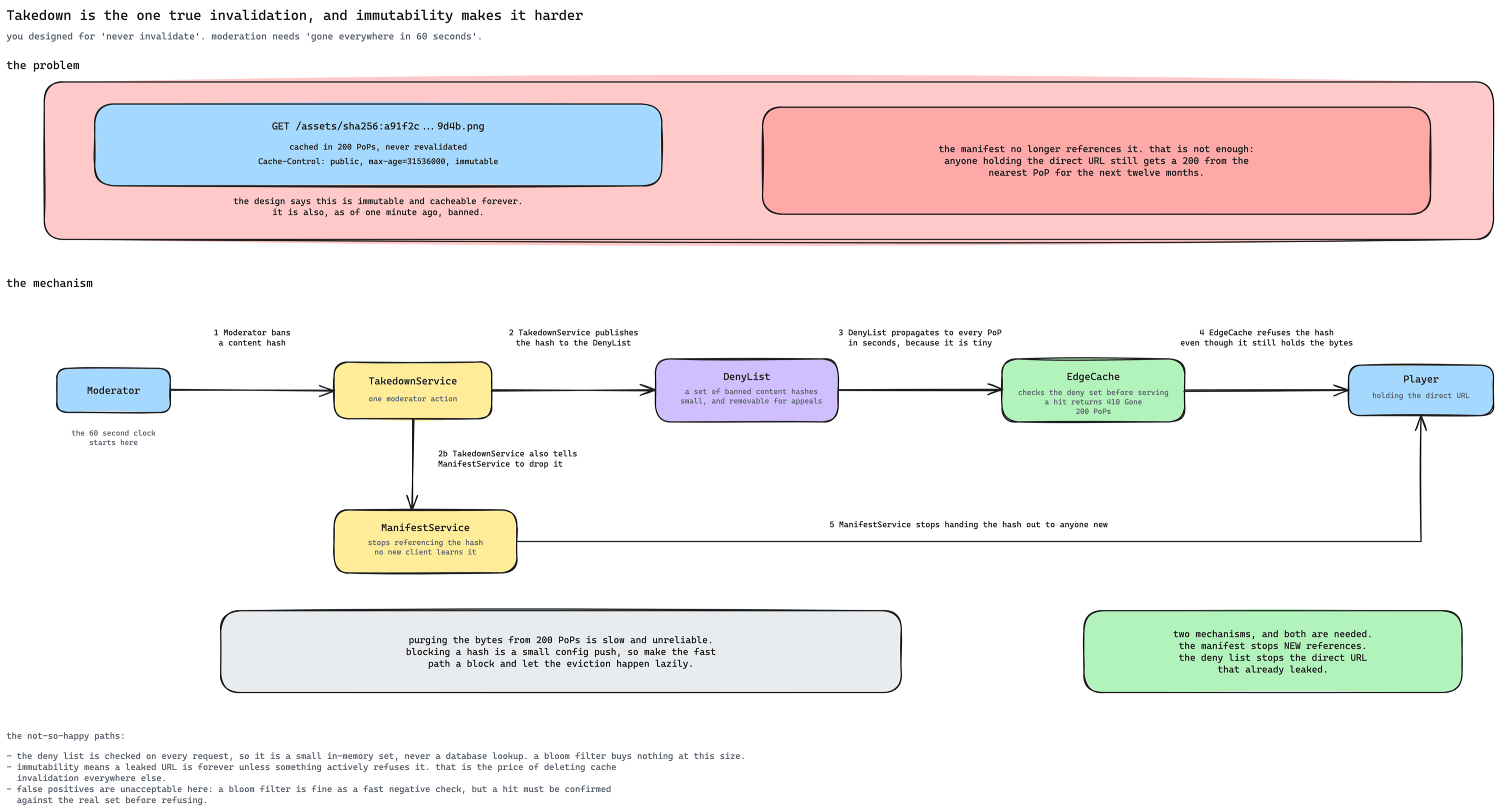
- Here is where the immutable design bites back, and it is worth walking into deliberately. Everything above says never invalidate. Moderation says this asset must be gone from 200 edges in under a minute.
- Removing it from the manifest is necessary and not sufficient. It stops new references, but anyone holding the direct URL keeps getting a 200 from their nearest PoP for the rest of the year.
- So the fast path is a REFUSAL, not a purge. A deny list of banned hashes is tiny, propagates to every PoP in seconds, and is checked before serving. Evicting the actual bytes can happen lazily afterwards.
- Both mechanisms are needed and they do different jobs: the manifest stops new references, the deny list stops the URL that already leaked.
- The check has to be cheap, because it runs on every request, and the sizing decides the mechanism.
- Ban a fraction of a percent of a 50M catalogue and you have hundreds of thousands of hashes. At 32 bytes each that is single-digit megabytes, which fits in memory at every PoP, so use the exact set.
- A bloom filter is ornamental here: where the exact set fits it buys nothing, and where it would help the confirming lookup becomes a network call on the request path.
- Name the propagation mechanism rather than saying "a config push". It is an edge key-value store or a config activation, and the products differ enough to matter: some cap at a few megabytes, and some document propagation up to 60 seconds, which spends the whole takedown budget before the decision has even landed.
- Decide the failure mode, because it is the most consequential policy here. A PoP without the current list either serves and alarms, or refuses and causes an outage. Pick one deliberately and write it down.
Potential deep dives
~20 min, interviewer steers1) The trade-off in the question, and why I will not take it
/assets/hat_42.glbkeeps its name and gets new bytes, and you call purge on publish.- Now you need a purge fan-out to 200 PoPs, a retry story for the ones that fail, and an answer to "is it done yet" that nobody can give you confidently.
- Because purge is unreliable you also shorten the TTL as a safety net, which lowers hit rate and raises origin load. That is precisely the trade-off the question describes, and you built it yourself.
- You have also made the system non-deterministic: two players in different regions can see different hats for an unbounded window.
/assets/hat_42.glb?v=7, bump the version on publish. This genuinely works and is what most sites do.- The weakness is that the version is metadata someone has to maintain, and it is easy to forget to bump, which produces a stale asset with no error anywhere.
- Some caches historically treated query strings inconsistently, which is a smaller problem now but still a reason to prefer the path.
- It also does not deduplicate: the same bytes uploaded by two creators are two cache entries and two origin objects.
- The URL contains the content hash, so the name and the bytes cannot disagree. You cannot forget to bump a version, because the version is derived rather than declared.
- Cache for a year, everywhere, with no purge path at all. The
immutabledirective also tells the browser not to revalidate on refresh, which removes a whole class of pointless conditional requests. - Deduplication is free. Two creators uploading identical bytes produce one object and one cache entry, which on a 50M item UGC catalogue with heavy template reuse is a real saving rather than a curiosity.
- Rollback is free too, and it is the part people miss: the previous version was never deleted, so reverting is a pointer write rather than a redeploy.
- The mutability moves rather than disappearing, and cheap has to be measured in requests, not bytes. The manifest is now the thing that changes fast. At about 2 KB it is trivially cheaper than a 300 KB blob in 200 places, but a per-avatar object with a 30 second TTL barely caches, so in a crowded scene it would outnumber the asset traffic. That is why the session server pushes the roster and the CDN object is the fallback.
- Name the two costs honestly: storage grows forever and needs a collector, and a URL that leaks is valid forever, which is what makes dive 4 necessary.
- And concede where a mutable URL is genuinely right, because that is the obvious counter-question.
- Anything a third party hotlinks: a profile picture in an embed, a shop listing image. There you want the address stable and the bytes to change, so content addressing forces a mutable redirector anyway.
- Clients you cannot update, where an old binary has a path compiled in and can never learn a new hash.
- The manifest itself, which IS a mutable URL bounded by a short TTL. So the accurate claim is not that the trade-off disappears, it is that I take it exactly once, on the one object small enough to afford it.
2) The cold tail, which is what UGC actually means
- Put a CDN in front of the origin and assume the hit rate will be fine.
- It is fine for the head and useless for the tail, and the tail is where the origin load comes from.
- Worse, a rarely requested asset gets evicted between requests, so the same item can miss repeatedly at the same PoP and look like a permanently cold object.
- Then every one of 200 PoPs independently discovers the same cold asset and independently asks origin for it.
- Cache for longer and buy more edge storage, so fewer things fall out. Correct as far as it goes, and content addressing already gives you the long TTL for free.
- But you cannot hold 50M assets in every PoP, and most of them would never be read if you did.
- It does nothing at all about the fan-in: the first request for a cold asset still multiplies by the number of PoPs.
- Put regional shields behind the edges. A PoP that misses asks its shield, not the origin, so the 200-way fan-in becomes one fetch per shield: roughly 10 with a handful of regions, not 1. And since the whole catalogue is 15 TB for one rendition and about 180 TB for all twelve, it fits in a shield either way, so the shields converge on holding everything and the tail stops being a tail.
- Coalesce concurrent misses inside each PoP. Ten thousand simultaneous requests for one cold asset should produce a single upstream fill with the rest waiting on it, which is a config setting rather than a design, and forgetting it turns a popular drop into a self-inflicted denial of service.
- Let the two tiers have different policies: edges keep a small hot set with ordinary eviction, the shields hold essentially everything. That is what makes the tail affordable without putting the whole catalogue in all 200 PoPs.
- Do the arithmetic out loud, because it makes the case: 46,000 requests a second at 98 percent hit is 926 origin requests a second and 24 TB a day of fill; at 99.9 percent it is 46 a second and 1.2 TB. The shield is what moves you between those rows.
- Be precise about what improves. Client egress is 1.2 PB a day no matter what you do. Hit rate buys origin fleet size and fill cost, not delivery cost, and saying that correctly is a small credibility win.
- Prefetch the predictable tail. You often know what a client will need before it asks, because the roster names it, so the client can request the whole set at once and the edge can warm on entry rather than on the first miss.
- Serve something before the whole thing arrives. Range requests over a mip-ordered texture let the client show a low-resolution version immediately and refine it, which serves the "never show a grey placeholder" goal better than the placeholder does, and pairs naturally with the LOD variants.
- Close the loop on what to warm. Edge and shield miss telemetry is what turns "this hash is suddenly hot in one region" into a push to the others, which is the only way to pre-warm the drops nobody announced.
3) The hot drop, which is the opposite failure
- Write the new version, let traffic warm the caches naturally.
- A famous creator's drop is a million clients requesting one brand new hash within a minute, and that hash is cold in all 200 PoPs simultaneously.
- Without coalescing, each PoP forwards every one of those requests, so origin sees a spike measured in hundreds of thousands of requests a second for a single object.
- This is the one moment where the design's usual comfort, that the tail is rare, is exactly wrong.
- Let each PoP collapse concurrent misses into one upstream fetch. This is the essential mechanism and it fixes most of the spike.
- You still get one fill per PoP, so origin sees 200 near-simultaneous requests rather than a million. Survivable, but it is a thundering herd you chose to accept rather than avoid.
- And the first requester at every PoP eats the full origin round trip, which for a launch moment is exactly the user you least want to make wait.
- Push the asset to the shields, and for a known launch to the edges, before the item is referenced by any manifest. Publishing the bytes and publishing the pointer are already separate steps, which makes this natural rather than a special case.
- That separation is the real payoff of content addressing here: the bytes can be fully distributed while still being invisible, because nothing points at them yet. Flipping the item pointer is then instant and cold-start free.
- Keep coalescing on as the backstop, because most drops are not scheduled and you will not pre-warm the ones you did not know about.
- Rate limit the origin explicitly rather than hoping. The origin should shed load and let the shields serve stale-if-error rather than fall over, since a slightly old asset is a much better outcome than no asset.
- Note the shape of this problem against the last one. The tail is many cold assets each asked for rarely; the drop is one cold asset asked for by everyone. Both are cache misses and they need different mitigations, which is why they are separate dives.
4) Takedown against a design that never invalidates
- Stop referencing the hash and consider it handled.
- The bytes are still cached in 200 PoPs with a year of TTL, and the URL still works for anyone who has it.
- For UGC takedowns, the people most likely to hold the direct URL are exactly the people you are removing it from.
- It is also invisible: nothing in the system reports that the asset is still being served, so you will believe it worked.
- Call the purge API for that URL across every PoP. This is the obvious answer and it does eventually work.
- Purge is slow and best-effort at 200-PoP scale, which is uncomfortable when the requirement is measured in seconds and the content is illegal.
- It also has no memory: a request arriving after the purge but before the origin is updated can refill the very object you just removed.
- And you have now reintroduced the purge infrastructure that content addressing let you delete, for one rare case.
- Publish the banned hash to a small deny list that every PoP holds in memory, and check it before serving. Propagation is seconds because the object is tiny, and it is a push rather than a fan-out of per-URL operations.
- The refusal is the fast path; eviction is cleanup. The bytes can leave the cache lazily, because a served 410 Gone is what the requirement actually asks for, and 410 is the honest status for something deliberately and permanently removed.
- Keep both mechanisms and say what each covers: the manifest stops new references, the deny list stops the leaked URL. Neither alone is sufficient and the interviewer is usually probing for exactly that.
- Make the check cheap and correct. An in-memory set is fine at this size; a bloom filter is acceptable as a fast negative but a positive must be confirmed, because a false positive means refusing a legitimate asset to everyone.
- Refill has to respect it too. Origin must also refuse the hash, or a cache miss after a lazy eviction quietly resurrects the content.
- Design the UN-ban, because classifiers are wrong and appeals are routine. A 410 is heuristically cacheable, so reversing a ban would mean evicting those 410s, which is a purge, which is the machinery this design deleted. So mark the refusal no-store, make the deny list a set you can remove from rather than append-only, and reversal becomes another small push.
- Cover bulk takedown, which is the common case and which content addressing makes harder. Banning a creator means banning thousands of assets, and hash-named URLs share no prefix, so there is no "remove everything by creator 8812" operation. Keep a creator-to-hash index for exactly that, and push the whole set as one update.
- Own the residual honestly: a client that already downloaded the bytes still has them.
- The operational version matters more: a running client keeps DRAWING a banned skin on other players until something tells it to stop, and the edge cannot reach a client that never requests. The roster push from the session server is what fixes that, and it beats any cache TTL.
5) Composition, and the request amplification nobody costs
- Ask for each mesh and texture when the renderer reaches it.
- One avatar is roughly 15 assets, so 100 players in view is 1,500 requests before deduplication, arriving in a burst at the moment the scene loads.
- Discovering them one at a time also serialises the round trips, so the slowest part of the scene is the number of hops rather than the bytes.
- Use HTTP/2 or HTTP/3 so the 1,500 requests share a connection without head-of-line blocking. Genuinely helps, and it is the right transport.
- It removes the connection cost but not the request count, and each one is still a separate cache lookup and a separate chance to miss.
- The deeper issue is that the client does not know what it needs until it has parsed something, so it cannot start early.
- The ROSTER lists every hash the scene needs, so the client learns the full working set in one message and can fetch with full parallelism immediately, rather than discovering dependencies as it renders. That is the session server's push, not a manifest fetch: a manifest is per avatar, so a hundred-avatar scene would otherwise be a hundred of them.
- Deduplicate across players before requesting. A hundred players wearing the same default body is one asset, and the client should collapse the set rather than asking 100 times.
- Bundle the common case. The default body and the starter items ship as one bundle with one hash, which turns the most frequent path from 15 fetches into one.
- Bake the distant ones server-side. A player 80 metres away does not need 15 separate assets; they need one low-detail composite. Compositing that once, caching it under its own hash, and serving it to everyone is a much better trade than shipping parts nobody can see.
- The composite is cached, but be careful about the key and about how much reuse there really is.
- The key is a hash of the INPUTS, the sorted component hashes plus LOD and format, because the output hash is not known until after baking. That means a small input-to-output mapping table, which is another mutable pointer and belongs in the entity list rather than being waved at.
- Do not overclaim the reuse. Combination entropy adds across slots, so even one effective bit per slot over 15 slots is 32,768 composites and two bits is a billion. The real win is narrower and still worth it: the default and near-default avatars, which are a large share of any crowd.
- Baking is also a service with a fleet and a queue, not a property. If it is the answer for the far case it has to appear in the architecture.
- Say the cost: baking adds a build step and a new class of derived asset to garbage collect, and it is only worth it because the far case is the common case in a crowded scene.
Three more dives, briefly
- Variants, and the combinatorial explosion nobody plans for.
- One logical item becomes several real assets: levels of detail, texture formats per GPU family, platform-specific meshes. Three LODs times four formats is twelve objects per item.
- Each variant is its own hash, which keeps immutability intact, but it multiplies both storage and the cold-tail problem by the same factor.
- So correct the headline number when you say this, or the interviewer will. 50M items at twelve renditions is 600M cacheable objects and roughly 180 TB, not the 15 TB quoted earlier, which was one rendition each. The conclusion survives easily, since 180 TB is still small, but the figure has to move with the claim.
- So generate variants lazily for the tail and eagerly for the head, and let the manifest decide which variant a given client is told about, because that keeps the decision on the server where it can change.
- Garbage collection, which immutability makes mandatory.
- Nothing is ever overwritten, so storage only grows: old versions, abandoned uploads, derived variants and baked composites all accumulate.
- Collect by reference: a blob is deletable when no item version, no manifest and no retention policy points at it, and moderation history has to be treated as a reference or you will delete evidence.
- The safety bound is the client's retention, not the manifest TTL, and getting that wrong deletes live blobs. A client receives its roster at scene load and holds that working set for the whole session, which is minutes to hours, not 30 seconds. Size the grace window against session length and then some.
- The race that content addressing creates is on the WRITE side and it is easy to miss. A creator uploads bytes that dedup onto an existing blob, and the collector deletes that blob between the dedup hit and the pointer write, so the publish points at nothing. Take a lease or a reference at dedup time, or use a mark epoch that aborts if any new reference appeared while marking.
- The client needs a collector too, for the same reason the server does. Hash-named assets never expire, so a game client accumulates them forever unless it has a disk budget and an eviction policy. Immutability makes client-side GC mandatory, not optional.
- Deletion must be slow and reversible, because content addressing means a mistaken delete cannot be repaired by re-uploading something similar. Only the identical bytes restore the URL.
- Cost, which for a delivery system is a first-class design input rather than an afterthought.
- 1.2 PB a day of client egress is the dominant line and it is fixed by the product, so the levers are compression, level of detail and bundle size, not caching.
- Caching buys origin fleet and fill, which is the smaller number, and it is worth being honest that hit rate is a capacity story more than a bill story here.
- Price the requests, not only the bytes. 4 billion requests a day at typical CDN request pricing is on the order of a million dollars a year, roughly half the egress bill, and it is driven entirely by the request amplification in dive 5. Bundling and baking are the only things that move it, which is the cost argument for them rather than the latency one.
- Cash in the indirection you already built. Because the manifest hands out URLs rather than ids, steering a fraction of traffic to a second CDN is a server-side change with no client release. On a design betting 1.2 PB a day on one vendor, that is the cheapest availability insurance going, and it is already paid for.
- Residency and erasure collide with immutability, and this is the sharpest legal edge here. "Stored forever" and "cached for a year in 200 PoPs" sit against an erasure obligation on user-generated content, and an EU creator's asset is replicated globally by default. The deny list is most of the enforcement; what is missing is a residency policy on where blobs may be filled from, and an erasure path that actually deletes rather than refuses.
- The genuinely large saving on bytes is making them smaller: Brotli for meshes and JSON, GPU formats like ASTC or BCn that are already compressed and gain nothing from another pass, and geometry compression. Applied to the head of the distribution, that beats any caching change, because the head is most of the traffic.
- Size the fleet at PEAK, not at the average. 139,000 a second is the number the origin, the shields and the manifest path have to survive, and quoting an average and then sizing nothing against the peak is a common way to be wrong by 3x.
- No, and refusing it is the answer. That trade-off only exists if you chose mutable URLs.
- Name the asset by the hash of its own bytes, and new bytes are a new URL. There is nothing to invalidate, so the TTL can be a year and hit rate is not in tension with freshness.
- A version in the query string is the halfway answer: it works, but the version is metadata someone can forget to bump, and it does not deduplicate identical bytes.
- The mutability does not vanish, it gets confined: about 2 KB rather than 300 KB in 200 PoPs. But cheap in bytes is not cheap in requests, so the roster travels over the session socket in the common case and the CDN manifest is the cold-entry fallback.
- Free extras worth naming: deduplication across creators, and rollback as a pointer write because the old version was never deleted.
- The two costs: storage grows forever and needs a collector, and a leaked URL is valid forever, which is why takedown needs its own mechanism.
- Concede where mutable is right, because that is the counter-question: anything a third party hotlinks, clients you cannot update, and the manifest itself. The honest claim is that I take the trade once, on the one object small enough to afford it.
- A normal CDN assumes a hot working set and UGC does not have one. The head is about ten thousand items and takes care of itself; the tail is where the origin load comes from.
- The specific failure is fan-in: a cold asset is cold in all 200 PoPs at once, so one item can produce 200 independent origin fetches for identical bytes.
- Regional shields collapse it: edges miss to a mid-tier that fills once for everyone behind it. With a handful of regions that is one fetch per shield, roughly 10 rather than 1, still a 20x cut and the honest number.
- The win worth claiming: the whole catalogue is 15 TB, so it fits entirely inside every shield. That makes the shield close to a full replica rather than a hot-set cache, which is what makes 99.9 percent reachable.
- The fan-in is worse than 200 unless you hash consistently INSIDE each PoP, because a PoP is many cache nodes.
- Coalesce concurrent misses inside each PoP too, so 10,000 simultaneous requests for one cold asset produce one fill rather than 10,000.
- Give the tiers different policies: small hot set at the edge, large warm set at the shield, so you never need 15 TB in every PoP.
- The arithmetic: 46K req/s at 98 percent hit is 930 origin req/s and 24 TB a day of fill; at 99.9 percent it is 46 req/s and 1.2 TB.
- This is the one place the immutable design makes life harder, and it should be walked into deliberately rather than discovered.
- Removing it from the manifest is necessary and not sufficient: it stops new references, but the direct URL still returns 200 from 200 PoPs for the rest of the year.
- The fast path is a refusal, not a purge: publish the hash to a small deny list that every PoP holds in memory and checks before serving. It is tiny, so it propagates in seconds.
- Evicting the bytes is cleanup and can be lazy, because a served 410 Gone is what the requirement actually asks for.
- Origin must refuse the hash too, or a miss after a lazy eviction quietly refills it.
- Make the check cheap and correct: an in-memory set, or a bloom filter as a fast negative with a confirming lookup, because a false positive refuses a legitimate asset to everybody.
- Design the un-ban too: a 410 is heuristically cacheable, so mark the refusal no-store and make the deny list removable, or reversing a ban needs the purge machinery you just deleted.
- Bulk is the common case: banning a creator means thousands of hashes with no shared prefix, so keep a creator-to-hash index and push the set in one update.
- The residual you cannot fix: someone who already downloaded the bytes still has them. A running client also keeps DRAWING it on other players until the session server pushes a new roster, which beats any cache TTL.
- Naively 1,500, arriving as a burst exactly when the scene loads, and serialised if the client discovers each dependency as it renders. That is the pre-deduplication number: the 200 distinct assets a session that sizes the whole system already assumes this work has been done.
- HTTP/2 or 3 removes the connection cost but not the request count, and each one is still a cache lookup and a chance to miss.
- The roster push is the fix: the session server sends the whole working set in one message, so the client fetches with full parallelism immediately instead of discovering as it goes. Not a manifest fetch, because a manifest is per avatar and a hundred-avatar scene would be a hundred of them.
- Then reduce the set: deduplicate across players, since a hundred players in the default body is one asset, and bundle the common starter case into a single hash.
- Bake distant players server-side into one low-detail composite. That composite is content-addressed too, so a popular combination of items is one cached object shared by everyone wearing it.
- Key the composite on a hash of its INPUTS, since the output hash is unknown until after baking. That input-to-output table is another mutable pointer and should be admitted as one.
- Do not overclaim the reuse: combination entropy adds across slots, so even one bit per slot over 15 slots is 32,768 composites. The real win is the default and near-default avatars, which are a large share of any crowd.
- Target 99.5 percent or better, and be precise about what it buys, because the obvious answer is wrong.
- The 1.2 PB a day going to clients is fixed by the product. Hit rate does not change what you ship to players at all.
- What it moves is origin fill and origin fleet size: 24 TB a day at 98 percent, 6 TB at the 99.5 target, 1.2 TB at 99.9, and 926 against 231 against 46 origin requests a second.
- But lead with latency, not capacity, because that is the bigger effect. An avatar is 15 assets, so at 98 percent per-asset hit, 26 percent of avatar loads contain at least one origin round trip. At 99.5 percent it is 7 percent, at 99.9 it is 1.5. That is what the player feels.
- On cost, be careful in both directions: it is a capacity story rather than a client-egress story, but origin fill is not automatically free either. It is genuinely free on an S3-to-CloudFront path and very much not on most others, so name the origin before claiming the saving is a rounding error.
- Content addressing is what makes a high hit rate reachable, because the TTL is a year and nothing forces it down for freshness.
- Price the requests as well as the bytes: 4 billion a day is on the order of a million dollars a year, and bundling and baking are the only things that move it.
- The genuinely large saving on bytes is making them smaller: better compression or a lower LOD applied to the head of the distribution beats any caching change, because the head is most of the traffic.
Final design + what is expected at each level
wrapFinal Design
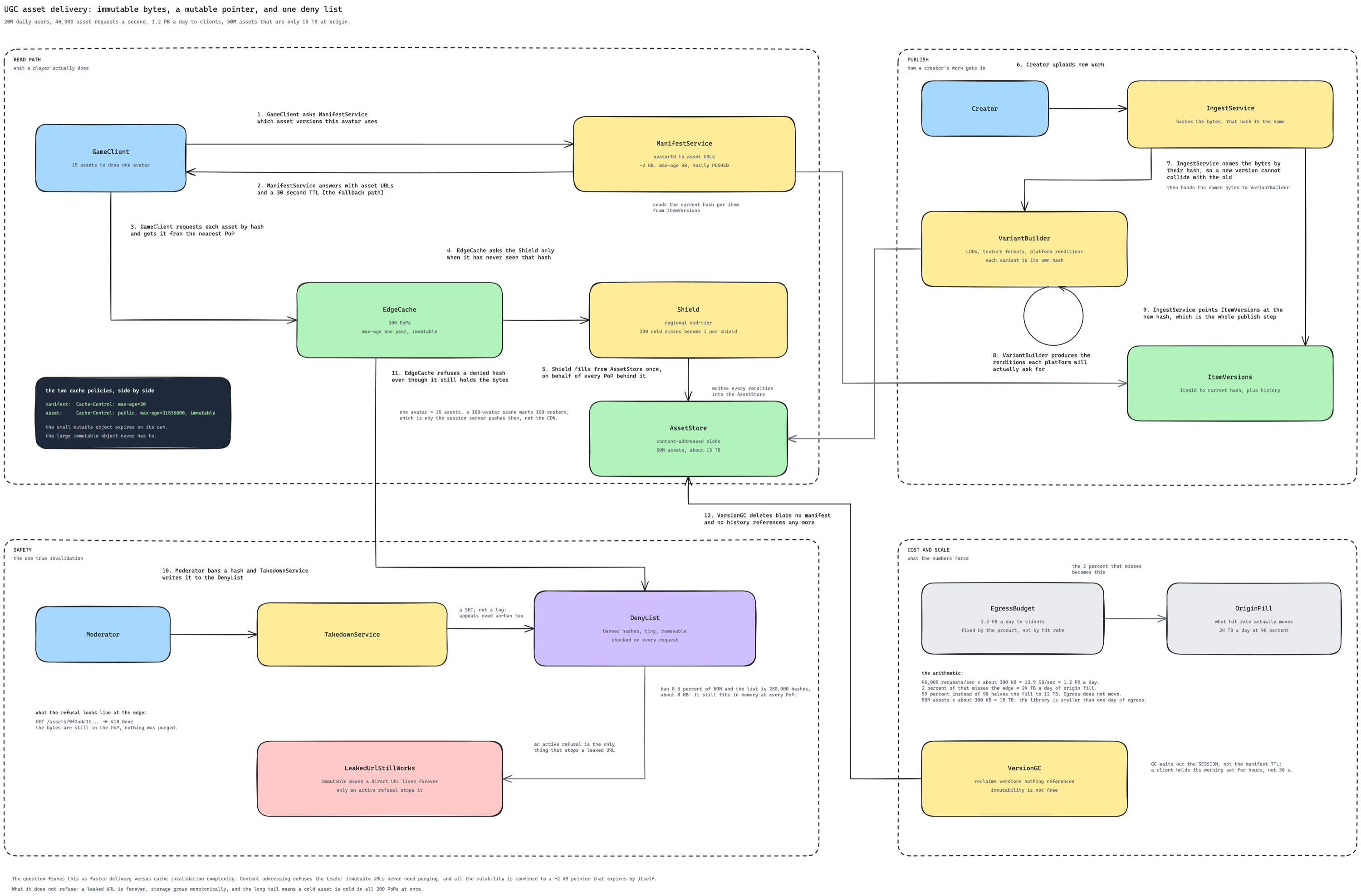
- In a session the client gets its roster of content hashes pushed by the session server; out of session it fetches a manifest of about 2 KB with a 30 second TTL. Either way it then fetches every asset it names by content hash, cached for a year at the nearest of 200 PoPs.
- Assets are named by the hash of their bytes, so publishing a new version creates a new URL and there is no purge path anywhere in the system.
- Regional shields sit between the edges and the origin, so a cold asset costs one origin fill per shield, roughly 10 rather than 200, and each PoP coalesces concurrent misses into a single upstream request.
- Ingest hashes the bytes, builds the variants each platform will ask for, and publishing is a pointer write from the item to the new hash.
- Takedown publishes a hash to a small deny list that every PoP and the origin check before serving, because the manifest alone cannot stop a URL that already leaked.
- A collector reclaims blobs that no item version, manifest or retention rule references, because nothing is ever overwritten.
- The invariant worth closing on: the large objects are immutable and the small object is not, which is what turns the question's trade-off into a non-question. The two things it does not solve are the cold tail and the takedown, and those are the dives worth having.
What is Expected at Each Level
- Mid
- Puts a CDN in front of an object store and serves assets from the edge.
- Knows that versioning the URL avoids stale content.
- Usually accepts the stated trade-off and designs a purge path for it.
- Usually assumes a hot working set and does not notice the tail.
- Senior
- Uses content-addressed immutable URLs and long TTLs deliberately, and separates the manifest from the assets.
- Identifies the cold tail and adds a shield or a mid-tier, and knows what request coalescing is for.
- Handles takedown as a separate mechanism rather than assuming purge covers it.
- Sizes the traffic and the catalogue instead of describing them qualitatively.
- Staff
- Refuses the trade-off in the question explicitly, and can explain that it is an artefact of mutable URLs rather than a law.
- Says where the mutability went instead of claiming it disappeared, and gives the small object its own policy and path.
- Separates the two cache-miss problems: many cold assets each asked for rarely, and one cold asset asked for by everyone at a drop.
- Is precise that hit rate moves origin fill and fleet size, not client egress, rather than overclaiming a cost saving.
- Treats takedown as the one true invalidation and designs refusal rather than purge, including the origin refill path.
- Raises composition and request amplification unprompted, and reaches server-side baking for the far case.
- Names what immutability costs: monotonic storage, a mandatory collector, an irreversible delete, and a leaked URL that lives forever.
Say the refusal out loud without notes: the trade-off only exists with mutable URLs, so name the bytes by their hash and there is nothing to invalidate.
Then write the two cache headers from memory: max-age 30 on the manifest, max-age 31536000 immutable on the asset. Then say why the manifest mostly does not travel that way at all.
Then say the two miss problems in one sentence each: a cold asset is cold in all 200 PoPs, and a hot drop is one cold asset wanted by everyone at once.