"Every movement of currency, including minting and destroying it, is a transfer between accounts in one append-only double-entry ledger. Everything else is derived from it."
Requirements
4 minFour questions. State your assumption for each so the interview moves even without answers.
- Player-to-player only, or do quests and shops mint and destroy? Assume mints: system accounts, first-class.
- Duplication exploit at 2am: what response? Assume detection in seconds plus a freeze lever.
- GM refunds and bug cleanups exist? Assume yes: compensating entries.
- Multi-region? Assume explicit cut: one region of record plus DR replica.
100M transfers/day ≈ 1.2K/s avg · 10-15K/s peak · reads 20-50x writes · slowest 1% of transfers still < 150ms (p99) · ~200M legs/day ≈ 20GB/day, TB-scale/yr · integers only
No double-spend. No negative player balance. Analytics may lag seconds and must say so. Transfers are never approximate.
Core entities
1 min- Account: holds a balance. Player accounts may never go below zero. System accounts (quest faucets, shop sinks) may, within a budget someone owns.
- Transfer: one requested movement, with a lifecycle.
- Ledger entry: every transfer writes two entries, called legs: minus on the sender, plus on the receiver. They always sum to zero.
- Rollups: per-account, per-hour summaries computed FROM the ledger. Derived, never the truth.
API
3 min
POST /v1/transfers        Idempotency-Key: key   // scoped (actor,key)
  { to, amount }          sender = auth session, never the body
  → 201 COMPLETED | 202 PENDING (cross-shard / queued)
  → 422, body: { error: INSUFFICIENT_FUNDS | ACCOUNT_CLOSED | ACCOUNT_FROZEN | FAUCET_BUDGET }
  → 409, body: { error: KEY_REUSED }   // same key, different body
GET  /v1/transfers/{id}   got a 202? ask here repeatedly until COMPLETED or REJECTED
GET  /v1/accounts/{id}/balance              → { balance, asOf }
GET  /v1/accounts/{id}/flows?window=24h     → { inflow, outflow, windowStart, windowEnd, asOf }
GET  /v1/accounts/{id}/balance-series?days=30 → { points:[{hourUtc, closingBalance}], asOf }
- Same key + same body replays the stored outcome. Retries are exact, not accidental.
- 202 PENDING is a first-class state, shared by the saga and the hot-sender queue.
- Validated: amount > 0, to ≠ actor, amount ≤ cap.
- Gateway rate-limits mutations; analytics reads are authorized to the account owner or a service principal. Every derived read carries asOf: freshness is part of the contract.
High-level design
10 min, end to end, no dives yet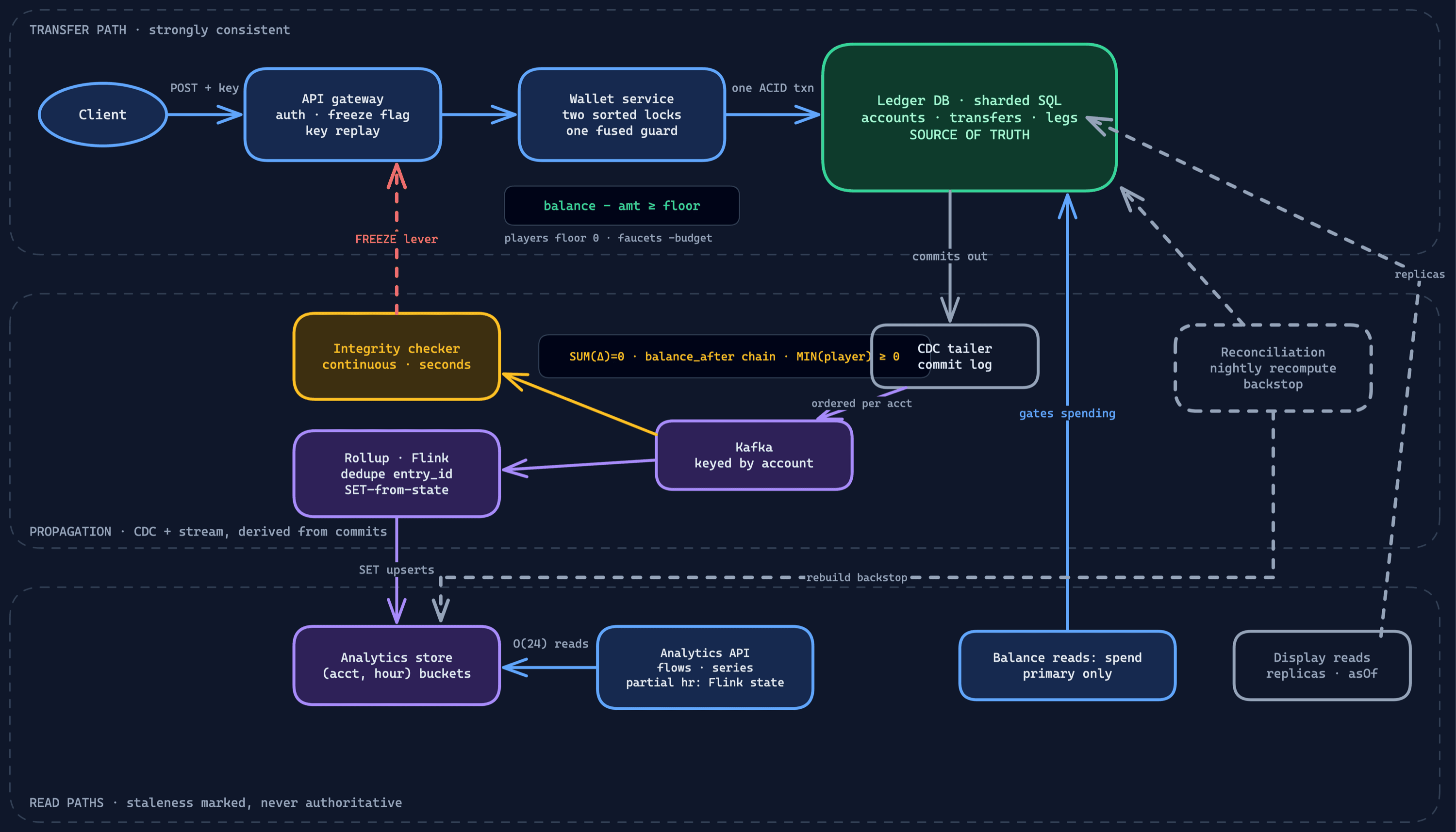
client → gateway → wallet svc → LEDGER (truth)          -- row 1, left to right
LEDGER ↓ CDC/Kafka → rollup → counts   +   checker      -- row 2
checker ↑↑ FREEZE back to gateway (dashed red)           -- the one arrow that makes the argument
everything else (replicas, reconciliation, escrow) only if asked
Every movement is one ACID transaction in a sharded SQL ledger → cross-shard: dive D: two sorted row locks, one fused guard (the balance check lives inside the debit UPDATE), two legs, status committed together → dive A. CDC streams committed changes into Kafka feeding two consumers: idempotent rollups → dive E and a continuous integrity checker with a freeze lever → dive G. Spending reads hit the primary; display reads hit replicas, staleness marked. Nightly recompute is the backstop.
- If they just nod and wait: "the riskiest box is the transfer transaction, shall I open it?"
- Running behind: protect dives A and G. Cut C first.
- If asked "why Kafka at this scale": one Postgres primary plus a one-minute SQL rollup is the right first system. The streaming tier was bought for one thing: catching corruption in seconds.
Deep dives: the core five
~20 min, interviewer steers
BEGIN
  INSERT transfers(actor, key, A, B, amt, PENDING)   -- dup(actor,key): replay / 409
  SELECT status FROM accounts WHERE id = min(A,B) FOR UPDATE   -- two single-row locks,
  SELECT status FROM accounts WHERE id = max(A,B) FOR UPDATE   -- explicit sorted order
      -- missing | CLOSED | FROZEN → status=REJECTED; COMMIT; 422
  UPDATE accounts SET balance = balance - amt
    WHERE id = A AND status = ACTIVE AND balance - amt ≥ floor
      -- players: floor 0. faucets: floor -budget. One guard stops
      -- overdraft AND runaway minting. 0 rows → REJECTED; COMMIT; 422
  UPDATE accounts SET balance = balance + amt WHERE id = B AND status = ACTIVE
  INSERT 2 ledger legs (each with balance_after, per-account seq)
  SET status = COMPLETED
COMMIT
accounts  (id PK, status, balance, floor)
transfers (id, actor, idem_key, from, to, amount, status, reversal_of,
           UNIQUE(actor, idem_key))              -- the anchor
legs      (transfer_id, account_id, delta, balance_after, seq,
           UNIQUE(account_id, seq))              -- chain-check; seq allocated in the balance-moving txn
Say why, in three sentences: Rejection commits, never rolls back; nothing changed, and the anchor row must survive for retries. Two explicit lock statements because ORDER BY + FOR UPDATE does not guarantee acquisition order. The guard is fused into the debit statement, so no check-then-act window exists.
- Spanner-class SQL: one transaction, even across shards.
- Dive A's code stays the same.
- Cost: slower commits, vendor lock-in.
- Three small local transactions, not one big one.
- Every shard has a parking account: ESCROW.
- Step 1: sender's money → her shard's escrow.
- Step 2: receiver paid from his shard's escrow.
- Step 3: square the two escrows later, in batches.
- Six legs; each step balances to zero on its own.
- Two workers can end up acting on the same transfer at once: the payment step, and the cancel job.
- If both act, the receiver gets paid AND the sender gets refunded. Money doubled.
- So: before touching any money, each worker must first write its claim into one table (
outcomes) on the receiver's shard. - The payment's claim is the row CREDITED. The cancel job's claim is the row CANCELLED.
- The table accepts only one row per transfer, so only one claim can ever land.
- The worker whose claim landed does its job. The other sees the existing row and gives up.
- All of this happens on one shard, so no machine ever waits on another.
- The payment step finds the receiver's account frozen or closed.
- It writes REFUSED as its claim and moves no money.
- The cancel job sees REFUSED and refunds the sender from escrow, exactly like a timeout.
- Step 1 also leaves a note: "transfer X started at 12:00:00."
- A background job scans for notes older than the timeout.
- When it finds one, it tries to cancel, through the claim table above.
- One escrow only fills up, the other only drains; step 3 settles the difference between them.
- Exclude escrow from circulation, or in-flight money looks minted.
- Gets 202 ("accepted, still working"). Asks GET /transfers/{id} until the status settles.
- Do not build this until cross-shard pairs are measured as common.
- Same-shard placement of trading partners may defer it forever.
- A quest reward = normal transfer, faucet account → player.
- The faucet's floor is its budget.
- Same guard, two jobs: stops overdrafts, caps minting.
- Shop fees and taxes = transfers into sink accounts.
- Money in circulation = minus the faucet balances, minus the sink balances.
- Faucet balances are negative, so the result comes out positive.
- The ledger is the dashboard. No separate metrics system.
- Paying every player = N ordinary transfers, sent in batches.
- The faucet is split into many sub-accounts ahead of time, so the burst never hammers one row.
- Afterward the ledger still sums to exactly zero.
- 1. All legs sum to zero: nothing created or destroyed.
- 2. Every ledger entry records the balance after it. Each entry must equal the previous balance plus its own change. Any gap = corruption.
- 3. No player balance is ever negative.
- The third is not redundant: a bug that double-spends the same coins consistently passes checks 1 and 2, and only check 3 catches it.
- Limits on how fast and how much one account may send.
- Catches abuse the balance guard cannot see: stolen accounts draining slowly, bots.
- Events are grouped by account, so a transfer's two legs end up in two different groups.
- So a separate checker regroups events by transfer id and pairs each transfer's two legs.
- Alarm if a leg stays unmatched past a few seconds.
- The checker reads the same event stream as analytics, so it reacts in seconds instead of waiting for the nightly job.
- Freeze the account.
- Then freeze the economy at the gateway: transfers 503, reads fine.
- Then page a human. Cleanup = bulk reversals.
- Nightly full recompute (hot DB + cold tier). Safety net, not front line.
- CDC (change data capture) watches the ledger database and copies every committed row into Kafka.
- Events are keyed by account, so one account's history stays in order.
- The rollup drops duplicates by entry id.
- The processor keeps a running total per (account, hour) in its own crash-safe storage.
- Flush writes the bucket's current TOTAL. Never an increment.
- Crash → recompute the same totals → overwrite with identical values.
- Hour's close = balance_after of the last entry at or before hour end.
- Idle hour: carry the previous value forward.
- Late data corrects only the hours it touches. Nothing compounds.
- Table: hourly_flows(account, hour, inflow, outflow).
- Answer = the sum of the last 24 hours, ending right now.
- That is 23 finished hours, plus the current unfinished hour, plus whatever slice of the oldest hour still falls inside the window.
- Served from the processor's own state.
- During restart: fall back to last flushed hour; asOf admits it.
Three more dives
rehearse after the core four- The remainder transfers to a system escheat account.
- Conservation holds right through closure.
- A refund is a NEW transfer in the opposite direction, with its reversal_of field pointing at the original.
- Never an edit to history.
- Only a dedicated service identity, two-person approval, own audit log.
- It is the one path allowed to move money its caller does not own.
- The transfer row's internal PENDING: born and finished inside one transaction. Nobody outside ever sees it.
- The API's 202 PENDING: cross-shard or queued transfers, resolved by poll.
- Saga intent rows that waited too long. Nothing else needs sweeping.
- Split into sub-accounts. Credits pick one at random; reads sum them.
- Credits have no guard, so nothing else changes.
- Freezing it = one status check on the parent.
- Already handled: the guard is the budget floor, split across shards.
- Give that one account a queue: one Kafka partition, one consumer.
- The consumer batches N payouts into a single transaction.
- Debits apply in queue order, each checked individually.
- Payouts that do not fit get their transfer rows marked REJECTED, in the same commit.
- Queued clients see 202 PENDING.
- Before the normal path touches an account, it checks whether that account is in queue mode.
- The check happens while holding the account's row lock, so the answer cannot change mid-write.
- The batch locks every account it touches in global sorted order.
- One region owns all writes. A second region keeps a copy, always slightly behind, for disaster recovery.
- True region loss: at most seconds lost, reconciled from the replica ledger.
- Nothing is ever merged.
- CDC pauses at the database's own commit log.
- The real limit: how long the database's own log (the WAL) can keep growing. Alert on the space left.
- Worst case: rebuild derived stores from the ledger.
- Reject transfers immediately. Never queue money you cannot commit.
- Balances stay readable from replicas, marked stale.
- 90 days in the fast database; everything, forever, in cheap cold storage.
- The ledger gets point-in-time backups: restore to any minute.
- Analytics store: derived, no backup needed.
- Transfer p99 + success rate; rejections by reason.
- Analytics freshness p99 < 5s; consumer lag.
- Reconciliation mismatches = 0; replication lag; hot-queue depth.
- At 1.2K/s: one Postgres primary + one-minute SQL rollup. Start there.
- The streaming tier buys one thing: corruption caught in seconds, not overnight.
The five hardest probes
show all (interview mode)Read the Step 4 walkthrough aloud once, timing yourself. If it runs past 90 seconds, cut words until it fits.