Design a real-time multiplayer system (Roblox)
"The server owns anything that is scored or spent, and for those things a client only ever sends inputs. Movement is the one real choice: simulate it on the server and let the client predict, which is fair and costs server CPU per player, or let the client own its own physics, which is cheaper, is what Roblox is documented to do (client network ownership, with its client-side anti-cheat there to compensate), and is exactly where speed and fly exploits come from; I default to server simulation with prediction for anything competitive and name client ownership as the casual-tier concession, under bounds checks I would add. Everything after that is spending a latency budget on purpose, and the three things in tension are latency, fairness and moderation, so the design's job is to say where each one is paid."
Understanding the problem
5 minFunctional Requirements
- Join: a player asks to play an experience and is placed into a session near them, with the right people (fill an existing session, or match by skill or party when the experience wants it).
- Play: a player's inputs change a shared world that every player in the session sees within about two hundred milliseconds, and the player's own actions feel instant.
- Trust: no client can assert a hit or a score, nor a position in the competitive tier; client-owned movement is a named concession under bounds checks and behavioural detection.
- Survive: a game server crash mid-session loses at most ten seconds of play and of declared progress, never a purchase, and the players are back in within about ten seconds.
Tier is a per-experience flag the creator sets: competitive (server simulates movement, hot standby available) or casual (client may own its movement under bounds checks). The FRs and dives use those two words with exactly that meaning.
Below the line (out of scope):
- The game logic and scripting itself. I care that a session runs a simulation at a fixed tick and validates inputs; what the experience does inside that tick is the creator's problem, not this hour's.
- Voice chat, and the economy and marketplace. Purchases show up exactly once, in the survive requirement, because they change where durable state has to live, and then they go away.
- Asset delivery, which is its own topic: ugc-assets. This page assumes the client already has the meshes and textures it needs to draw the world.
- The moderation DECISION for chat and content is a machine-learning problem. Only the enforcement plumbing is mine: because everything passes through the server, actions and chat can be logged, filtered and enforced, and I will say where that seam is.
- Account and auth. I assume a signed player identity arrives with the join request.
Non-Functional Requirements
- Fleet: 5M concurrent, ~167K sessions, ~21K hosts. Size it first, because "how many sessions" is the number that shapes everything else. Call it 5M concurrent players at peak; Roblox's real figures are larger, but the shape is the same.
- Sessions hold up to 100 players; assume 30 on average. So 5,000,000 / 30 is about 167K live sessions at peak.
- One session is one server process, because nothing is shared between sessions and that is what makes them the unit of scale. At 8 processes per host that is about 21K hosts (167,000 / 8), spread over about a dozen regional sites, so roughly 1,750 hosts per region (21,000 / 12).
- CPU sizing: one core per session, with a 16.7 ms tick budget and the replication ticks the heavy ones (100 clients x about 30 interest decisions and delta encodes each). So 8 sessions per host is a DESIGN ASSUMPTION for a 12-16 core box with headroom, not a Roblox fact.
- A few hundred edge PoPs (points of presence) sit in front of those dozen sites. The PoPs terminate the client's transport; they hold no game state.
- Label the Roblox specifics as publicly documented rather than known: max players per server is configurable and well above 100 (700 was announced; verify), and the 100 here is an interview ceiling for the bandwidth math.
- Then the tick: 60 Hz simulate, 20 Hz replicate. It sets the unit of everything downstream.
- The server SIMULATES at 60 Hz, one tick every 16.7 ms. It REPLICATES at 20 Hz, sending each client a delta (only what changed since a baseline, the last snapshot that client acknowledged) every 50 ms, which is every third tick. Roblox is publicly documented at roughly that shape: replication about 20 Hz, a 60 Hz Heartbeat frame event (Roblox's name for its per-frame step, not the fleet health heartbeat), and a 240 Hz physics substep (verify the 240).
- Clients send inputs at 30 Hz. The newest input is about 40 bytes, the two redundant older inputs ride along delta-encoded at about 15 B each, plus the 28 B UDP/IP header, so about 100 B on the wire x 30 Hz is about 3 KB/s upstream. Upstream is never the problem; downstream is.
- Say why the two rates differ: simulation wants fine steps for physics and hit detection, replication is bounded by bandwidth, and the client interpolates across the gap.
- Bandwidth: 14 KB/s landed against a 20 KB/s cap, and do the arithmetic out loud rather than saying "efficient".
- One replicated entity is about 40 bytes per update, and that 40 B is ALREADY quantised (rounded to fewer bits): position 6, rotation 8, velocity 6, animation and flags 4, entity id 2, plus a per-field change mask and some slack. The packet header (about 28 B UDP/IP) is per PACKET, not per entity.
- Naive full-state broadcast to 100 players: 100 entities x 40 B is 4 KB per client per update, x 20 Hz is 80 KB/s per client, x 100 clients is 8 MB/s (64 Mbit/s) per session outbound. It is O(N^2): 100 x 100 x 20 is 200,000 entity-updates a second for one session.
- Interest management (sending each client only the entities near it) alone, about 30 entities in full-rate interest and the rest at 5 Hz or not at all: 30 x 40 B x 20 Hz is 24 KB/s, plus 70 x 40 B x 5 Hz is 14 KB/s, so 38 KB/s raw. Not enough on its own.
- Deltas against the last ACKed (acknowledged) baseline, on top of interest, cut the 38 to about a third, because the change masks show most fields do not change in 50 ms: about 13 KB/s of payload, plus about 0.6 KB/s of packet headers (28 B x 20 Hz). So it lands around 14 KB/s against a cap of 20 KB/s down per client (160 kbit/s), which a phone on cellular handles. Both levers are needed to get there.
- Per session the 100-player WORST CASE is 100 x 160 kbit/s = 16 Mbit/s; a 30-player session has little to interest-manage and sits well under that. Fleet at peak, counted per player because that is the honest base: up to 5M x 160 kbit/s = 800 Gbit/s, about 0.8 Tbit/s at the per-client cap, and expected roughly half that, about 0.56 Tbit/s at the landed 14 KB/s; the KPI is the landed number. Egress dominates the bill, which is why replication bytes per client is the KPI.
- Latency: p95 client-to-server RTT at or under 60 ms, and be precise about which latency you mean, because own-action latency and other-player latency are different numbers.
- The RTT budget: at or under 60 ms at p95 via regional placement across about a dozen sites, and label that an assumption (it is plausible for North America and Europe, not for every player); the hard cap for a playable session is about 150 ms.
- The player's OWN actions feel instant, 0 ms perceived, because the client predicts them (applies its own inputs locally before the server confirms).
- OTHER players' actions are seen roughly 200 ms after they happen even at 50 ms RTT, and that number is honest: input sample wait 0-33 ms (30 Hz) + one-way 25 ms + wait for the next tick 0-17 ms + wait for the next replication 0-50 ms + one-way 25 ms + a client interpolation buffer of two 20 Hz snapshots, 100 ms. That is 150-250 ms, call it 200. The 100 ms buffer is a choice: some engines hold one snapshot and extrapolate, and pay for it in jitter.
- Fairness: lag compensation capped at 200 ms, and the cap is a choice.
- Lag compensation rewinds the server by the shooter's one-way latency plus their interpolation delay, capped at 200 ms. A 200 ms RTT player at 100 + 100 sits exactly at the cap, which is why 200. Beyond the cap the laggy player is the one who suffers, and that is a fairness choice (Valve's Source engine defaults to 1 s), not an industry constant.
- Matchmaking is two different products with two different budgets.
- Fill-join (pick an open session near me): p95 under 2 s.
- Queue-match (skill or party): seconds to about a minute. The queue mechanics are the game-matching topic; this page covers PLACEMENT and hands the ticket off.
- Fault tolerance has to come with a loss bound, or "resilient" means nothing.
- Game servers heartbeat to the Fleet Manager (the per-region control service that allocates session processes and watches their heartbeats) every 1 s and are declared dead after 3 missed, so about 3-5 s.
- The session checkpoints to a regional store, and the loss bound falls out of four facts:
- Cadence: a delta every 10 s and a full every 60 s.
- Contents: engine entity state plus whatever the experience declares checkpointable, about 0.5-1 MB per full for a 100-player world.
- Restore: the last full plus up to five deltas, then players rejoin via a resume token (a token the join reply carries so a client can reattach to its session; TTL, time to live, 60 s) within about 10 s.
- Loss bound: at most 10 s of play and DECLARED progress, never a purchase; undeclared progress is bounded by the 60 s DataStore write.
- Durable player state (purchases, progress, inventory) is NEVER only in session memory. Purchases are an idempotent receipt to the economy service, off the tick loop, retried until granted; progress is written to the player DataStore (Roblox's durable per-player key-value store) every 60 s and on leave, with key events batched into those writes, because the DataStore has per-server request budgets and "write on every event" is not affordable.
- Availability, stated as a join number and a session KPI, not two nines figures.
- A region failing sends new joins elsewhere; sessions inside it are lost outright, because the checkpoint store is regional, unless that store replicates cross-region. Target 99.9 percent for join.
- The session KPI is the crash rate per session-hour, not a nines figure, because a dropped session is felt by 100 people at once and what you can actually measure and drive down is how often a process dies.
- Name the triangle before the design, so every later choice can be placed on it: latency, fairness and moderation. Prediction spends a little fairness to buy latency; the server-side validation seam spends latency to buy fairness and moderation; placement buys latency for free but only within a region; client-owned physics buys server CPU at the cost of fairness, and is named as a concession.
Entities + API
5 minDefining the Core Entities
- Player is the identity behind a connection:
playerId, and while in a session, a connection, an input sequence number and a resume token. A player is in at most one session at a time. - Experience is a game:
experienceId,maxPlayers(up to 100), a region policy, and a matchmaking mode (fill, or queue by skill or party). The mode is what decides which branch the join takes. - Session is one running world, and it is the unit of everything:
sessionId,experienceId, region,serverAddr, capacity, occupancy, state, and the current tick.- One session is one server process, and nothing is shared between sessions. Say that here, because it is why the fleet scales horizontally with no coordination in dive 5.
- Occupancy is a counter that two matchmaker workers can race on, which is why the Session Registry (the Redis index of open sessions, HLD 1) reserves slots atomically rather than reading and writing.
- GameServer is host plus process: region, capacity, health, last heartbeat. The Fleet Manager owns this table and expects a heartbeat every 1 s; the heartbeat is what makes "dead" a fact rather than a guess.
- Input is what a client sends:
playerId,seq,clientTick,actions[]. An input is an intent, never an outcome. "I pressed jump" is an input; "I am at (x, y, z)" is not, and refusing the second one is the whole trust requirement. - Delta / Snapshot is what the server sends:
serverTick,ackSeq, entity changes since the client's ACKed baseline. A snapshot is a delta against nothing, sent on join and whenever the baseline is too old.ackSeqis load-bearing: it tells the client which of its inputs the server has applied, so the client knows which unacked inputs to replay after it rewinds.
- Checkpoint is
sessionId, tick, and a blob: engine entity state plus whatever the experience declared checkpointable through an API, because developer Luau (Roblox's Lua dialect that experiences are scripted in) heap state is not generically serialisable. A delta every 10 s and a full every 60 s to a regional store, about 0.5-1 MB per full for a 100-player world; a restore is the last full plus up to five deltas. It is what bounds the loss on a crash. - Region / EdgePoP: a region is one of about a dozen sites that run game servers; an edge PoP is one of a few hundred points that terminate the client's transport and carry the flow over a pinned tunnel to the region. The distinction matters because only one of them holds game state.
API or System Interface
// control plane, HTTPS
POST /join {experienceId, playerId, party?, prefs?}
     -> 200 {sessionId, serverAddr, edgeAddr, joinToken}   // placed now (fill path); serverAddr is a routing handle, e.g. "euw1/s91"
     -> 202 {ticketId}                                       // queued (skill or party), then
GET  /join/{ticketId}                                        // push or poll until placed
POST /sessions/{sessionId}/leave

// internal, control plane
POST /fleet/allocate {experienceId, region}                  // -> a session on a warm server
PUT  /fleet/servers/{id}/heartbeat {load, sessions[]}       // every 1 s
POST /sessions/{id}/reserve                                  // atomic slot reservation in the registry

// data plane, a UDP-based reliable/unreliable channel protocol
C -> S  INPUT    {seq, clientTick, actions[]}               // 30 Hz, unreliable, carries the last 3 inputs, ~3 KB/s up
S -> C  DELTA    {serverTick, ackSeq, baselineTick, changes[]}  // 20 Hz, unreliable
S -> C  SNAPSHOT {serverTick, entities[]}                   // on join, or when the ACKed baseline is > 1 s old
S -> C  EVENT    {chat | kill | score | purchaseConfirmed}  // reliable channel
C -> S  RESUME   {sessionId, resumeToken}                   // on reconnect
- Two planes with deliberately different transports, and that split is the shape of the architecture. The control plane is HTTPS: join, leave, allocate, heartbeat, all rare, all fine with a round trip. The data plane is a UDP-based channel protocol running at 30 Hz up and 20 Hz down, where a retransmit is worse than a loss.
- Native: plain UDP with a thin reliability layer (Roblox's is publicly a RakNet-derived protocol). Web: WebRTC data channels or WebTransport. TCP on 443 is the fallback where UDP is blocked, and it costs head-of-line blocking: one lost packet stalls every packet behind it, which for a 20 Hz stream means a visible hitch.
- The reliable channel exists for the things that must arrive exactly once and in order: chat, kill, score, purchase confirmed. Position never goes on it, because a stale position is worthless by the time it is retransmitted.
- Join returns an address, not a session; the client then connects DIRECTLY to the game server through the edge, and never touches the matchmaker again. The
joinTokenis what the game server checks so that only a placed player can attach; theedgeAddris the PoP the client discovers by anycast (one address announced from every PoP, the network delivers to the nearest) and then pins for the life of the session, because anycast route flaps would break a UDP flow. serverAddris an OPAQUE ROUTING HANDLE, not a game-server IP. Its format is<region>/<sessionId>, for exampleeuw1/s91; the edge PoP resolves it to the game server over the backbone, and the client never learns a game-server address. That is what makes "the address never leaks" true rather than aspirational, and it is the same handle a RESUME presents after a crash: the client never gets a new address, the edge simply resolves the old handle to the replacement.- Join has two shapes, 200 and 202, because it is two products. Fill-join places you now. A skill or party queue returns a ticket, and the ticket is handed to the game-matching machinery, which pushes or is polled. Do not make the client retry
POST /joinin a loop; that is the retry storm dive 5 is about. - INPUT carries the last 3 inputs redundantly, so one lost packet loses nothing. The newest input is about 40 bytes, the two older ones are delta-encoded to about 15 B each, plus the 28 B UDP/IP header, so the packet is about 100 B on the wire and about 3 KB/s up at 30 Hz. That is cheap, and it means the unreliable channel is safe for the one message that drives the whole simulation. Inputs carry no position field to lie in: they are intents, and the server decides the outcome.
- DELTA carries
ackSeqandbaselineTick, and both are for the client's benefit.ackSeqsays which inputs the server applied so the client can replay the rest;baselineTicksays which snapshot the delta is relative to. If the client's ACKed baseline is more than 1 s old the server stops sending deltas and sends a full SNAPSHOT, so a lossy link recovers on its own. - RESUME is a data-plane message, not a second join, because the whole point is that the player lands on the replacement server without going through matchmaking again. The resume token has a TTL of 60 s, chosen to exceed detection (3-5 s) plus allocate plus restore with margin, and the registry holds the player's SEAT for that TTL so a fill-join cannot take it during the failover. After 60 s the player is a fresh join.
High-level design
10 min, end to end, no dives yet1) Join: matchmaking as placement
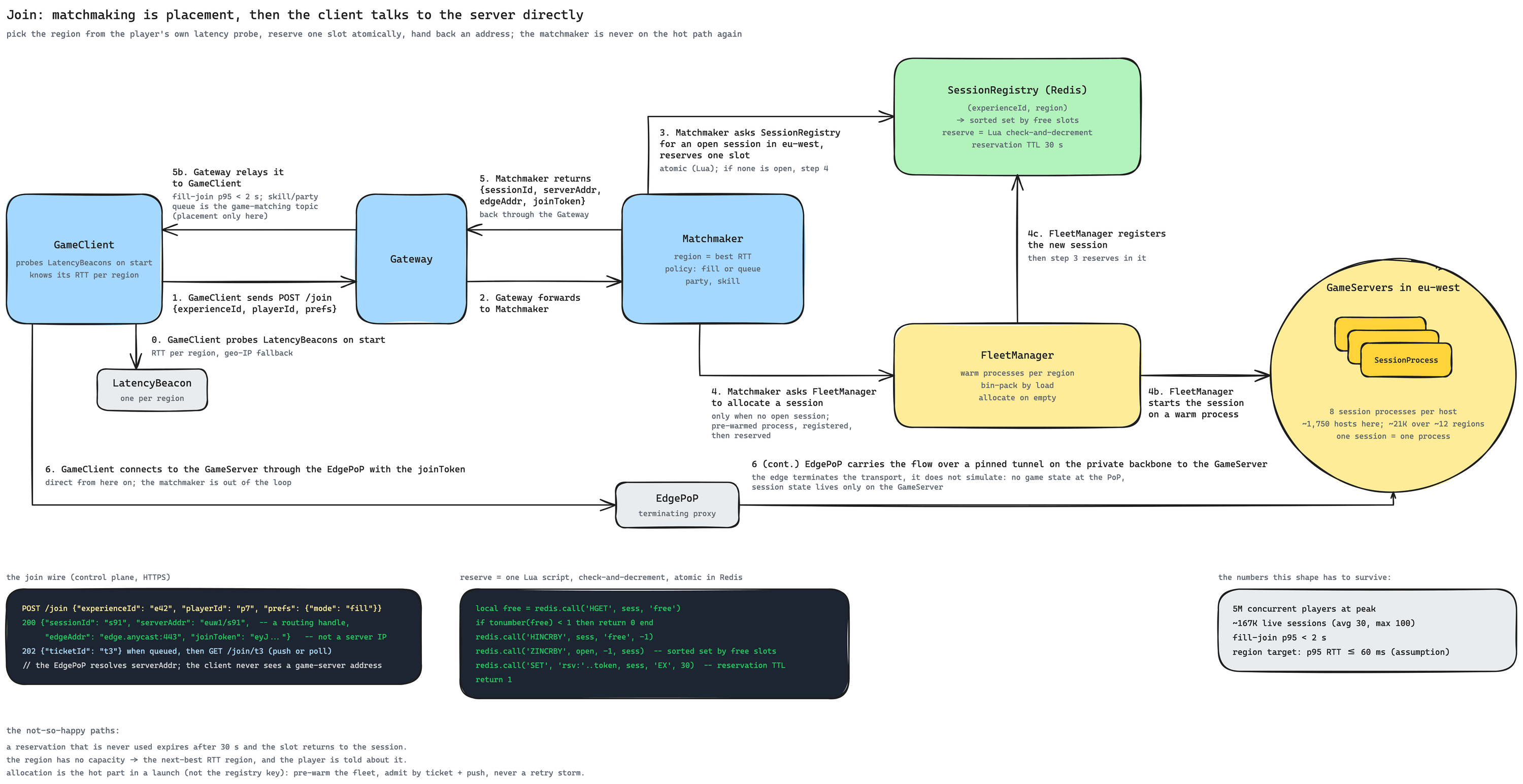
- Matchmaking here is a placement problem first and a pairing problem second. The client hits the gateway (the public HTTPS front door), the gateway hands the request to the Matchmaker, and the Matchmaker's first job is to pick a REGION, because region is what decides the RTT and RTT is what decides whether the session is playable.
- Region comes from the client's own latency probe, not from a guess.
- On app start the client pings a beacon in each regional site and sends the resulting latency map with the join. That is a dozen small pings, cached for the app session.
- Geo-IP is the fallback when the probe is missing or stale, and it is a fallback for a reason: geography is a poor proxy for network distance.
- The Matchmaker then applies the experience's policy: fill or queue, party constraints, skill if the experience asks for it. Policy decides which of the two paths below the join takes.
- Fill path, which is the common one: pick an open session near me, and reserve one slot atomically.
- The Session Registry is Redis keyed
(experienceId, region), a sorted set of open sessions scored by free slots, so "an open session in this region for this experience" is one read. - The reservation is a Lua script (a Redis-side atomic script): check the free count and decrement it in one atomic step, with a TTL of about 30 s on the reservation so a client that never connects gives the slot back. Two matchmaker workers cannot both hand out the last seat.
- The reply is
serverAddr(the routing handle,euw1/s91style),edgeAddrand ajoinToken, returned to the client back through the gateway. p95 under 2 s is a registry read, a Lua call and one allocation at worst.
- The Session Registry is Redis keyed
- Empty path: no open session in that region, so ask the Fleet Manager for one. The Fleet Manager keeps warm processes (pre-started, assets loaded) on every host, bin-packs new sessions by load (fills the fullest host that still has room, so the fleet can shrink), registers the new session in the registry, and the Matchmaker reserves into it. Cold-booting a process on demand is what makes join p95 blow past 2 s, so the fleet is warm on purpose. No capacity in the region at all: place in the next-best RTT region, and the player is told.
- Then the client connects DIRECTLY to the game server, through the edge PoP of HLD 3 (Latency: regions and edge), and never speaks to the matchmaker again. The matchmaker is on the join path only, so it can be slow, restarted or sharded without a running session noticing.
- Skill or party queue: the ticket goes into the queue machinery, out of scope here beyond the handoff. The join returns 202 with a
ticketId, the queue mechanics live in game-matching, and when a match forms it comes back to this same placement step: pick the region that minimises the p95 RTT of the players in the match, allocate, reserve.
2) Play: the authoritative loop, inputs in, deltas out
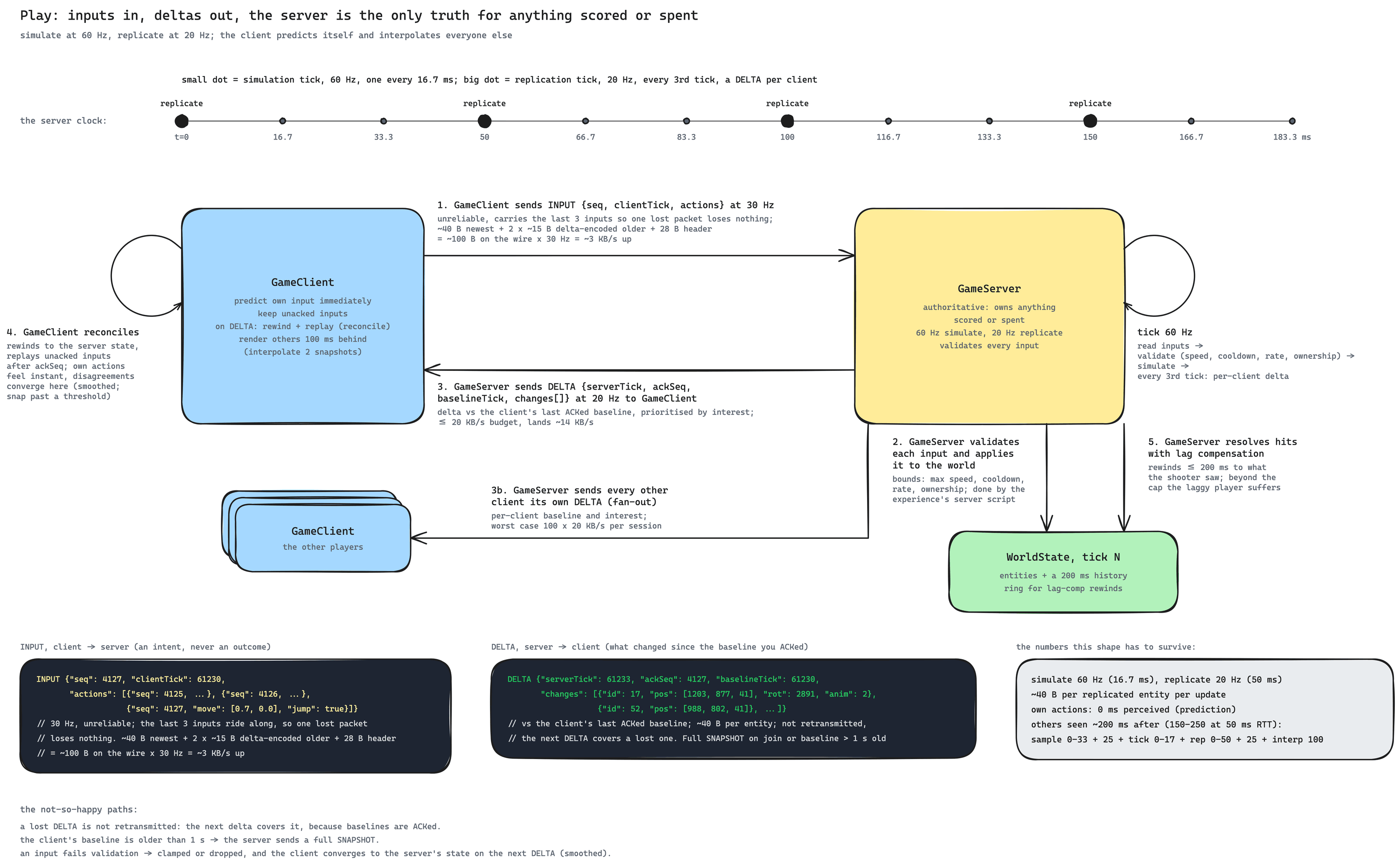
- The game server runs one loop at a fixed 60 Hz, and every tick does the same four things. Read the inputs that arrived since the last tick, validate each one, apply them to the simulation, advance the world by 16.7 ms.
- Validation is per input and it is bounds: maximum speed, cooldowns, rate of inputs, ownership of the thing being acted on. An input that fails is rejected or clamped, never trusted.
- The simulation is the truth for anything scored or spent. There is exactly one copy of the world, on this process, and it is the only place a score, a hit or a purchase is decided.
- Who validates: the experience's server script behind the platform's seam (dive 3 has the four walls). On Roblox the game server runs the developer's Luau (Roblox's Lua dialect that experiences are scripted in), so the platform cannot know what a "hit" means; it provides the seam and the walls, and the experience's SERVER script does the validating.
- Every third tick, at 20 Hz, replication runs, per client, and it is a budgeted job rather than a broadcast.
- For each client: compute the delta between the world now and that client's last ACKed baseline, prioritise the changes by interest (near, visible, relevant), cut the list to the client's byte budget, send.
- The delta rides the unreliable channel. If it is lost, the next delta is computed against the same old baseline and covers the gap, so nothing is retransmitted.
- The budget is what caps a client at 20 KB/s no matter how busy the world is; the typical landed figure is about 14 KB/s.
- On the client, the player's own entity is predicted, and everyone else's is interpolated, and those are two different mechanisms.
- Prediction: the client applies its own inputs immediately, so a jump happens the frame the button is pressed. It keeps every input the server has not ACKed yet.
- Reconciliation: on each DELTA the client rewinds its own entity to the server's state for
ackSeq, then replays the unacked inputs on top. If the server agreed with the prediction, nothing visibly moves. If it disagreed, the client smooths the correction over a few frames and snaps only past an error threshold. - Interpolation: OTHER entities are rendered between the two most recent snapshots, which is 100 ms behind the server at 20 Hz. That buffer is what makes other players move smoothly instead of teleporting every 50 ms.
- Hit registration happens on the server with lag compensation, and it is the one place the server deliberately looks backwards. When a shot arrives, the server rewinds the other entities to where the shooter SAW them (the shooter's one-way latency plus their 100 ms interpolation delay), tests the hit against that, then returns to the present. The rewind is capped at 200 ms, so a laggy shooter cannot hit into the past forever.
- Movement is the one place there is a real choice, so make it out loud. Server-simulated movement with client prediction is fair and costs server CPU per player; client-owned physics under server bounds checks is cheaper and is what Roblox is documented to do, and it is where speed and fly exploits come from. Default: server simulation with prediction for anything competitive; client ownership named as the concession for the casual tier.
- Say the honest number for what a second player sees. Own actions: 0 ms perceived. Another player's action: roughly 200 ms even at 50 ms RTT, because it is input sample wait (0-33) plus one-way (25) plus tick wait (0-17) plus replication wait (0-50) plus one-way (25) plus the 100 ms interpolation buffer, 150-250 ms. That is what "within about two hundred milliseconds" costs once you have counted the buffer, and saying so is better than being corrected.
3) Latency: regions and edge
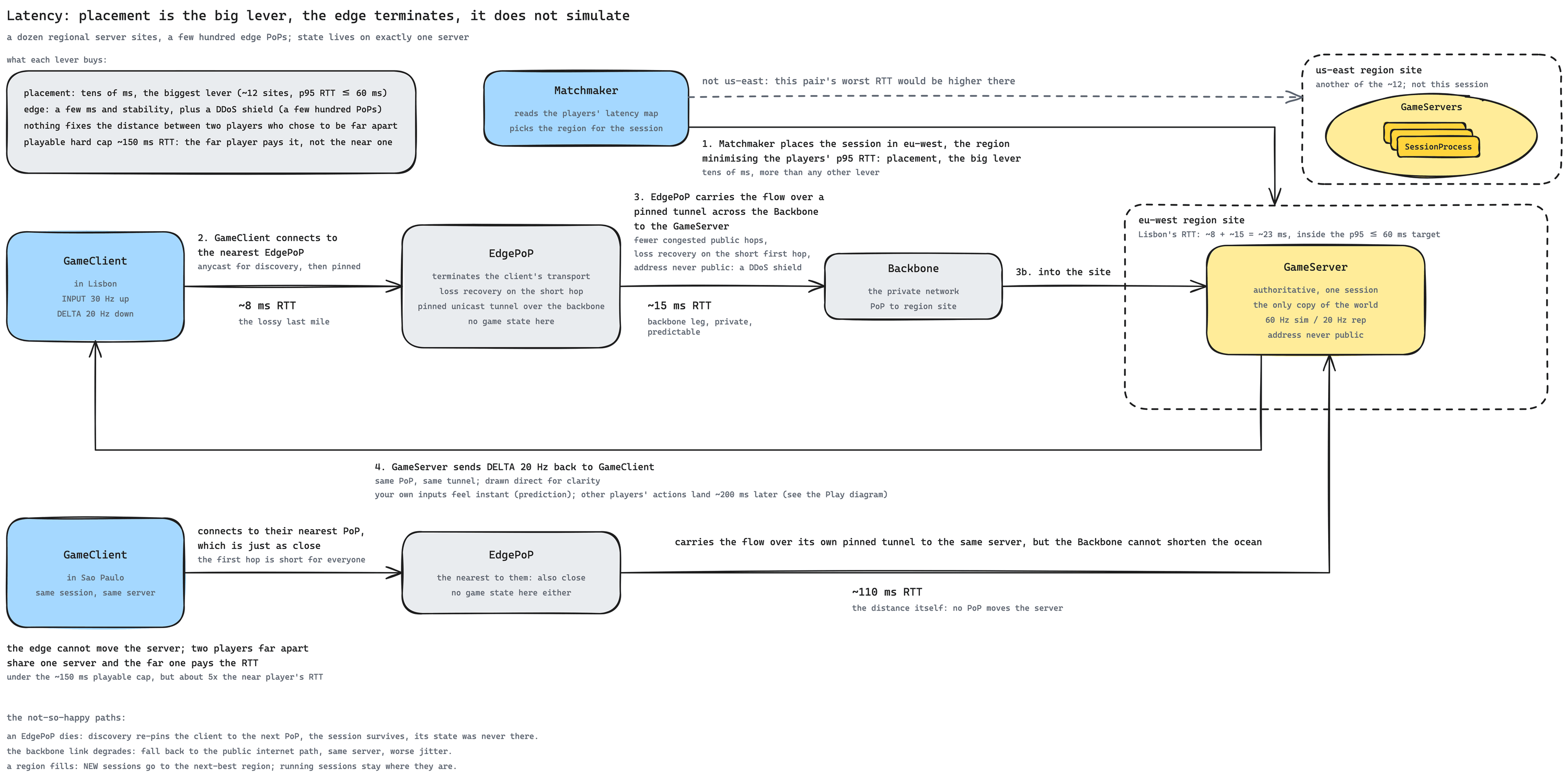
- Start by saying where the milliseconds actually go, because it makes the levers obvious. Input sample wait, client to server one way, wait for the next tick, wait for the next replication, server to client one way, then the interpolation buffer. Only the two one-way legs are network; the rest is design.
- Lever one, PLACEMENT, is the biggest lever by far. Put the session in the region that minimises the p95 RTT of the players in it. With about a dozen regional sites the target is p95 RTT at or under 60 ms (an assumption, plausible for North America and Europe), and that is a placement outcome, not a network trick.
- Lever two, EDGE, is a few hundred PoPs that TERMINATE the client's transport near them and carry the flow over a pinned unicast tunnel across the private backbone (the operator's own network between sites) to the regional server.
- The PoP holds per-flow transport state and does loss recovery on the short first hop, so a lost packet is recovered in a few milliseconds instead of a full client-to-region round trip.
- Fewer congested public-internet hops, because the client's packets leave the public internet at the nearest PoP.
- Anycast is for discovery and the handshake only; then the client pins one PoP for the life of the session, because an anycast route flap mid-session would break a UDP flow.
- A DDoS shield in front of game servers whose addresses never leak: the client only ever knows
edgeAddrand an opaque session handle. - Worked example, the one the diagram draws: a player in Lisbon on an eu-west server has about 8 ms RTT on the lossy last mile to the PoP plus about 15 ms RTT on the private backbone, about 23 ms RTT, inside the p95 target of 60 ms.
- If the backbone link degrades: fall back to the public internet path, same server, worse jitter. The session does not move.
- Say explicitly: the edge TERMINATES, it does not SIMULATE. There is no game state at the PoP. Game state lives on exactly one server, so losing a PoP loses a transport hop and not the session; the client re-pins to another PoP and RESUMEs. An edge PoP that ran simulation would be a second source of truth, and this page has exactly one.
- Now the thing edge does NOT fix, which is the trade the question is really asking about. Two players on opposite sides of the world in one session share one server, and physics does not care about anycast. The Lisbon player is at about 23 ms and a Sao Paulo player on the same eu-west server is at about 110 ms RTT, about 5x, under the 150 ms cap but not close; that player's PoP carries the flow over its own pinned tunnel to the same server, but the backbone cannot shorten the ocean. The honest answer is that a session is regional, and cross-region play pays the RTT. Placement decides who pays it.
- So the answer to "how do you get global low latency" is that you do not; you get regional low latency and you choose the region well. That is the difference between this design and a CDN, and it is worth saying out loud.
4) Survive: crash, checkpoint, rejoin
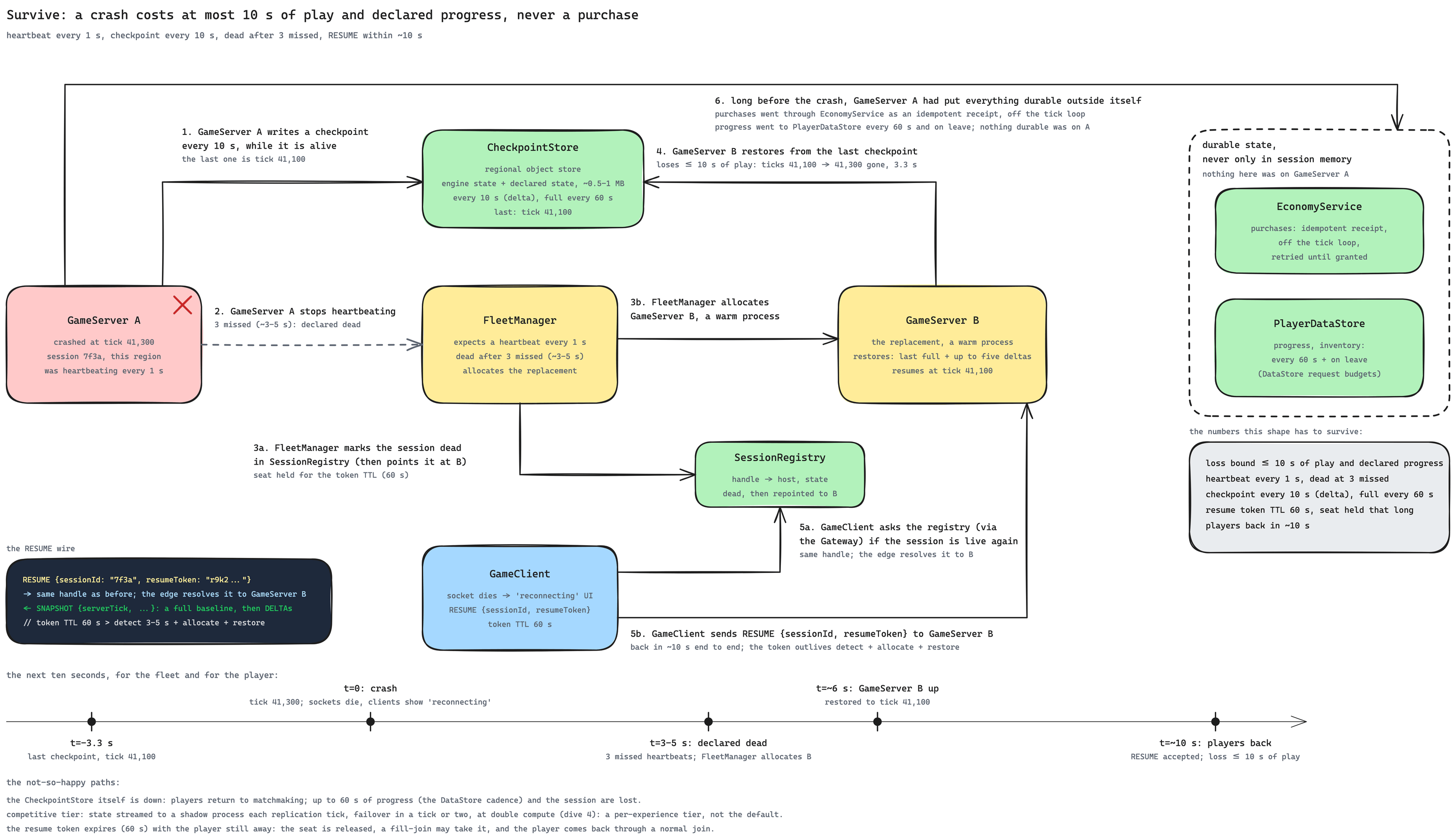
- The server heartbeats every 1 s to the Fleet Manager and checkpoints the session to a regional store: a delta every 10 s, a full every 60 s. Those intervals are the whole recovery story: the heartbeat bounds how fast a death is noticed, the checkpoint cadence bounds how much play is lost.
- Be honest about what is in the checkpoint and what it costs, because "compact world state" hides two problems.
- A full is engine entity state plus whatever the experience declares checkpointable through an API, about 0.5-1 MB for a 100-player world; developer Luau heap state is NOT generically serialisable. A restore is the last full plus up to five deltas.
- Concede that Roblox itself does not restore sessions: its documented answer is DataStore plus rejoin another instance. Checkpoint and restore is a step past that, and it needs that declare-checkpointable API to be worth anything.
- Cost: the ingest ceiling is about 17 GB/s fleet-wide if every session were 100 players (167K sessions x about 1 MB / 10 s), about 1.4 GB/s per region, and that assumes every checkpoint were a full-sized 1 MB; with fulls at 1 MB / 60 s (about 2.8 GB/s fleet-wide) plus small deltas the actual is well below that, and a third again at the 30-player average.
- Death is declared after 3 missed heartbeats, so about 3-5 s, and then the Fleet Manager runs one sequence.
- Mark the session dead in the registry, so no new joins land on it, and hold every player's SEAT for the resume token TTL (60 s) so a fill-join cannot take it during the failover.
- Allocate a replacement process on a warm server in the same region.
- Restore the world from the last full checkpoint plus up to five deltas, at most 10 s old.
- Update the registry: the handle is unchanged (it is region plus sessionId), the mapping behind it now points at the replacement, and the session is marked live again.
- The clients see the socket die and show "reconnecting"; they do not go back to the lobby. One registry read (via the gateway) asking whether the session is live again, then, with the SAME handle, which the edge now resolves to the replacement, RESUME on the data plane with their resume token, land on the new server, get a full SNAPSHOT, and play continues. Loss at most 10 s of play and of declared progress, back in within about 10 s. The 60 s token TTL is chosen to exceed detection plus allocate plus restore with margin.
- Durable state was never at risk, and say why with the two paths. A purchase is an idempotent receipt to the economy service, off the tick loop, retried until it returns granted, and the session never holds the only copy, so a crash cannot lose one or double-grant one. Progress is written to the player DataStore every 60 s and on leave, with key events batched into those writes because the DataStore has per-server request budgets; between those writes the checkpoint carries declared progress, so the loss bound on progress is the same 10 s. If the checkpoint store itself is down, the honest loss is up to 60 s of progress (the DataStore cadence) and the session.
- Concede that this is graceful degradation, not a seamless failover. Ten seconds of "reconnecting" is a visible event. A hot standby fed by state streamed each replication tick takes over in a tick or two, that is dive 4's Great, and it costs double compute for a rare event, which is why it is a tier and not the default.
Potential deep dives
~20 min, interviewer steers1) Client-server against peer-to-peer, and the sync model that follows
- The answer in two lines: P2P has no simulation bill and any client can lie, so the moment a game is competitive or moderated the server has to own anything scored or spent.
- Then the latency that authority costs is bought back with placement and prediction; interpolation buys smoothness and lag compensation buys fairness at the latency you have; deltas buy bandwidth, not latency.
- Every client simulates its own character and tells the others where it is.
- Lowest possible latency and no simulation bill (STUN/TURN relays still cost), which is exactly why the interviewer offers it, and it is the wrong trade for anything scored. Be precise about the saving: P2P does NOT lower client bandwidth, because each client uploads to N-1 peers; the saving is the simulation server.
- Any client can lie. "I am at the flag", "I hit him", "I have 999 coins" are all just messages, and there is no moderation seam because there is no place every message passes through.
- NAT traversal is painful and unreliable on consumer networks, N clients need N(N-1)/2 connections, so 100 players is 4,950 links, and the "lower latency" is not reliably lower once relays are in the path.
- Name the legitimate P2P family so the refusal is informed: deterministic lockstep with rollback (fighting games, RTS) works because every peer runs the identical simulation on the identical inputs. It needs a deterministic sim, and a platform running developer Luau on a physics solver does not have one.
- The prompt's own framing says it: P2P is "hard to moderate, cheat-prone", and Roblox chose client-server with heavy latency optimisation for that reason.
- One server owns the world, clients send inputs, the server sends the whole state back at a fixed rate and the client draws whatever it last received.
- Fair and moderatable, because every input passes through the one place that decides. This is most of the trust requirement.
- But every action waits a full round trip before the player sees it, so at 60 ms RTT a jump happens at least 60 ms after the button, closer to 100 once tick and replication waits are counted, and that is felt.
- And bandwidth is O(N^2): 100 entities x 100 clients x 20 Hz is 200,000 entity-updates a second, 8 MB/s per session, which dive 2 is about.
- The server stays the only source of truth for anything scored or spent, and every input still goes through validation; what changes is how the client hides the round trip. Fairness and moderation are not traded away for anything scored; latency is bought with placement and prediction, interpolation buys smoothness, lag compensation buys fairness at the latency you have, and deltas buy bandwidth.
- Client-side prediction for your OWN entity: apply the input locally the frame it happens, keep the unacked inputs, and on each DELTA rewind to the server's state for
ackSeqand replay the rest. Own actions feel instant; the round trip is only felt when the server disagrees, and then the client smooths the correction over a few frames and snaps only past an error threshold. - Interpolation for OTHER entities buys smoothness: render them between the two most recent snapshots, 100 ms behind the server. Smooth motion, at the cost of the honest roughly 200 ms number for seeing someone else act at 50 ms RTT.
- Lag compensation on the server buys fairness at the latency you have: rewind the targets to what the shooter saw (their one-way latency plus their interpolation delay), capped at 200 ms, so a fair shot at 100 ms RTT lands and a laggy player cannot shoot into the past forever.
- Delta compression on the wire, which is the bandwidth lever, not a latency lever: send changes against the client's last ACKed baseline, not the world (the 40 B per entity is already quantised). That is roughly a third of the bytes, and it is what makes 20 Hz replication affordable.
- Name the honest exception, because the interviewer who knows Roblox will.
- Roblox is publicly documented to hand physics ownership of a player's own character to that client. That is a client asserting state, and it is why speed and fly exploits exist there, and why Roblox also ships client-side anti-cheat (Hyperion, from the Byfron acquisition, since 2023, publicly documented; I do not claim its internals).
- So the interview answer is: server simulation with prediction for anything competitive, bounds validation always, and client ownership only for non-competitive physics (a rolling barrel) or as the named concession for the casual tier, never for anything scored. If I concede ownership for a character, I say the cost out loud: that entity is now one cheater away from being wrong for everyone, and I am buying server CPU with fairness.
- Place it on the triangle: prediction spends a little fairness (the client renders a state the server has not confirmed) to buy latency; the server never adopts a predicted state, it only lets the client draw one. That sentence is the whole design.
2) 100 players in one session: what the network looks like
- The answer in two lines: naive full-state is 80 KB/s per client and 8 MB/s per session, O(N^2), and it eats a phone's plan and the egress bill.
- Interest management alone gets to 38 KB/s raw; deltas on top of interest cut the 38 to about 13 KB/s of payload, so it lands around 14 KB/s with headers against a 20 KB/s cap, which is 16 Mbit/s per 100-player session at the ceiling and up to about 0.8 Tbit/s across the fleet at the cap (5M x 160 kbit/s), expected roughly half at the landed figure.
- Every 50 ms, send every client the whole world.
- 100 entities x 40 B is 4 KB per client per update. x 20 Hz is 80 KB/s per client. x 100 clients is 8 MB/s (64 Mbit/s) per session outbound.
- It is O(N^2) in players: 100 x 100 x 20 is 200,000 entity-updates a second for one session, and doubling the session size quadruples it.
- 80 KB/s (640 kbit/s) down is about 290 MB an hour of a phone's data plan and roughly 6x the egress bill of the landed 14 KB/s; throughput is not the issue, the plan and the bill are. And the server side is 64 Mbit/s per process, 512 Mbit/s per 8-process host.
- Send each client only what changed since the snapshot it last ACKed, using per-field change masks.
- Most entities do not change every 50 ms, and the ones that do change a few fields, so deltas alone are roughly a third of full state: about 25-30 KB/s per client.
- Quantisation is already in the 40 bytes, not a further saving: position 6, rotation 8, velocity 6, animation and flags 4, entity id 2, plus the change mask and slack. The 28 B UDP/IP header is per packet, not per entity.
- Still O(N^2), because every client still hears about every entity; the constant got smaller, the shape did not.
- Interest management changes the shape, not just the constant. Each client has an area of interest: about 30 nearby entities at full rate, the far ones at 5 Hz, the irrelevant ones not at all. A client hears about 30 things every update, not 100. On Roblox the publicly documented primitive is StreamingEnabled, radius-based instance streaming.
- Show the math exactly, because the target only holds when the two mechanisms combine.
- Interest management alone: 30 near entities x 40 B x 20 Hz is 24 KB/s, plus 70 far entities x 40 B x 5 Hz is 14 KB/s, so 38 KB/s raw. Over budget on its own.
- Deltas on top of interest cut the 38 to about a third, because the change masks show most fields did not change in 50 ms: about 13 KB/s of payload.
- Plus about 0.6 KB/s of packet headers (28 B x 20 Hz), so it LANDS around 14 KB/s against the 20 KB/s (160 kbit/s) budget, with room for a busy moment. Interest alone would not get there (38 KB/s), and deltas alone would not (25-30 KB/s); together they do.
- A per-client priority accumulator with a byte budget per update is what makes the cap a guarantee rather than an average. Every entity accrues priority each tick it is not sent (closer and faster-moving accrue quicker); each update sends the highest-priority changes until the budget is spent, and the rest wait. A crowded fight degrades to lower update rates for far entities, never to a blown budget.
- Snapshot baselines with ACK, so a lost delta is recovered by the next one, not retransmitted. The server keeps the last few baselines per client; a delta is always against the newest one the client ACKed. If the ACKed baseline is more than 1 s old the server sends a full SNAPSHOT instead. No retransmit queue, no head-of-line blocking.
- Now the numbers the design is sized to, and get the base right.
- Per client: a cap of 20 KB/s (160 kbit/s), landing about 14.
- Per session: the 100-player worst case is 100 x 160 kbit/s = 16 Mbit/s; a 30-player session has little to interest-manage, so the 100-player math is the ceiling.
- Fleet at peak, per player: up to 5M x 160 kbit/s = 800 Gbit/s, about 0.8 Tbit/s at the per-client cap, and expected roughly half, about 0.56 Tbit/s at the landed 14 KB/s; the KPI is the landed number.
- Upstream: about 3 KB/s per client (about 100 B on the wire x 30 Hz), 300 KB/s per 100-player session, and never the problem.
- Say what it costs, in two currencies. Egress dominates the bill, up to about 0.8 Tbit/s at the cap and roughly 0.56 expected, across about 21K hosts, which is why replication bytes per client is the KPI. And interest management is a decision per client per update, so replication CPU grows with players squared even though bytes do not, and the alert to watch is tick time over 16.7 ms, not bandwidth.
3) Cheating, and why prediction is the crack it lives in
- The answer in two lines: the server validates every input against physical bounds and decides every hit itself, so a client can only ever ask, never assert; on Roblox "the server" is the experience's server script behind the platform's seam.
- Prediction is exactly where cheats live, so the rule is that the server never adopts a predicted state; it only lets the client render one.
- The client says "I am here" and "I hit him" and the server writes it down.
- Speed hacks, teleports, aimbots that report a hit on every frame, and infinite score are all one modified client away.
- There is nothing to moderate because nothing passes through a place that can say no.
- This is the P2P failure mode reappearing inside a client-server design, and it is what physics ownership of a character amounts to.
- Inputs are intents; the server checks each against maximum speed, cooldowns, rate limits and ownership of the thing being acted on, and rejects or clamps.
- A "move" that would exceed max speed is clamped to max speed. A "fire" inside the cooldown is dropped. A "pick up" for an object the player is not near is dropped.
- This is most of the trust requirement and it runs inside the same tick that applies the input, so it adds no round trip.
- What it does not cover: hits under latency, which need the server to reason about time, and behaviour that is inside every bound but still inhuman.
- Hit registration is server-side, with lag compensation capped at 200 ms. The server rewinds the targets to where the shooter saw them (the shooter's one-way latency plus their interpolation delay), tests the hit there, and returns to now. The cap is a fairness choice, not an industry constant (Valve's Source engine defaults to 1 s): a 200 ms RTT player at 100 + 100 sits exactly at the cap; a shooter at 400 ms does not get to hit a target that moved out of the way 300 ms ago, so beyond the cap the laggy player is the one who suffers, and I say that out loud rather than pretending everyone can be served.
- Say who validates, because on Roblox the game server runs the experience developer's untrusted Luau.
- The platform cannot know what a "hit" means in a given experience, so "the server validates every input" means the experience's SERVER script does.
- The platform provides the seam and the walls: server scripts and RemoteEvents (Roblox's client-to-server message primitive) are the only path from a client to server state; Luau is sandboxed with script timeouts and memory limits per instance; process isolation between the 8 instances on a host, which is our design rather than a stated Roblox fact; and the network is rate-limited per connection.
- Roblox is publicly documented to also ship client-side anti-cheat (Hyperion, from the Byfron acquisition, since 2023), precisely because character physics is client-owned. I say it as documented and do not claim its internals.
- Inputs are intents, never outcomes, and that is a schema decision. The INPUT message has no position field to lie in. If a client wants to be somewhere, it sends the movement that would get it there and the server decides whether it did.
- Per-connection rate limits and packet signing or tokens. A client that sends 300 inputs a second instead of 30 is throttled at the edge; a packet without the session's token never reaches the simulation. This is also what makes the edge a DDoS shield.
- Physics ownership only for unscored objects. A rolling barrel can be simulated by the nearest client because nobody wins by lying about a barrel; a character in a competitive experience, a projectile, a score never is. Where the platform concedes character ownership for the casual tier, that is exactly where the exploits are, and I say so.
- Offline behavioural anti-cheat over the telemetry stream. Every input and outcome is already logged because it passed the server, so a pipeline can find statistical outliers (accuracy nobody has, reaction times nobody has) and replay suspicious sessions. Detection is offline; enforcement is a ban or a shadow flag, and it does not need to run inside the tick.
- The moderation seam falls out for free, and it is worth naming as a benefit of the architecture rather than a feature. Chat, actions and events all pass through the server, so they can be logged, filtered and enforced there. The moderation DECISION is ML and out of scope; the plumbing is this seam.
- Name the tension honestly: prediction is the crack cheats live in. The client is allowed to render a state the server has not confirmed, and a cheat is a client that renders (or reports) a state the server would never confirm. The defence is that the server never adopts a predicted state; it validates the input and the client converges on whatever the server says, smoothing small corrections and snapping past an error threshold. Every scored outcome is computed on the server, from validated inputs, at server time.
4) The server crashes mid-game
- The answer in two lines: heartbeat every 1 s and dead after 3 missed, checkpoint delta every 10 s and full every 60 s to a regional store, restore on a warm process and clients RESUME, so the loss is at most 10 s of play and of declared progress, never a purchase.
- A hot standby fed by state streamed each replication tick takes it to a tick or two of loss, and doubles compute for a rare event, so it is a per-experience tier, not the default.
- The process dies, the sockets close, and 100 players are dropped to matchmaking.
- If progress lived in session memory it is gone too, and if a purchase was applied in memory before it was recorded, the player paid for nothing.
- The players are back in eventually, but in a different session with different people, so a competitive round is simply lost.
- This is the design that "fault tolerance" in the prompt is warning against, and it is what you get if the only fix is "restart the process".
- The Fleet Manager notices in 3-5 s, restores from the last full plus up to five deltas (at most 10 s old) on a warm process in the same region, and clients RESUME with their tokens.
- Loss bound at most 10 s of play and of declared progress, never a purchase; players back in within about 10 s. Durable state was never at risk because purchases are an idempotent receipt to the economy service, off the tick loop and retried until granted, and progress goes to the DataStore every 60 s and on leave.
- The player sees "reconnecting" for about ten seconds and comes back into the same world with the same people, a little rewound.
- The gap: it is a visible interruption, and for a ranked match ten seconds of rewind is a real complaint. And the checkpoint is only as good as what is in it, which the Great card is honest about.
- The checkpoint is HLD 4's: delta 10 s, full 60 s, about 0.5-1 MB, engine state plus declared state, restore is the last full plus up to five deltas. Its honest limits (Luau heap state is not serialisable, Roblox itself does not restore sessions, the ingest ceiling of 17 GB/s is a full-sized-checkpoint ceiling and the actual is well below) are stated there once and not repeated here.
- For competitive or high-value sessions, run a hot standby fed by STATE STREAMING, not input-log replay. Replaying the input log on a shadow needs a deterministic simulation, and determinism is a day-one engine property, not a bolt-on: Luau plus the physics solver plus os.time and HttpService are not deterministic across machines. So the realistic tier streams the state to a shadow process each replication tick; failover is a tick or two, no lost play; the clients RESUME to the shadow's address.
- Concede the cost, because it is exactly the "fallback to replication" the prompt mentions, and it doubles compute for a rare event. That is why it is a per-experience tier, not the default: the KPI the fleet is run against is crash rate per session-hour, and doubling the hosts of that tier's sessions (not the 21K fleet) to shave ten seconds off the rare crash is a bill I would charge for.
- Walk the client side as a timeline too, because half of "survive" is what the player sees.
- t=0: the socket dies; the client shows "reconnecting" and keeps rendering the last state frozen.
- t=3-10 s: it retries a registry read (via the gateway) asking whether the session is live again, until the Fleet Manager has repointed the handle; the handle itself does not change.
- about t=10 s: RESUME on the data plane with its resume token, a full SNAPSHOT, play continues rewound by at most 10 s.
- The token TTL is 60 s, chosen to exceed detection (3-5 s) plus allocate plus restore with margin, and the registry holds the player's seat for the TTL so a fill-join cannot take it during the failover. After 60 s the player is a fresh join and their seat is released.
- Walk the fleet side as a timeline.
- t=0: crash.
- t=1..3 s: heartbeats missed.
- t=3-5 s: declared dead; session marked dead in the registry so no new joins land on it; seats held for the token TTL.
- t=5-8 s: replacement process allocated on a warm host; last full plus up to five deltas restored.
- t=8-10 s: registry repointed to the replacement and marked live; clients see that and RESUME with the same handle. Loss is whatever happened after the last delta, at most 10 s.
- Purchases and progress, precisely, because "durable" hides two different mechanisms. A purchase is an idempotent receipt (a ProcessReceipt-style callback, the one Roblox invokes for a purchase receipt) handled off the tick loop and retried until it returns granted, so the session never holds the only copy and a crash cannot double-grant. Progress is written every 60 s and on leave with key events batched in, because the DataStore has per-server request budgets and "write on every event" is not affordable; the checkpoint covers the gap between writes.
- Say what happens if the checkpoint store is what died, because the interviewer will ask what the fallback's fallback is. The session cannot be restored, so the honest move is to return the players to matchmaking with the loss stated: purchases are safe (economy service), progress is safe back to the last DataStore write, so up to 60 s of progress (the DataStore cadence) and the session are lost. Do not pretend a regional store failure is invisible.
- And say what a whole-region failure looks like: new joins go elsewhere via the latency map, sessions inside the region are lost outright because the checkpoint store is regional (unless that store replicates cross-region, or the tier's standby was cross-region), and the target is 99.9 percent for join precisely because join can move and a session cannot.
5) Millions of players: what is sharded by what, and where it still gets hot
- The answer in two lines: the session is the shard, so game servers scale with no coordination; a launch is a capacity spike, not a registry spike.
- The control plane is sharded by (experienceId, region), and the launch is REGIONAL: 1M joins in 10 minutes is about 1,667 joins a second fleet-wide, trivial for the registry, but 10K to 33K new sessions is about 4,100 hosts, more than a doubling of the ~1,750-host region a launch actually lands in, so pre-warm from the launch calendar, spin-up rate second, and a ticket queue with push.
- Add hosts as concurrency grows and let a single matchmaker and a single registry place everyone.
- The game servers are fine, because a session never talks to another session. The control plane is not: every join in the world goes through one placement path.
- The first launch of a popular experience finds no open sessions, so every join takes the empty path, and a Fleet Manager cold-booting processes on hosts it does not yet have falls behind; clients retrying
POST /jointurn a slow allocation into a retry storm.
- Sessions are the unit of scale, one per process, nothing shared, so 167K sessions on 21K hosts need no coordination between them.
- The Matchmaker is sharded by
(experienceId, region), and the Session Registry is Redis partitioned the same way, so a shard sees only its own experience in its own region. - A Fleet Manager per region does the bin-packing, keeps processes pre-warmed, and autoscales hosts on occupancy.
- This is enough for the steady state. It is not enough for the launch, which is a capacity spike inside ONE region of about 1,750 hosts, not a fleet-wide average.
- The Matchmaker is sharded by
- The hard case is a hot LAUNCH: 1M players joining one experience in 10 minutes, and do the arithmetic to find where it actually hurts.
- Joins: 1,000,000 / 600 s is about 1,667 joins a second FLEET-WIDE, about 140 a second per region key if spread across a dozen regions, about 800 a second even if one region takes half. A Redis sorted set with a Lua reservation handles that trivially; the registry key is NOT the bottleneck.
- Sessions: a launch fills sessions to maxPlayers, so 10K sessions if maxPlayers is 100 (about 17 starts a second) up to 33K if the experience caps at 30 (about 55 a second, 33,000 / 600). Process spin-up rate matters, but it is the secondary knob.
- Capacity, and frame it regionally: 33K sessions at 8 per host is about 4,100 hosts. If the launch lands mostly in one region of about 1,750 hosts, that is more than a doubling of the region (about 20 percent of the 21K fleet only if it spread evenly, which a launch does not), and at one core per session that is real hardware. THAT is the hot part: regional host capacity and autoscale lead time.
- So the answer is pre-warming from the launch calendar, with process spin-up rate as the secondary knob. A launch is scheduled, so the Fleet Manager in each region has the hosts provisioned and warm, asset-loaded processes registered before the first join, and the spin-up rate keeps ahead of 17-55 sessions a second. The empty path of HLD 1 then rarely cold-boots anything.
- Admit through a queue when allocation still lags: ticket plus push, never a retry storm. If a region cannot allocate fast enough the join returns 202 with a ticket and the client waits to be pushed, exactly the queue shape the skill path already uses. Clients never poll
POST /joinin a loop. - Salting the hot key by a small salt (a small suffix that spreads one hot key over several; the key is already per region) is a minor extra, worth doing so the sorted set and the Lua reservation spread across Redis partitions, at a small cost in fill quality (a salt-1 reader may not see a free slot in salt 3). Say it as an extra, not as the fix, because the numbers say the key was never the problem.
- Cross-session features go over a message bus, never through the session loop, and on Roblox they have public names. The game server publishes and moves on: nothing outside the session is ever on the 16.7 ms tick path, and that is what keeps "nothing shared between sessions" true.
- MessagingService (pub/sub, rate-limited) for cross-server chat and events.
- MemoryStoreService (ephemeral shared state) for live leaderboards and queues.
- TeleportService and ReserveServer to move players between instances.
- DataStoreService (durable, per-server request budgets) for progress.
- Say what stays hot even after all that, and what the bill is. The Fleet Manager for the launch region stays hot, because allocation is a decision with a regional view of hosts; it is one process per region on purpose, and the queue in front of it is what protects it. The fleet is about 21K hosts (one core per session, 8 sessions on a 12-16 core box, a design assumption) and up to about 0.8 Tbit/s of egress at the per-client cap, roughly 0.56 expected at the landed 14 KB/s; egress dominates the bill, which is why replication bytes per client is the KPI I would put on the dashboard.
Four more dives, briefly
- Transport: UDP with a reliability layer against WebRTC, WebTransport and TCP, and why head-of-line blocking is the deciding fact.
- TCP delivers in order, so one lost packet stalls everything behind it until the retransmit arrives, which at 20 Hz is a visible hitch. Position data does not want that: a stale position is worthless by the time it is retransmitted.
- Native clients: plain UDP with a thin reliability layer (Roblox's is publicly a RakNet-derived protocol), unreliable channel for INPUT and DELTA, reliable channel for EVENT. Web clients: WebRTC data channels or WebTransport, which give the same two channel kinds inside a browser.
- TCP on 443 is the fallback for networks that block UDP, and it costs exactly the head-of-line blocking above; say so rather than pretending it is equivalent.
- INPUT carries the last 3 inputs redundantly (newest about 40 B, the two older ones delta-encoded to about 15 B each, plus the 28 B header: about 100 B on the wire, about 3 KB/s), so the unreliable channel loses nothing on a single drop, and DELTAs are against ACKed baselines so a lost delta is covered by the next one.
- Tick rate: why 60 simulate and 20 replicate, and what a higher tick costs.
- 60 Hz simulation is 16.7 ms per tick, fine enough for physics and hit tests to feel right; 20 Hz replication is a bandwidth decision, because every replication is a per-client delta computation and a packet. Roblox is publicly documented near that shape (about 20 Hz replication, a 60 Hz Heartbeat frame event, Roblox's name for its per-frame step and not the fleet health heartbeat, and a 240 Hz physics substep; verify the 240).
- Why 30 Hz inputs when you simulate at 60: one input per two ticks. 60 Hz inputs would buy about 8 ms of mean input wait for double the upstream packets (about 6 KB/s); I would take 60 for a competitive tier.
- Doubling replication to 40 Hz would want about 28 KB/s per client (about 14 KB/s landed, doubled), so the priority budget clips it and far entities degrade to lower rates: the cap is a cap. It also doubles the replication CPU per session for a smoother remote view that interpolation already mostly provides. Doubling simulation to 120 Hz halves the CPU headroom per tick, and tick time over budget is the alert that matters.
- Determinism is worth one sentence here: the client's prediction runs the same movement code as the server so reconciliation rarely snaps, but a fully deterministic simulation across machines is not something this platform has (Luau, the physics solver, os.time), which is why the hot standby streams state rather than replaying inputs, and why lockstep P2P was never on the table.
- Clock sync and input timing: the client runs ahead so its inputs arrive just before the tick they target.
- The client learns the server tick and RTT/2 from the handshake and keeps it updated from every DELTA's
serverTick, then runs its own clock ahead by one-way latency plus a margin, so an input stamped for tick T arrives just before the server simulates T. - The server keeps a per-client jitter buffer of 1-2 ticks so a slightly early or late packet still lands in its tick. Early beyond the buffer is dropped; late beyond the buffer is dropped too, and that second rule is a security rule: accepting late inputs is a speed-hack vector, because a client that can post-date inputs can move twice in one tick.
- This is also where the 0-33 ms input sample wait in the latency decomposition comes from: at 30 Hz the next input frame is up to 33 ms away, and it is honest to count it.
- The client learns the server tick and RTT/2 from the handshake and keeps it updated from every DELTA's
- Observability: the alert is "tick over budget", not "CPU high".
- Per session: tick time (p50, p99 against the 16.7 ms budget), replication bytes per client per second against the 20 KB/s budget (about 14 KB/s expected), inputs rejected per second (a spike is either a cheat or a bug), inputs dropped as late.
- Per region: RTT histograms per client (is p95 at or under 60 ms), heartbeat misses, crash rate per session-hour, checkpoint write latency, and join p95 against 2 s.
- A host at 90 percent CPU with every tick under 16.7 ms is fine; a host at 40 percent CPU with one session ticking at 25 ms is a session that is visibly stuttering for 100 people. Alert on the thing the player feels.
- Because in P2P any client can lie and there is no place every message passes through, so there is no moderation seam and no way to validate a hit or a score; the moment a game is competitive or moderated the server has to own anything scored or spent.
- Then the latency that authority costs is bought back with placement (p95 RTT at or under 60 ms) and prediction of your own entity (0 ms perceived); interpolation of others (100 ms buffer) buys smoothness and lag compensation capped at 200 ms buys fairness at the latency you have; deltas buy bandwidth, not latency. Another player's action is still seen roughly 200 ms after it happens even at 50 ms RTT.
- Be precise about "cheaper" and "faster": P2P saves the simulation bill (STUN/TURN relays still cost), not client bandwidth, since each client uploads to N-1 peers; it needs N(N-1)/2 connections, 4,950 for 100 players, plus NAT traversal, so the "lower latency" is not reliably lower.
- The legitimate P2P family is deterministic lockstep with rollback (fighting games, RTS), and it needs a deterministic simulation, which a platform running developer Luau on a physics solver does not have.
- Name the exception the interviewer knows: Roblox is documented to hand physics ownership of a player's own character to that client, which is why speed and fly exploits exist there and why it ships client-side anti-cheat (Hyperion, from the Byfron acquisition). My answer: server simulation with prediction for the competitive tier, bounds validation always, client ownership either unscored or explicitly conceded for the casual tier, named out loud.
- Close on the triangle: latency, fairness, moderation. P2P pays fairness and moderation to buy latency; client-server pays latency and then buys most of it back without giving up the other two.
- The server decides, always. On Roblox that is the experience's server script behind the platform's seam. The client sends "fire" as an input with its sequence number and client tick; it never sends "I hit him".
- As of the moment the shooter SAW the target, not the moment the input arrived: the server rewinds the other entities by the shooter's one-way latency plus their interpolation delay (their view is 100 ms behind), tests the shot there, then returns to the present.
- That rewind is lag compensation, and it is capped at 200 ms. This shooter at 200 ms RTT is 100 ms one-way plus the 100 ms interpolation buffer, exactly at the cap, which is why the cap is 200: they are compensated in full. At 300 ms RTT the extra is not compensated and the laggy player is the one who suffers. That is a fairness choice, not an industry constant (Valve's Source engine defaults to 1 s), and I say it out loud.
- Why a cap at all: without it a laggy attacker can shoot into the past forever, hitting a target that already moved to cover on everyone else's screen, and the victim experiences being shot around a corner.
- The victim's client never decides either: the hit arrives as an EVENT on the reliable channel from the server, and their health is server state.
- Prediction does not change any of this. The shooter's client can play the muzzle flash instantly, but the damage only exists when the server says so, because the server never adopts a predicted state.
- Bounds still apply first: fire inside the cooldown is dropped, fire at a rate above the limit is throttled, and only then is the hit tested.
- Start with the unit: one replicated entity is about 40 bytes per update, already quantised (position 6, rotation 8, velocity 6, animation and flags 4, id 2, plus a change mask and slack), replicated at 20 Hz. The 28 B UDP/IP header is per packet, not per entity.
- Naive full state: 100 x 40 B = 4 KB per client per update, x 20 Hz = 80 KB/s per client, x 100 clients = 8 MB/s (64 Mbit/s) per session. O(N^2): 200,000 entity-updates a second for one session.
- Interest management alone changes the shape: about 30 nearby entities at full rate, the rest at 5 Hz or not at all. 30 x 40 B x 20 Hz is 24 KB/s, plus 70 x 40 B x 5 Hz is 14 KB/s, so 38 KB/s raw. Still over budget on its own.
- Deltas on top of interest cut the 38 to about a third, because the change masks show most fields did not change in 50 ms: about 13 KB/s of payload, plus about 0.6 KB/s of packet headers (28 B x 20 Hz), so it lands around 14 KB/s against the 20 KB/s (160 kbit/s) cap. Both levers are needed.
- A per-client priority accumulator with a byte budget per update turns that into a guarantee: send the highest-priority changes until the budget is spent, let the rest wait, so the cap holds at 20 KB/s even in a crowded fight.
- Snapshot baselines with ACK mean a lost delta is recovered by the next delta, not retransmitted; a baseline older than 1 s triggers a full SNAPSHOT.
- Per session the 100-player worst case is 100 x 160 kbit/s = 16 Mbit/s; a 30-player session sits well under. Fleet at peak, per player: up to 5M x 160 kbit/s, about 0.8 Tbit/s at the cap, expected roughly half (about 0.56 Tbit/s at the landed 14 KB/s), and egress dominates the bill; the KPI is the landed number. Upstream is about 3 KB/s per client (about 100 B on the wire x 30 Hz) and never the problem.
- The cost: interest management is CPU per client per update, so the alert is tick time over 16.7 ms, not bandwidth; and replication bytes per client is the KPI because egress is the bill.
- Fleet, t=0 to 3 s: the process is dead, so the 1 s heartbeats to the Fleet Manager stop. Nothing is declared yet.
- Fleet, t=3-5 s: three heartbeats missed, the Fleet Manager declares the server dead, marks the session dead in the registry so no new joins land on it, and holds every player's seat for the resume token TTL.
- Fleet, t=5-10 s: the Fleet Manager allocates a replacement process on a warm host in the same region, the replacement restores the last full checkpoint plus up to five deltas (engine state plus declared state, about 0.5-1 MB per full, at most 10 s old), and the registry is repointed to the replacement and marked live; the handle the client holds does not change.
- Player, t=0: the socket dies, the client shows "reconnecting" and freezes on the last state rather than dropping to the lobby.
- Player, about t=10 s: one registry read (via the gateway) to see the session is live again, same handle, then RESUME on the data plane with its resume token (TTL 60 s, chosen to exceed detect plus allocate plus restore), lands on the new server, receives a full SNAPSHOT, and play continues, rewound by whatever happened after the last delta. Loss at most 10 s of play and of declared progress, never a purchase.
- Durable state was never at risk: a purchase is an idempotent receipt to the economy service, off the tick loop and retried until granted, so the session never held the only copy; progress was written to the DataStore every 60 s and on leave with key events batched in, and the checkpoint carries declared progress between those writes.
- t=10-30 s: everyone is back, the dead host is drained by the Fleet Manager, and if the checkpoint store itself was what died the honest fallback is to send the players back to matchmaking: up to 60 s of progress (the DataStore cadence) and the session are lost, never a purchase.
- Concede: this is graceful degradation, not seamless, and Roblox itself does not restore sessions (its documented answer is DataStore plus rejoin another instance). For competitive tiers a hot standby fed by state streamed each replication tick fails over in a tick or two, at double compute for that tier's sessions, so it is a tier and not the default; input-log replay is not an option because the simulation is not deterministic across machines.
- The session is the shard. 5M players at 30 per session is about 167K sessions, each on one process with one core, 8 per host (a design assumption for a 12-16 core box), about 21K hosts over about a dozen regions, and nothing is shared between sessions, so game servers scale horizontally with no coordination.
- The Matchmaker is sharded by (experienceId, region), and the Session Registry is Redis partitioned the same way, so a shard only sees its own experience in its own region.
- A Fleet Manager per region owns bin-packing, pre-warmed processes, and autoscaling on occupancy.
- Where it still gets hot: a launch, and not where you would guess. 1M players joining one experience in 10 minutes is about 1,667 joins a second fleet-wide, about 140 a second per region key if spread and about 800 even if one region takes half, which a Redis key handles trivially, so the registry is NOT the bottleneck.
- The hot part is CAPACITY, and it is regional: a launch fills sessions to maxPlayers, so 10K sessions if maxPlayers is 100 (about 17 starts a second) up to 33K if the experience caps at 30 (about 55 a second), and 33K sessions at 8 per host is about 4,100 hosts, more than a doubling of the ~1,750-host region the launch lands in (20 percent of the fleet only if it spread evenly, which a launch does not). Answer: pre-warm from the launch calendar (host capacity and autoscale lead time); process spin-up rate is the secondary knob; admit through a ticket queue with push when allocation still lags (never clients retrying POST /join); salting the key is a minor extra.
- Cross-session features go over a message bus, never through the session loop: MessagingService (pub/sub), MemoryStoreService (ephemeral shared state), TeleportService and ReserveServer (move players between instances), DataStoreService (durable, per-server request budgets). Nothing outside the session is ever on the 16.7 ms tick path.
- What stays hot by design: the Fleet Manager for the launch region, one per region because allocation needs a regional view of hosts, protected by the queue in front of it. The bill: about 21K hosts and up to about 0.8 Tbit/s of egress at the per-client cap, roughly 0.56 expected, and egress dominates, so replication bytes per client is the KPI.
Final design + what is expected at each level
wrapFinal Design
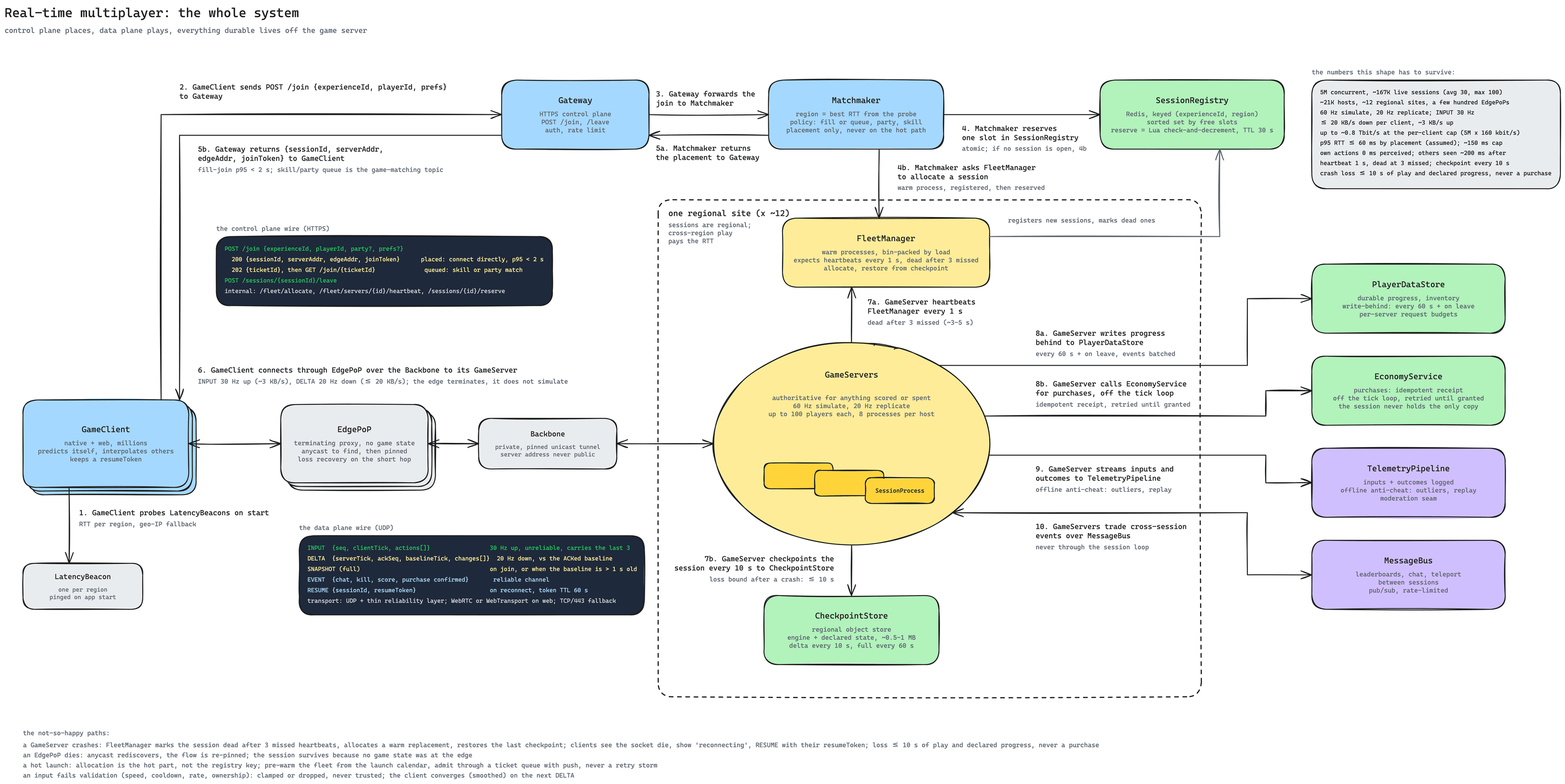
- 1) Player clients, native and web, discover the nearest Edge PoP by anycast and pin it (a few hundred PoPs, a terminating proxy with no game state), which carries the flow over a pinned tunnel across the private backbone to a regional game server. The client only ever knows the edge address and an opaque session handle; about 3 KB/s up, at most 20 KB/s down.
- 2) Control plane: the Gateway hands a join to the Matchmaker, which reads the client's latency map and the experience policy, picks the region, and either reserves a slot in an open session via the Session Registry (Redis, keyed by experience and region, Lua for the atomic reservation) or asks the regional Fleet Manager to allocate a session on a warm server. Queue-match tickets hand off to game-matching and come back to the same placement step.
- 3) The regional Game Server fleet runs one session per process, about 167K sessions on about 21K hosts at peak, and heartbeats the Fleet Manager every 1 s.
- Simulate at 60 Hz; validate every input against bounds (the experience's server script, behind the platform's seam).
- Replicate deltas at 20 Hz under a per-client cap of 20 KB/s, landing about 14; fleet egress at peak up to about 0.8 Tbit/s at the cap (5M x 160 kbit/s), roughly 0.56 expected.
- Decide hits server-side with lag compensation capped at 200 ms.
- 4) Side stores, each with a different durability job.
- The Checkpoint store (a regional object store): engine state plus declared state, a delta every 10 s and a full every 60 s, about 0.5-1 MB per full; it bounds the loss on a crash to 10 s of play and declared progress, never a purchase.
- The Player DataStore holds durable progress: every 60 s and on leave, key events batched.
- The Economy service takes purchases as an idempotent receipt off the tick loop, retried until granted, so no purchase ever exists only in session memory.
- 5) Async: every input and outcome is logged to the Telemetry and anti-cheat pipeline, and cross-session features (leaderboards, chat, teleport) ride a Message bus, so nothing outside the session is on the tick path.
- 6) Failure footnote: a crash is noticed after 3 missed heartbeats, the Fleet Manager restores the last full plus deltas on a warm process while the registry holds each seat for the 60 s token TTL, and clients see the session live again via the gateway and RESUME with the same handle and their tokens, the edge resolving it to the replacement; at most 10 s of play and declared progress lost, never a purchase, back in within about 10 s.
- The invariant worth closing on: nothing scored or spent becomes truth without passing server-side validation; latency is bought with placement and prediction; interpolation buys smoothness and lag compensation buys fairness at the latency you have; anything a client is allowed to own is bounded, named out loud as a concession, and either unscored or explicitly conceded for the casual tier. Every place the design spends latency, fairness or moderation, it says so.
What is Expected at Each Level
- Mid: says the server is authoritative and clients send inputs, and stops at "put servers near players".
- Names the authoritative server, but not what authority costs in latency or how that is bought back.
- Has matchmaking pick a regional server, and inputs in and deltas out.
- Knows the server validates inputs, at least as a sentence.
- Does not size anything: no tick, no bytes per client, no loss bound.
- Senior: prediction and reconciliation, the honest 200 ms, the bandwidth math, checkpoint plus rejoin with a loss bound, edge terminates not simulates.
- Explains client-side prediction and reconciliation for the player's own entity, and interpolation for the others, and gives the honest roughly 200 ms number for seeing another player act at 50 ms RTT.
- Does the bandwidth math (8 MB/s per session naive, 38 KB/s with interest management alone, about 14 KB/s landed against a 20 KB/s cap once deltas against the ACKed baseline are added) and reaches interest management on purpose.
- Handles a crash with checkpoint plus rejoin and states the loss bound (at most 10 s of play and declared progress, never a purchase), with durable state kept out of session memory.
- Says the edge terminates but does not simulate, and that game state lives on one server.
- Staff: the triangle and where each corner is paid, the 200 ms cap as a choice, the ownership concession with its cost, the regional launch arithmetic, standby as a tier, the bill.
- Names the latency, fairness and moderation triangle and says where each is paid, rather than claiming to win all three.
- Gives the 200 ms lag-compensation cap and the reason: a 200 ms RTT player at 100 + 100 sits at it, beyond it the laggy player suffers, by design, and it is a choice, not a constant.
- Raises the physics-ownership exception unprompted, with its cost, and confines it to unscored objects or the explicitly conceded casual tier; knows the server that validates is running the developer's untrusted Luau behind a platform seam (RemoteEvents, script timeouts and memory limits), and that Roblox's client-side anti-cheat exists because of that concession.
- Works the hot launch with the arithmetic: 1,667 joins a second fleet-wide is trivial for the registry; 10K to 33K sessions is about 4,100 hosts, more than a doubling of the ~1,750-host region a launch lands in, so the bottleneck is regional capacity: pre-warm on the calendar, spin-up rate second, admit through a queue.
- Offers hot standby by state streaming as a per-experience tier, not the default, and charges for the doubled compute of that tier's sessions; knows input-log replay needs a determinism the platform does not have.
- Puts the bill on the table: about 21K hosts (one core per session, 8 per host as a design assumption) and up to about 0.8 Tbit/s of egress at the per-client cap, roughly 0.56 expected; egress dominates, so replication bytes per client is the KPI.
- Pushes back on the prompt where it is loose: edge servers do not lower the RTT between two players who chose to be far apart, "fallback to replication" is a doubling of compute you should charge for, and a checkpoint of a Luau world only holds what the experience declares.
- Says "the server never adopts a predicted state, it only lets the client render one" as the sentence that reconciles prediction with fairness.
Say the opener out loud without notes, first sentence word for word: "The server owns anything that is scored or spent, and for those things a client only ever sends inputs." Then: movement is the one real choice and I default to server simulation with prediction and name client ownership as the casual-tier concession, and everything after that is spending a latency budget on purpose.
Then write the bandwidth chain from memory: 100 x 40 B (already quantised) x 20 Hz = 80 KB/s per client and 8 MB/s per session; interest alone 24 + 14 = 38 KB/s; deltas against the ACKed baseline alone to about 13 KB/s payload, landing about 14 with headers against a 20 KB/s cap; 16 Mbit/s per 100-player session at the ceiling; up to 5M x 160 kbit/s, about 0.8 Tbit/s at the cap, roughly 0.56 expected.
Then say the crash timeline in one sentence: heartbeat 1 s, dead at 3 missed, checkpoint delta every 10 s and full every 60 s, RESUME within about 10 s on a 60 s token, at most 10 s of play and declared progress lost, never a purchase.